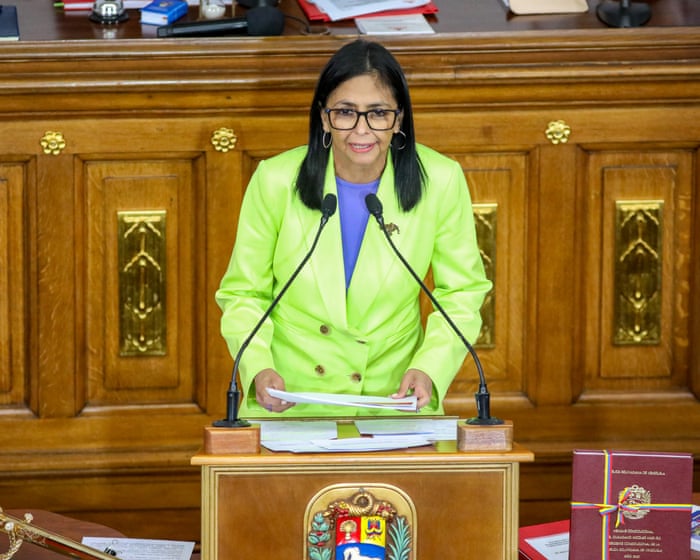
The communications minister holds a phone up to a microphone before a group of regime-friendly influencers. On speakerphone is Venezuela’s acting president, Delcy Rodríguez, who claims that when U.S. forces captured dictator Nicolás Maduro, she and other cabinet members were given 15 minutes to comply with Washington’s demands—“or they would kill us.”
Rodríguez, the former vice president who took power after the U.S. attack—and has since been praised by Donald Trump for cooperating with his demands—says she only did so because the “threats and blackmail are constant.” She also admits that her priority was “to preserve political power.”
Her comments come from a leaked recording of the nearly two-hour meeting, held in Venezuela one week after the U.S. attack. The video, first reported by the local journalism collective La Hora de Venezuela, offers a rare look inside Venezuela’s Chavista regime and shows how its leaders scrambled to control the narrative after Washington removed its figurehead.
Amid reports that Rodríguez and other cabinet members held talks with the U.S. before the attack, the recording reveals the surviving regime figures’ fear of being labeled traitors—and their attempts to keep their political movement from splitting apart.
“The only thing I would ask for is unity,” Rodríguez tells the group.
Before putting her on speakerphone, then–communications minister Freddy Ñáñez defends Rodríguez, urging an end to “gossip, rumors, intrigues, and attempts to discredit” her. He argues she is “the only guarantee we have that … we can bring back the president and the first lady—but also turn the page and reconfigure our forces.”
Rodríguez, who spoke for six minutes on speakerphone, said it “hurt … to have to assume responsibilities in these circumstances.”
She then described the U.S. military operation: “The threats began from the very first minute they kidnapped the president. They gave Diosdado [Cabello, the interior minister], Jorge [Rodríguez, the acting president’s brother and congressional president], and me 15 minutes to respond, or they would kill us.”
Rodríguez said U.S. troops initially “told us [Maduro and his wife, Cilia Flores] had been assassinated, not kidnapped,” and that she, her brother, and Cabello replied they “were ready to share the same fate.”
“And I tell you, we stand by that statement to this day, because the threats and the blackmail are constant, and we have to proceed with patience and strategic prudence, with very clear objectives, brothers and sisters,” she added, listing three goals: “to preserve peace … to rescue our hostages … and to preserve political power.”
The meeting appears to have been recorded on a videoconferencing platform—most influencers were in the room, but others joined online—and it is unclear how it was leaked. Neither the Venezuelan nor the U.S. government responded to requests for comment.
Rodríguez has not repeated the allegation of a U.S. death threat, and this week officials in Washington said she would soon visit the U.S. capital.
“We are in a process of dialogue, of working with the United States, without any fear, to confront our differences and difficulties … and to address them through diplomacy,” Rodríguez said on Wednesday.
Since the capture and extradition of her predecessor, Rodríguez has walked a fine line, publicly expressing defiance whileAt home, she is signaling to Washington that she is ready to cooperate with the Trump administration.
Historian and political analyst Margarita López Maya, a retired professor at the Central University of Venezuela, said it is difficult to know whether there was ever a death threat. “This could be a narrative Rodríguez herself is constructing to hold her base together, because everyone knows Maduro’s removal could only have happened with internal complicity,” López Maya said.
During the meeting, the communications minister urged influencers to be “careful” with “purists” who “will come out saying we are handing over the country, betraying the revolution and Chavismo.”
She also claimed that “everything happening today,” including U.S. control over Venezuelan oil, “is simply the plan that Maduro put on the table,” adding: “It’s not a concession, a gift, or a defeat; selling oil to the U.S. has always been our plan.”
Since the U.S. sanctions relief, the regime has maintained a seemingly contradictory stance—flooding social media and Telegram channels with harsh rhetoric against the U.S. while complying with all of Trump’s demands.
“I think what the [Venezuelan] government is really negotiating is how to save its own skin,” said López Maya.
Days after the video was leaked, she was appointed environment minister in a cabinet reshuffle.
One of the first moves by her successor, writer Miguel Ángel Pérez Pirela, was to create a social media account supposedly aimed at “defending the truth about Venezuela against fake news campaigns.” This is seen as another example of how—even without Maduro and amid a rapprochement with the U.S.—the regime remains fundamentally unchanged, marked by repression, hundreds of political prisoners, and no timetable for new elections.
“We have two broad options,” said López Maya. “One is that the country opens up to a democratic transition. The other is the one Chavismo is clearly playing with: obeying the U.S., but trying to buy time to see whether, along the way, they can remain in power through an authoritarian model with some economic openings.”
Frequently Asked Questions
Of course Here is a list of FAQs about the topic Leaked video reveals Venezuelas government scrambling to control the narrative framed in a natural tone with direct answers
Basic Understanding The Event
Q What is this leaked video everyone is talking about
A Its a video reportedly from inside a Venezuelan government meeting that shows officials apparently discussing how to manage public perception and control the story around a sensitive issue or crisis
Q Who was in the video and what were they discussing
A While specifics can vary by leak such videos typically show highlevel officials ministers or communications staff They are often discussing strategies for public messaging how to respond to criticism or how to frame a news story favorably for the government
Q What does scrambling to control the narrative mean
A It means the government was caught offguard by an event or revelation and was urgently trying to shape how the public understands itdeciding what information to emphasize what to downplay and how to deflect blame
Context Implications
Q Why is this a big deal Isnt all governments do this
A While all governments engage in messaging a leaked video provides rare candid proof Its a big deal because it appears to show the gap between internal private discussions and the official publicfacing story suggesting a deliberate effort to manipulate public opinion
Q What kind of narrative might they be trying to control
A This could relate to economic crises political repression election integrity human rights issues or a specific scandal The leak itself becomes a new crisis they must then also try to control
Q Is this video authentic Could it be fake
A Thats a critical question Authenticity must be verified by independent analysts examining metadata sourcing and context Both the government and independent journalists will debate its legitimacy Initial reporting from credible news outlets is the best guide
Advanced Questions Broader Impact
Q How does this leak affect the Venezuelan publics trust in their government
A It likely further erodes public trust For citizens suffering from economic hardship seeing officials focused on spin rather than solutions can deepen feelings of cynicism and disillusionment