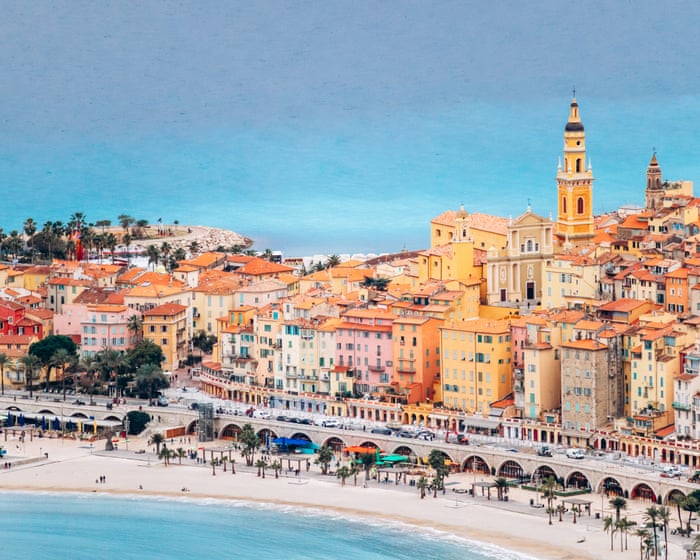
“It’s not France, it’s not Italy, it’s Menton.” This seaside town on the French-Italian border has changed hands many times throughout history. It was the only town in France fully annexed by Italy during World War II, but it has also been part of Monaco under the Grimaldis, belonged to the Kingdom of Sardinia, and only became French after a public vote in 1860. Today, setting aside the flags of France and Italy, almost everything is painted in various shades of yellow, celebrating the town’s deep connection to its beloved lemon.
Mauro Colagreco, the chef at the spectacular Mirazur restaurant just steps from the border, takes me into the hills to visit one of his lemon and citrus suppliers. “You can eat the peel of a Menton lemon; it has a thick, sweet rind. You can eat the whole thing—it’s completely organic and very juicy.” Menton’s microclimate, with its warm winters, terraced hills, and sandy soil, is perfect for growing citrus. “What’s special about the Menton lemon is that it has a smile, a little curved fold at one end,” says Colagreco, who uses them in his restaurant while also exploring the possibilities of Star Ruby grapefruits, yuzu confit, and kumquats.
This time of year, late February and March, is known as “yellow time,” thanks to the lemons, daffodils, and mimosa on the hillsides. It’s also the season of the Fête du Citron, a two-week festival featuring parades, giant floats, and this year, huge models of a whale, 12-meter-high parrots, and entwined storks—all covered in citrus fruit. It was the 92nd edition of the festival, but the Menton lemon is too expensive and rare to use, so all 123 tonnes of oranges and lemons now come mostly from Spain and Portugal.
In a perfect spot to appreciate Menton’s dual personality is Luciano Fondrieschi, who runs R Bike Menton, a cycling shop on the promenade between the old town and the Italian border. He believes there’s a lively rivalry between Italy and France here. Fondrieschi was a successful runner and triathlete in Italy, and his shop is always full of French and Italian customers browsing shoes, pedals, and bikes and asking for advice.
“Menton is a French town with an Italian spirit,” he tells me. “All the boats in the harbor are Italian.” However, looking around, most of the cars are French. Fondrieschi switches languages effortlessly in his repair shop. While we chat, a breathless but exuberant British couple in Lycra come in, having just completed a 36-mile (58 km) round trip to Sanremo. They are followed by an Italian pensioner who cycled 13 miles to Dolceacqua for a pizza lunch, and a couple from Luxembourg who need a puncture repair before heading to Saint-Jean-Cap-Ferrat. “French people really prefer to speak French, but we Italians speak with our hands, so we can talk to anyone!” says Fondrieschi. His in-store café offers a mix of brioches, rústico caprese, Italian cordials, and café au lait.
Like every town in France, Menton’s streets are named after the country’s authors, politicians, and war heroes. But in Menton, for every Avenue Pasteur, Victor Hugo, or Général de Gaulle, there’s an Avenue Cernuschi and Laurenti, a Rue Pietra Scritta, Isola, Urbana, Pieta, or Mattoni. There’s also a Square Victoria (Queen Victoria stayed here in 1882), Avenue Blasco Ibáñez (the Spanish writer lived in a grand villa here in the 1920s), and Avenue Katherine Mansfield (who stayed at the Villa Isola Bella)—the last two connected by Rue Webb-Ellis.
William Webb-Ellis, the schoolboy who supposedly invented rugby during a football match in 1823, later became an Anglican vicar and moved to Menton in the 1860s.According to legend, he invented rugby by picking up the ball during a school football match in 1823. He later became an Anglican vicar and moved to Menton in the 1860s, where he spent his final years. He is buried in the hilltop Vieux Château cemetery, a steep climb from the old town. His grave overlooks the sea and is always covered with rugby balls and club ties.
The grave of English illustrator Aubrey Beardsley is even higher up the hill in Trabuquet cemetery. He died at 25 and lies alongside many other young artists, writers, and aristocrats who came to Menton in the late 19th century, seeking cures for respiratory ailments and solace in the town’s many botanical gardens.
Half a century later, France’s own master of pen and ink, Jean Cocteau, also arrived in Menton. In 1955, the mayor invited him to decorate the interior of the Salle des Mariages. The resulting work depicts the myth of Orpheus and Eurydice, featuring centaurs and a Menton wedding scene. Visitors can obtain a key from the town hall to view it.
A hundred metres away is Allo Robert, a warehouse-like emporium filled with French and Italian bric-a-brac—the sorts of items that would have been on wedding lists a century ago. I discovered a light-up Tabac sign, cabinets stocked with 1930s soda siphons, candlesticks, champagne buckets, Italian crockery, and blue chairs from Nice’s promenade. It’s a dusty snapshot of early 20th-century Menton, as the sign outside says: “de curiosités … et tutti quanti” (“curiosities … and so on”).
Stay at the seafront Hôtel Napoléon, which features a solar-heated pool; doubles from €106 (napoleon-menton.com). Dine on pizzas, vitello tonnato, and flavoured burrata at Mauro Colagreco’s La Pecoranegra (pecoranegra.fr).
Frequently Asked Questions
Frequently Asked Questions about Totally Mediterranean Discovering Menton
General Location
Q Where exactly is Menton
A Menton is a beautiful coastal town in the very southeast corner of France right on the border with Italy Its often called the Pearl of France and sits where the French Riviera meets the Italian Riviera
Q What makes Menton different from other Riviera towns like Nice or Cannes
A Menton has a unique quieter charm Its less glitzy and crowded with a stronger Italian influence in its architecture cuisine and gardens Its famous for its microclimate stunning lemon festivals and picturesque old town
Planning Your Visit
Q What is the best time of year to visit Menton
A Spring and early autumn are ideal The weather is warm and sunny perfect for exploring and the crowds are smaller February is special for the famous Fte du Citron but its very busy
Q How many days should I spend in Menton
A You can see the highlights in 12 full days However 34 days allow you to soak in the atmosphere visit multiple gardens take day trips and truly relax
Q Do I need a car to get around Menton
A Not within the town itself The compact old town and seafront are best explored on foot A car is helpful for visiting nearby hilltop villages or exploring the Italian Riviera but parking can be difficult and expensive The train station connects you easily to Nice Monaco and Italy
Sights Activities
Q What are the absolute mustsee things in Menton
A Dont miss the Old Town with its steep colorful lanes the Basilica of SaintMichel Archangel the Jean Cocteau Museum a stroll along the Promenade du Soleil and at least one of the famous gardens like Jardins Biovs or Val Rahmeh Botanical Garden