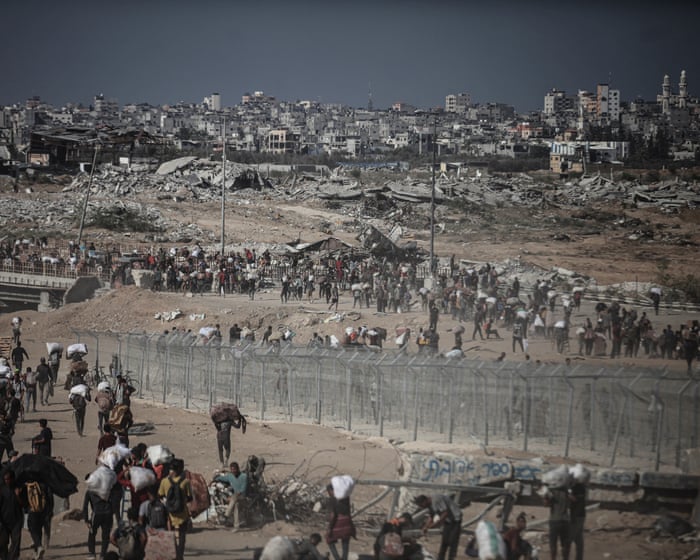
The Gaza recovery plan being pursued by Donald Trump’s Board of Peace (BoP) has been scaled back significantly. What was once an ambitious blueprint for rebuilding the entire territory is now just a small pilot project in the southern part of the strip.
Even this pilot plan—which involves setting up a temporary camp for a tiny fraction of Gaza’s 2 million displaced people, along with a Palestinian administration, police force, and a small international security team—isn’t expected to be ready before the end of the year.
A reconstruction plan for ‘New Gaza’ put together by the Board of Peace. Illustration: Board of Peace
In recent weeks, some small steps have been announced. A few Moroccan and Kosovar officers have arrived in Israel, where they are meant to form the core of an International Stabilization Force (ISF) tasked with protecting the pilot camp. A logistical base for this future force—where vehicles, equipment, and other supplies can be stored—is nearly complete at the Kerem Shalom crossing between Israel and Gaza.
However, work on the pilot camp near the southern Gaza city of Rafah hasn’t started yet, and neither has construction of the camp’s ISF support base. Satellite images of the area show disturbed ground but no new buildings. Major progress isn’t expected until after Israel’s elections on 27 October, which could bring down Benjamin Netanyahu’s far-right coalition government.
The aftermath of Israel’s air and ground offensive in Rafah, Gaza, photographed in January 2025. Photograph: Jehad Alshrafi/AP
Israel has repeatedly violated the ceasefire brokered by Trump since it was announced last October. It has blocked all reconstruction work and severely limited the flow of humanitarian aid into Gaza. Western diplomats in Jerusalem believe the best chance for progress in Gaza is a new Israeli government, but it’s far from clear whether any successor coalition would be much more flexible.
One diplomat in Jerusalem argued that the BoP had no choice but to make the most of the very limited progress so far. Admitting failure, they said, would open the door for extreme factions in the Israeli government that have very different plans for Gaza.
“The goal is just to keep something going, keep the ball rolling, because if you stop, there are others with a more extreme agenda waiting to jump in and take over. They’re talking about wholesale population transfer and colonization,” the diplomat said.
There is growing concern that Netanyahu, facing the threat of losing the election, might gamble on launching a new all-out offensive in Gaza before the October vote.
Since the October ceasefire, Israel has carried out frequent strikes on Gaza, killing more than 1,100 Palestinians. Israeli forces have also repeatedly moved forward from the ceasefire line agreed in October, which had split the strip roughly evenly between Israeli- and Hamas-controlled areas. The Israeli army now directly occupies more than 60% of the territory and has created a buffer zone beyond that.
Hamas al-Hdabi holds the body of his father, Sohail, who was killed in an Israeli strike on Gaza City on Thursday. Photograph: Dawoud Abu Alkas/Reuters
A return to full-scale war would likely wipe out even the BoP’s modest pilot plan.
Israeli officials have repeatedly suggested that a return to war is inevitable because Hamas has refused to disarm. Hamas has said it would be willing to lay down its weapons under certain conditions and took part in talks in Cairo over the weekend about possible disarmament mechanisms.
Board of Peace focus on Hamas risks return to war in Gaza, critics say
Read more
The Cairo talks with the BoP covered the disarmament of Hamas and rival Israeli-backed militias inside Gaza. They discussed who would receive the surrendered weapons, how they would be stored, and whether assault rifles should be considered offensive weapons or personal arms.
The head of an anti-Hamas faction, Hussam al-Astal, in an Israeli-held area in Khan Younis, Gaza, in November 2025. Photograph: RReports from the Egyptian capital suggest that progress on disarming weapons is unlikely as long as Israel continues its airstrikes and pushes deeper into Hamas-controlled territory.
“As long as Israel doesn’t commit to a gradual withdrawal from the Gaza Strip and to changing the situation there, there’s no basis for talks,” a Palestinian source told Haaretz.
Nickolay Mladenov, the high representative for Gaza appointed by the Board of Peace (BoP), faced widespread criticism for echoing Israeli talking points in a May report to the UN Security Council. In it, he blamed Hamas for the stalled peace process without directly mentioning any Israeli violations.
The Bulgarian diplomat Nickolay Mladenov, the BoP’s lead envoy for Gaza, held a briefing for the media in Jerusalem in May. Photograph: Ammar Awad/Reuters
The limited pressure on Israel has been more subtle. Aryeh Lightstone, the Trump administration’s lead negotiator in Israel who also serves as a BoP adviser, wrote privately to the Netanyahu government in June. He called for easing restrictions on “dual-use” humanitarian aid entering Gaza, which have blocked essential items like water pipes and solar panels.
Lightstone’s letter—first reported by Israeli public broadcaster Kan and confirmed by an official familiar with its contents—also asked the coalition to approve the eventual entry of the International Security Force (ISF) and a vetted Palestinian police force into Gaza. According to the official, the Israeli government has not yet approved any of these requests.
The pilot program near Rafah is a far cry from the BoP’s original ambitions. When launching the plan with an overly optimistic slideshow in January, Trump’s son-in-law Jared Kushner promised that aid gates would open wide and basic infrastructure—including water, sewage, and electrical systems, hospitals, and bakeries—would be restored across the strip within 100 days.
Jared Kushner speaks after signing a Board of Peace charter at Davos in January. Photograph: Evan Vucci/AP
After five months of deadlock, a much less ambitious pilot plan was worked out two weeks ago at meetings in Cyprus. Attendees included Mladenov, Lightstone, advisers from the Tony Blair Institute, and members of the National Committee for the Administration of Gaza (NCAG).
The NCAG, a group of 13 Palestinian professionals and technocrats, has been barred from entering Gaza by Israel. Since being convened by the BoP earlier this year, it has been based in Cairo.
The pilot camp outlined in the current plan would consist of portable cabins for tens of thousands of displaced people in Gaza. It would be set up in the buffer zone along the ceasefire line near Rafah.
Israeli troops would withdraw from the line, and security at the crossing between Hamas-run Gaza and the camp would be overseen by the ISF and a specially trained Palestinian police force. This force would be officially vetted by the NCAG and the ISF—though in reality, Israel is expected to have a decisive say in who is recruited.
Training for that force in Egypt has not yet started and is expected to take several months. The hope is that the ISF will be about 5,000 strong (a quarter of the originally anticipated force), with troops from Morocco, Kosovo, and possibly Albania and Kazakhstan. They will also take months to train, and the legal framework for their presence is still being negotiated with the Israeli government.
“I think you’re looking at late 2026. If we got this done and in place by December, I’d be very happy,” said an official familiar with the planning.
Preference for settlement in the pilot camp would go to former residents of the Rafah area, but it’s unclear what other criteria would be used to vet Palestinians wanting to move there. Critics, including former Israeli Prime Minister Ehud Olmert, have denounced the entire scheme as a “concentration camp” in the making, but BoP off…Officials insist there will be freedom of movement in and out of the pilot area.
A wider range of humanitarian relief items would be allowed into the pilot camp, but even there, the Israeli government has insisted on a distinction between humanitarian aid and reconstruction, with only the former being permitted.
It is unclear where the funds for the pilot would come from. Very little of the $17 billion (£12.6 billion) originally pledged for Trump’s 20-point peace plan for Gaza has actually materialized. The EU’s Palestine Donor Group announced on Monday that it had raised €883 million (£770 million) for Gaza. The money is intended for restoring basic water and sanitation infrastructure and waste management, and is meant to complement the BoP’s projects.
The BoP is negotiating for some of the $11 billion in Palestinian tax revenue and frozen bank assets seized and withheld by Israel to be diverted to project funds.
“We’re working on that. It’s under discussion,” a source familiar with the negotiations said. The suggestion has sparked outrage from the Palestinian Authority (PA) in the West Bank, which has been financially suffocated.
“These are not Israeli funds to withhold or bargain with,” said the PA foreign minister, Varsen Aghabekian. “These funds must be released immediately and unconditionally.”
Aghabekian said that shifting focus from a whole-of-Gaza approach to a small pilot project presents a dilemma for Palestinians.
“The humanitarian catastrophe cannot be managed through fragmented or partial measures. At the same time, every effort that genuinely saves Palestinian lives deserves careful consideration,” said Aghabekian. “Our concern, however, is that temporary arrangements must never become a substitute for a comprehensive solution or serve to normalize an unacceptable reality.”
According to an official familiar with the Cyprus talks, the NCAG was divided over whether to support the Rafah pilot scheme, fearing it would create divisions among Gaza’s 2.1 million Palestinian population and put the vast majority on a lower priority second tier for humanitarian relief.
Frequently Asked Questions
Here is a list of FAQs based on the news that the Trump administrations Gaza recovery plan has been scaled back from a fullscale recovery to a small pilot project
BeginnerLevel Questions
Q What happened to Trumps big plan for Gaza
A The original plan to completely rebuild and recover all of Gaza has been abandoned Instead the team is now focusing on a much smaller pilot project to test what works
Q What is a pilot project in this case
A Its a small limited test Instead of trying to fix everything at once they will try to fix a small area or a specific problem to see if the approach is effective
Q Why did they give up on the full plan
A The full plan was likely too expensive too complicated or faced too many political and security obstacles to be realistic right now
Q Who is in charge of this new pilot project
A The Board of Peace is overseeing the shift to the smaller project
Q Is this good news or bad news for people in Gaza
A Its mixed Its bad because the massive recovery they were hoping for is off the table Its potentially good because a small focused project might actually get started and deliver some real immediate help rather than a big plan that never launches
IntermediateLevel Questions
Q What kind of work will the pilot project likely involve
A It will probably focus on the most basic and urgent needs clearing unexploded bombs removing rubble from a specific street or block repairing a single water pipeline or restoring electricity to one hospital
Q Does this mean the US is giving up on helping Gaza entirely
A No but it means the US is lowering its ambition They are moving from a rebuild the whole country strategy to a prove we can do one thing right strategy
Q What were the main obstacles that killed the full recovery plan