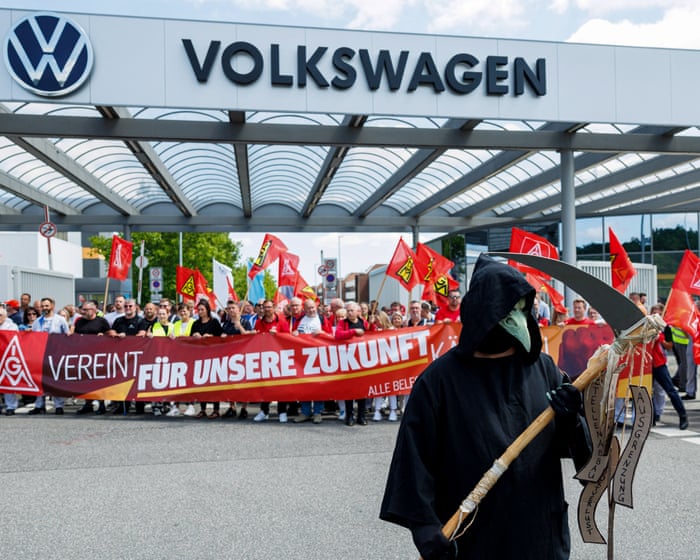
Volkswagen has approved controversial plans to cut 100,000 jobs as it fights to survive intense competition from Chinese rivals. Following the latest round of talks this week, the company announced an additional 50,000 job cuts and agreed to phase out production at four German plants—Emden, Zwickau, Hanover, and the Audi site in Neckarsulm—between 2031 and 2034. No specific plans have been made beyond that.
The agreement came as a surprise after a meeting of shareholders, unions, and state representatives on the supervisory board, which was seen as a major test for the German carmaker’s chief executive, Oliver Blume. He had even arranged an emergency meeting in case the package was rejected, preparing for a possible clash with unions.
“This is a strong signal for the future,” said Blume, who now has approval for what the company previously called the “most strategically profound transformation programme” in the history of the VW group. Last month, he was booed by staff during a tour of the company’s headquarters in Wolfsburg, northern Germany, as part of discussions about the need to tackle the company’s financial problems.
IG Metall, the company’s largest staff union and a representative on the supervisory board, said both sides had made concessions to avoid “a dangerous escalation of the conflict.” A key concession was keeping four plants open that were threatened with closure, in exchange for an agreement on staff reductions. The deal includes a sweeping cost-cutting plan to eliminate another 50,000 positions by 2030, bringing total job losses to 100,000.
“Concrete solutions must now be developed for all locations… we expect the board to now do its homework based on the compromise reached and deliver results promptly,” said Christiane Benner, first chair of IG Metall, and Daniela Cavallo, chair of the General and Group Works Councils of VW.
Blume said the company would invest “a three-figure billion sum” over the next few years “to make our iconic brands even more attractive, stronger and more competitive.”
The supervisory board acknowledged that there was overcapacity in Europe to produce 500,000 vehicles for which there was no market. Plans to turn a plant in Osnabrück into a defence factory were abandoned this year after objections from Qatari investors.
The number of car models VW group produces, including the Bentley and Audi brands, will be cut in half. “It is essential to systematically align workforce levels with economic realities,” VW said.
The total of 100,000 cuts will be the largest restructuring ever carried out in the global automotive industry and amounts to about 15% of the carmaker’s employees. Volkswagen employs more than 650,000 people across all its brands, which also include Skoda, Seat, Porsche, Cupra, and Lamborghini.
Analysts at Deutsche Bank said the approval of the restructuring plan was a “fundamental breakthrough” and proved wrong investors who believed the carmaker to be “unfixable.” “The unanimous approval is, in our view, a fundamental breakthrough and a much-better-than-feared outcome,” the analysts said in a note to investors on Friday. “To be clear, [the] agreement does not solve Volkswagen’s challenges overnight. Execution remains key. The market debate was never about whether Volkswagen had challenges. It was about whether those challenges could realistically be addressed within Volkswagen’s complex governance structure. [The] agreement does not end that debate, but it provides the strongest evidence yet that the company can move forward.”The answer may be yes. Volkswagen has been under growing pressure from Chinese competitors in Europe, facing falling sales in China and heavy US tariffs. Even before that, it had been struggling for years with declining profits and overproduction in Europe.
Analysts at Citi described the deal as a “brave and rational plan,” adding that it was a “realistic decision for everyone involved.” They noted, “Given VW’s lack of competitiveness in German plants and limited global revenue opportunities, VW simply had no other choice. Also, considering VW’s supervisory board structure, this shows the responsibility the workers’ council has taken to ensure the long-term survival of VW’s core business in Europe.”
VW shares rose 8% in early trading on Friday.
The tough market in China has also affected other carmakers. For instance, BMW lowered its profit forecast for this year due to disruptions from the Iran war and its own difficulties in the Chinese market.
Frequently Asked Questions
Here is a list of FAQs regarding Volkswagens plan to cut 50000 additional jobs written in a natural tone with clear answers
General Background Questions
1 Is it true that Volkswagen is cutting 50000 more jobs
Yes Volkswagen has reached an agreement with unions to cut around 35000 jobs in Germany as part of a larger plan Reports indicate the total workforce reduction across the company will be closer to 50000 jobs globally over the next few years
2 Why is Volkswagen cutting so many jobs
Volkswagen is facing several challenges high production costs in Germany slowing demand for electric vehicles in Europe and stiff competition from Chinese automakers The company needs to become leaner to survive and stay profitable
3 I thought they were just closing factories Is this different
Volkswagen had threatened to close three German factories for the first time in its history The new agreement prevents immediate factory closures but in exchange the company is making deep cuts to the workforce through early retirement and buyouts
4 What was the dispute with the unions about
The unions were fighting against factory closures and mandatory layoffs Volkswagen wanted to cut costs aggressively to compete The dispute was about how to save money without destroying jobs and breaking labor agreements
Impact Details
5 Will I lose my job if I work at a VW plant
If you are a permanent employee in Germany you are likely protected from forced layoffs until 2030 However the company is offering voluntary severance packages and early retirement so jobs will disappear through attrition
6 How will Volkswagen avoid forced layoffs if they need to cut 50000 people
They are using a demographic curve This means they will stop replacing workers who retire and offer big bonuses to older employees who agree to leave early They are betting that natural turnover will cover most of the reductions
7 Are these cuts only happening in Germany
No While the agreement with German unions covers the 35000 jobs there the remaining cuts will happen globally Volkswagen is also reducing capacity in China and reviewing operations in other regions
8 Will my cars warranty or service be affected by these job cuts
No Your warranty and service agreements are handled by dealers and separate