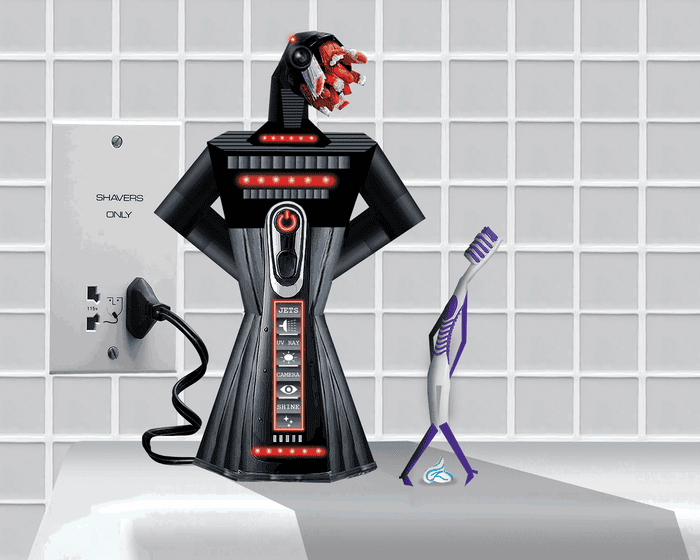
In December 1969, the consumer magazine Which? looked at a fairly new gadget that it predicted many people would give as Christmas presents: the electric toothbrush. For readers who had not seen one yet, the magazine explained that it was “not that much different in principle from an ordinary brush – you have a stick with a brush on the end. The difference is that an electric one moves the brush head for you.” Progress indeed.
Nearly sixty years later, electric toothbrushes can do far more than just vibrate. They offer multiple speeds and motion sensors that track in real time where you have brushed; some even promise gum-massage or tongue-cleaning modes. Prices range from about £25 for a basic Oral B model to £599.99 for a Philips Sonicare that provides “smart coverage feedback.” The newest super-toothbrush – priced at just £419.99 – has a camera and a built-in water jet to clean between teeth, using AI to spot gaps. Made by Dyson, it is still essentially a stick with a brush on the end, although another toothbrush on the market is shaped like a mouthguard, with individual brushes, and claims to clean your teeth in 20 seconds.
View image in fullscreenThe Dyson CameraJet toothbrush. Photograph: Dyson
In the UK, 59% of adults use an electric toothbrush, and sales, including replacement heads, reached £361 million last year, according to the market intelligence company Mintel. Any product launch by Dyson – still known for reinventing the vacuum cleaner – feels like an event, so its move into oral health does seem significant, says Rachel Bairsto, head of museum services at the British Dental Association. “We’re seeing more and more expensive toothbrushes,” she says. “Expensive toothpaste as well.”
These highly designed everyday objects have become symbols of affluence. “If you see a picture of a swanky bathroom, it will definitely have plug sockets for some kind of rechargeable electric toothbrush,” says Bairsto. “Whereas I’ve tried to look through the archives to find pictures of bathrooms with toothbrushes in them, and I can’t. Was everybody appalled at the sight of a toothbrush in the bathroom? I don’t know.” With many toothbrushes now, she says, “I think there’s definitely a status symbol [aspect] to it.”
‘The mouth is a gateway into your body’: the fascinating, frightening links between our gums and our health
Read more
We are more interested in oral health than ever, says Dr Zaeem Jafri, a dentist and founder of Nova Smiles, an online advice website. “From what I’ve seen from my patients, people are more conscious about it, wanting to avoid dental treatment, wanting their teeth to look nice and feel nice, and I think a lot of people are turning to gadgets to help.” Another dentist, Dr Reena Wadia, known as Dr Reena, a periodontist or gum specialist at the RW Perio clinic in London, says: “Gum health has become super topical. One reason is that there’s really good evidence now that gum health is linked to your general health, so gum health is now part of the wellness conversation. People are taking it more seriously.” There is growing evidence that gum disease, she says, comes with an “increased risk of diabetes and cardiovascular disease. Those are the two key ones, [but] there’s lots of other conditions related to it.” A poor oral microbiome has been linked to a range of diseases, including Alzheimer’s and several types of cancer, as well as depression.
Both Dr Reena and Jafri recommend rechargeable electric toothbrushes over manual ones, but neither urges patients to go out and buy a Dyson brush, or spend similar amounts on other brands. “There’s no robust research that says a certain kind of electric brush removes plaque at a better rate than others,” says Jafri.
Jafri has tested Dyson’s CameraJet, along with many other electric toothbrushes. He found it messy – the water jet was hard to angle, and he says it did not seem to find all the gaps bebetween his teeth. He points out that a non-foaming toothpaste is needed for an adequate camera view – sold by Dyson, with the cheapest at £8.49. The live stream to a phone app was a novelty, but in reality he says it was hard to see much with water, teeth and the inside of his cheeks in the way. Cameras in toothbrushes, says Jafri, “have the potential to be good. If patients had cameras that were detecting chipped and broken fillings and can send those images to a dentist to review [and] spot things early, that would be a phenomenal advancement. For Dyson right now, it’s using the camera to detect when the brush is in the right position to shoot the water jet – it didn’t really work that well for me. It’s a bit of an overkill.”View image in fullscreenGood brushing habits start early. Photograph: Oleg Breslavtsev/Getty ImagesAnother concern is that the water jet rinses away the toothpaste when most dentists now recommend spitting, not rinsing, so the fluoride in it stays on and around the teeth for longer. Dr Reena adds: “[The water jet may] make people think, oh, I don’t need to floss, or I don’t need to use interdental brushes. But actually, that jet is an adjunct, not a replacement.” Niamh Turney, a Dyson engineer who worked on the CameraJet, says, however, “The goal is to make interdental cleaning easier and more convenient for those who aren’t already managing to fit flossing into their routine.”There have been reports of some brushes overheating, and charging problems; at the time of writing, the brush was unavailable to buy. Dyson says it is aware that “a small number of early batches may have experienced a component issue. We are isolating those batches and are taking all the necessary steps to support our customers,” and that there are “some shortages of supply as we are in the process of scaling up production. We expect the next wave to be available in the coming weeks.”Meanwhile, we are in the midst of an oral health crisis. It is slowly improving on previous years, but access to NHS dentists remains low – 60% of the adult population in England have not seen an NHS dentist in the two years to March 2026. Inequality has a huge effect on oral health – in the most deprived areas, adults are less likely to brush their teeth twice a day, and children are more than three times more likely to have tooth extractions related to decay. The proportion of adults who use an electric toothbrush is 47% in the lowest income groups, compared with 76% in the highest income. Jafri says that the people who are considering spending hundreds of pounds on an electric toothbrush, or those who track their brushing on apps, are likely to be “health-conscious individuals who are brushing their teeth well to begin with, and [this is] probably not solving the bigger problem we have”.View image in fullscreen‘Wonderful things happen!’ A 1962 advert for GE’s electric toothbrush. Photograph: Patti McConville/AlamyThe first electric toothbrushes, says Bairsto, had a “clunky side-to-side action, and that’s about all they could do.” There was an increased interest in dental and oral health in the 1960s – programmes to add fluoride to drinking water were rolled out – and electric toothbrushes were part of this, even if they were slow to take off. That 1969 Which? report tested “all 11 we could find on the market”, including those made by Bosch and Boots, alongside several by US manufacturer Ronson, more famous at the time for its cigarette lighters. Women, it claimed, preferred brushes with a softer touch; men liked something more vigorous “as you might expect”. Children liked them, the report said, “perhaps because they are a good way of doing action paintings with toothpaste on the bathroom mirror”.Now the market is dominated by Oral B, owned by Procter & Gamble. Jafri says dentists don’t earn commission from selling products but, he adds, “in dental school, they come in with free pizzas and give everyone an Oral B brush. All the dental students kind of associate with OrOral B will grow quite quickly. There will be the “Oral B lecture” that everyone talks about because of the free pizza.” According to Ziyu Tian, a personal care research analyst at Mintel, it holds about 60% market share. “Other big players include Philips, own-label brands like Superdrug and Boots, and Colgate,” she says. Tian says the Dyson launch is a premium product that won’t appeal to everyone, but it will raise consumer expectations and may push existing brands in the sector to innovate. Along with growing awareness of the link between oral health and general health, she says, “teeth whitening and the beauty side of oral care is something the younger generation is really embracing. So oral care isn’t just about cleaning teeth or freshening breath—it’s more about beauty and wellness routines in general.” As more evidence emerges, especially links to the gut microbiome, companies will use this in their marketing, says Tian. You can already see it in products like toothpaste containing “prebiotics and probiotics for our microbiome, magnesium for evening wind-down, and exosomes [‘messengers’ between cells, already used in skincare] for tissue regeneration, anti-ageing and longevity.” Toothpaste flavours are branching out too, from traditional mint to berries, chocolate and even fried chicken. “I think it’s tied to the rise of GLP-1 [weight loss injections],” says Tian. “Consumers might not get these indulgent flavours from food and drink, so oral care like toothpaste and other products can be a substitute.” View image in fullscreen ‘Dental professionals should be showing their patients how to brush.’ Photograph: GoodLifeStudio/Getty Images One of the newer entrants to the toothbrush market is Suri (from £65), launched in 2022, which makes well-designed, recyclable, largely plastic-free electric toothbrushes. Its founders, Mark Rushmore and Gyve Safavi, both previously worked in marketing for Procter & Gamble. Rushmore says they were driven by the environmental impact of toothbrushes. “Billions of brushes are thrown away—manual, electric—and end up in landfills and oceans. Every brush you’ve probably ever used since you were a child still exists somewhere.” Damien Walmsley, an emeritus professor of dentistry at the University of Birmingham, has worked with all the big powered toothbrush companies, and most recently with Suri. He says he is probably still under non-disclosure agreements so won’t go into detail; “but I’ve seen some wacky ideas out there, some strange ones.” Companies are constantly trying to add new features, “so that people feel they’re getting a newer product, and people will then be attracted to it. If it’s something new, it will catch the imagination, and that’s what this new Dyson has done.” If it encourages people to brush their teeth more effectively, and more often, “that’s really good.” But Walmsley questions how long the novelty lasts. “We’d like to see more long-term studies evaluating the cost. Was it worth paying the extra money, and did it bring about extra value from that? Those studies aren’t out there.” Walmsley was one of a number of scientists involved in the 2003 review of literature by the Cochrane library, with the latest update in 2014, concluding that powered toothbrushes were more effective at removing plaque than manual brushes—by 11% in the short term, and 21% after three months—and at reducing gingivitis (early-stage gum disease). Many of the studies were small, short-lived—and run by Oral B. Should consumers be concerned about that? Research studies are expensive, says Walmsley, and over the years Oral B was among the few companies doing them. “We have certain criteria, and we checked that [studies] followed that, and we followed up the evidence,” says Walmsley. “It was as open as it can be.” He also points out that toothbrushing technique and usage in a controlled trial may be different comparedDental professionals should show their patients how to brush, says Dr Reena. “It sounds basic, but many people have never been shown. Essentially, you brush along the gum line at around a 45-degree angle to remove trapped bacteria. The bristles should go slightly under your gum line.” But don’t brush too hard, as this can cause gum recession. A pressure sensor is a useful feature. “Different modes, such as speed settings, are also helpful for people with sensitivity or gum problems.” She is interested in the idea of a camera in a toothbrush, especially if it can give “real-time feedback on what a patient is doing. But the key thing it always comes back to is that technique and consistency are more important.” Do you have an opinion on the issues raised in this article? If you would like to submit a response of up to 300 words by email to be considered for publication in our letters section, please click here.
Frequently Asked Questions
FAQs How Big Toothbrush Took Over and Turned Our Mouths Into a Profitable Market
1 What does Big Toothbrush mean
Its a nickname for the giant companiesColgatePalmolive Procter Gamble Unilever and GlaxoSmithKlinethat dominate the global oral care industry
2 How big is the oral care market
Its worth over 50 billion a year worldwide and keeps growing mostly through toothpaste toothbrushes mouthwash and whitening products
3 How did a few companies end up controlling so much of the market
Through decades of advertising buying up smaller brands and paying for shelf space and dentist endorsements Today just a handful of firms own most of the brands you see
4 When did brushing become a daily habit
Only in the 20th century Before that most people rarely brushed Mass advertising military hygiene rules in WWI and dentist campaigns turned it into a twice a day norm
5 Why do we replace toothbrushes so often
Partly for real hygiene reasons but also because replace every 3 months is a brilliant business modelit guarantees repeat purchases forever
6 Is there really a difference between cheap and expensive toothpaste
Mostly no Nearly all fluoride toothpaste does the same core job Youre often paying for flavor packaging and marketing not better cleaning
7 Are whitening toothpastes worth it
They remove surface stains but cant change the natural color of your teeth Real whitening needs peroxide or a dentist Many whitening claims are exaggerated
8 Why do dentists sell so many products
Dentistry is a business too Product sales sponsorships and brand partnerships with companies like OralB and Colgate make recommendations profitablethough many recommendations are genuinely useful
9 Do I actually need mouthwash
Not usually Brushing and flossing do most of the work Mouthwash is a nice extra but its heavily marketed as a necessity when it isnt one
10 Whats the biggest problem with the Big Toothbrush model
It pushes products over prevention Companies profit more from treating problems whitening sensitivity gum