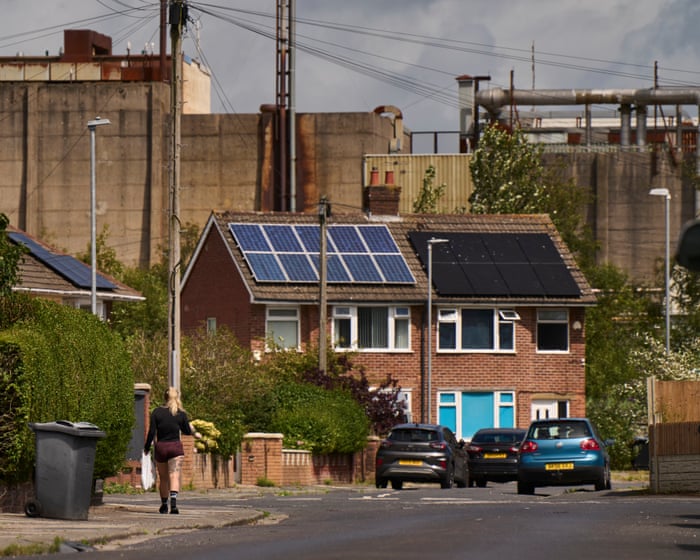
“Everything I wanted was finally coming together. A house, a new job, and getting married,” says Liz Hurst, gazing out at the sea on a warm evening in Blackpool. “But then, all of a sudden, everything was put on hold.” Fifteen years ago, at age 32, Hurst was diagnosed with kidney cancer. “The doctors told me they didn’t know why I got it. They said it was very rare for someone my age and gender,” she says.
Last month, a government-commissioned study found higher-than-expected rates of kidney cancer near the AGC Chemicals Europe plant in Thornton-Cleveleys, a town north of Blackpool where Hurst lived until recently. Between the 1950s and 2012, the facility released an estimated 49 tonnes of the carcinogenic chemical PFOA. PFOA, or perfluorooctanoic acid, is a type of PFAS that international research has linked to kidney cancer. PFAS, short for per- and polyfluoroalkyl substances, are often called “forever chemicals” because they don’t break down in the environment. The Thornton-Cleveleys factory, which AGC Chemicals Europe bought in 1999, used PFOA to make PTFE (polytetrafluoroethylene), another forever chemical used for non-stick coatings. PFOA was banned globally in 2020.
Despite the higher rates, the study in Thornton-Cleveleys found no evidence of a cancer cluster or any environmental link to the elevated kidney cancer rates, and it’s impossible to know if one person’s cancer was caused by PFOA exposure. But world-leading experts have called the study’s findings a “major source of concern” and believe further investigation, including blood testing, is needed.
Residents were advised not to eat eggs laid within 1km of the factory and to wash and peel homegrown produce. Hurst says AGC Chemicals Europe played a big role in her childhood. She remembers regular “cloud burst drills” at her primary school to prepare for a chemical spill. She also spent several summers working in the factory’s labs as a young science student. “It was just always there,” she says. A spokesperson for AGC Chemicals Europe says that as far as it can tell, the company wasn’t involved in those drills.
As global concern grows over the harmful effects of PFAS chemicals on human health and the environment, in 2024 the local council and the Environment Agency (EA) started an investigation into historical emissions from the site. As part of this, soil and local produce were tested for PFOA. After widespread soil contamination was found, residents were told not to eat eggs laid within 1km of the factory and to wash and peel homegrown fruit and vegetables. “I saw an article in the local paper about the contamination and started looking into it,” Hurst says. “I read about what diseases were linked to it, and when I saw kidney cancer, I just went cold. I just want to know if it caused my cancer.” Hurst has been cancer-free since 2019 after having her left kidney removed.
As regulators decide what to do next and scientists analyze the data, life goes on for those living near the factory. For the past five years, Alan Hodson, 61, has had a plot on allotments that border the AGC Chemicals Europe site. The allotment has become his sanctuary, he says. “It just gets me out for a few hours,” Hodson says. “I just potter around, leave my problems outside, and when I go home, my mind’s clear, the brain fog has lifted.” The factory’s constant hum can be heard from the allotment. Hodson says he did question how close it was when he first got the keys to his plot, but assumed it was safe.It used to be safe. That changed last year when a group of men in high-vis jackets came to the allotment to test the soil and the crops.
A few months later, Hodson received a hand-delivered letter telling him that his beetroot had the highest level of PFOA of all the produce tested. In the UK, there is no “safe level” for PFOA in soil or food. But one soil sample from the allotment was seven times higher than Belgium’s guideline level for PFOA in soil.
Since then, the Environment Agency (EA) has recommended that the allotment be officially classified as contaminated land, as it meets the legal criteria. Because of the potential risks to human health, the local council told Hodson it has no choice but to close the entire allotment. The locks are expected to be changed any day now.
Hodson has spent the last few weeks clearing his plot. “The strawberries in there, the birds have eaten them,” he says, pointing to a raised bed he built when he first learned about the contamination. “There’s stuff I spent money on, things I grew from seedlings that I’ve just thrown away.”
Hodson has been throwing away all the produce he spent years cultivating. “It’s like I’m wearing a pair of lead wellies,” he says. “I haven’t been sleeping. I just think about all the time I spent here – I could have been doing something else. It’s just wasted time. I just want another plot.”
Sam Hammond, 48, lives next to the allotment with her five children. She has found out that her garden is also contaminated with PFOA, and at much higher levels. One sample collected on behalf of the EA contained 40 times more PFOA than the Belgian guideline level.
The level of PFOA in one of Hammond’s duck eggs was so high that if she ate just one egg a week, her exposure to PFAS would exceed the European safe weekly level by 10 times. Hammond and her children have been eating these eggs every day for years.
While the allotment is about to close, Hammond still hasn’t been told what the test results mean for her or her home.
“I just think it’s disgusting that we’ve been left in limbo like this,” she says. “I’ve increased my mental health medication. It’s just stressful. It’s in my brain when I get up, when I go to bed, when I’m trying to sleep – there’s no escape from it.”
Wyre Council said all agencies involved in the investigations are committed to being transparent, and the EA plans to contact residents once formal conclusions are reached.
A spokesperson added: “We are working closely with our partner agencies to make sure the process moves forward as quickly as possible. This is a complex investigation, both from a scientific perspective and in terms of the legal process that must be followed. So it’s critical that we take the right amount of time to ensure any decisions made are solid, based on evidence, and cannot be challenged.”
In the US, the PFAS contamination crisis has been going on for years, with class-action lawsuits already leading to billion-dollar settlements.
While Europe has yet to see legal action on that scale, that could be about to change. On July 8, lawyers at the environmental law NGO ClientEarth filed a complaint with the European Committee of Social Rights over the Belgian government’s failure to protect people from widespread PFAS pollution.
In Thornton-Cleveleys, the law firm Leigh Day has written to AGC Chemicals Europe to say it is investigating whether a claim can be made on behalf of Hammond, related to the “loss of enjoyment and use” of her land and possible personal injuries. More than 90 residents have said they are interested in being part of any potential legal action, with 50 already having blood tests.Over the summer, Hurst says: “I want as many people in the area to know about this so they can get the healthcare they need. I’m just angry.”
A spokesperson for AGC Chemicals Europe said: “We take our responsibilities to our employees, the local community, and the environment very seriously. While it wouldn’t be right to comment on specific cases or claims, the multi-agency Health Cell report found no evidence of a statistically significant kidney cancer cluster, no grouping of cases near the current AGC Chemicals Europe Ltd site, and no sign of a link to environmental factors.”
“In addition, as far as we can tell, the so-called ‘cloudburst drills’ did not involve AGC Chemicals Europe Ltd.”
Get in touch
Contact us about this story
The best public interest journalism relies on firsthand accounts from people in the know. If you have something to share on this topic, you can contact us confidentially using the following methods:
Secure Messaging in the Guardian app
The Guardian app has a tool for sending tips about stories. Messages are end-to-end encrypted and hidden within the routine activity that every Guardian mobile app performs. This prevents anyone from knowing you’re communicating with us at all, let alone what’s being said.
If you don’t already have the Guardian app, download it (iOS/Android) and go to the menu. Select ‘Secure Messaging’.
SecureDrop
If you can safely use the Tor network without being observed or monitored, you can send messages and documents to the Guardian through our SecureDrop platform.
Our guide at theguardian.com/tips lists several ways to contact us securely and discusses the pros and cons of each.
Frequently Asked Questions
Here is a list of FAQs generated for the topic I just want to know if it caused my cancer living in the shadow of a Lancashire PFAS factory
BeginnerLevel Questions
1 What is a PFAS factory
A PFAS factory makes chemicals called forever chemicals These are manmade substances used to make things nonstick waterproof or stainresistant The factory in Lancashire produced these chemicals for decades
2 What does PFAS stand for
PFAS stands for per and polyfluoroalkyl substances Its a large group of thousands of different chemicals
3 Why are people worried about living near this factory
People are worried because PFAS chemicals can leak into the air soil and water If you breathe them in or drink contaminated water they can build up in your body Studies have linked high levels of some PFAS to certain cancers
4 Can living near the factory actually cause cancer
Its very difficult to say for sure for one person Scientists know that high exposure to some PFAS is linked to a higher risk of certain cancers However cancer is complex and can have many causes Living nearby doesnt guarantee cancer but it may increase the risk
5 What cancers are most commonly linked to PFAS
The strongest evidence links PFAS to kidney cancer and testicular cancer Some studies also suggest links to thyroid prostate and ovarian cancers
6 How do I know if I was exposed
If you lived near the factory drank local tap water or ate food grown in the area for many years you may have been exposed The only way to know your level is through a blood test that measures PFAS in your body
7 Is there a test to see if PFAS caused my specific cancer
No There is no medical test that can prove a single chemical caused your cancer Doctors can link exposure to a higher risk but not to a specific case
Intermediate Advanced Questions
8 How does PFAS get from the factory into my body
Drinking water The biggest risk is contaminated groundwater or public water supplies
Air PFAS particles can be released into the air and inhaled