Exploring the area west of Santander feels like stepping into a time machine. Within a half-hour drive from the Cantabrian capital on Spain’s green northern coast, you can discover prehistoric cave art, a perfectly preserved medieval town, and a relaxed beach resort.
My weekend trip began in the rain, so I started my journey in the Upper Paleolithic period at the Cave of Altamira, a UNESCO World Heritage site, gazing up at some of the oldest art on Earth. Well, almost. The original cave was largely closed to the public decades ago to protect the fragile paintings, so I visited the Neocueva—a meticulously reconstructed replica built beside it, which costs just €3 to enter.
Above me, bison and deer charged across the undulating rock ceiling, their bodies rendered in rich ochres and charcoals. The prehistoric artists—hunter-gatherers who lived here 13,000 to 36,000 years ago—used the natural bumps and hollows of the cave to give the animals a three-dimensional presence.
Altamira is often called the “Sistine Chapel of prehistoric art,” and standing beneath those larger-than-life painted animals, it’s easy to see why. Knowing the paintings were replicas did little to diminish their impact.
The cave, whose main entrance was sealed by a rockfall around 13,000 years ago, was discovered in 1868 by a local hunter and brought to wider attention by amateur archaeologist Marcelino Sanz de Sautuola. When Sautuola first presented the paintings to the scientific community in 1880, many experts dismissed them as fakes, unable to believe that prehistoric people were capable of such sophisticated artistry.
Walking through the museum, it’s striking how little humanity has changed. From handprints pressed against cave walls to the selfies visitors take beside them today, the impulse is the same—to leave a trace.
Time was slipping away, and my travel companions—my husband and our infant son—were beginning to lose patience with my archaeological enthusiasm. Hungry and still slightly awestruck, we drove a few minutes down the road to Santillana del Mar, the small medieval town that serves as Altamira’s gateway.
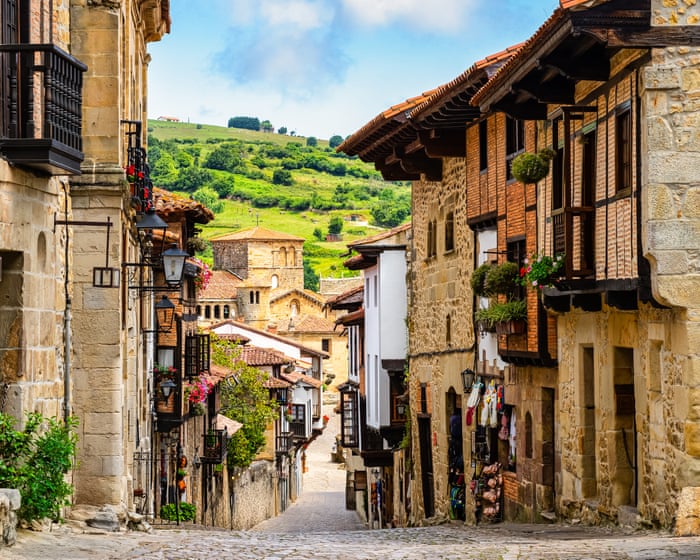
After a quick lunch, we found ourselves in the Middle Ages. Santillana del Mar feels as though it’s come straight from the pages of a fairytale or, for the less imaginative, Game of Thrones. Noble houses, monastery buildings, and towers line winding cobbled streets. The rain turned out to be something of a gift, emptying the streets of tourists.
Santillana traces its origins back to the ninth century, when monks carrying the relics of Saint Juliana settled here and built a small hermitage. Around it grew a monastery, then homes, farms, and workshops, forming a settlement that gradually evolved into Santillana. During the Middle Ages, the town flourished as part of the Astur-Leonese kingdom and became an important stop for pilgrims traveling along the Camino de Santiago.
The flow of travelers brought trade and wealth, hence the grand stone houses and palaces. In 1209, King Alfonso VIII granted the town a charter, marking the height of its medieval prosperity.
Santillana appeared in Sartre’s Nausea, as the narrator points to a photograph and describes it as “the prettiest town in Spain.”
The town sits close to the start of the Camino Lebaniego, a less well-known pilgrimage route that winds inland to the monastery of Santo Toribio de Liébana in the Picos de Europa mountains. Cantabria is the only region in the world crossed by two Christian pilgrimage routes recognized as UNESCO World Heritage sites.
For a town deeply tied to…While Santillana del Mar is best known as a stop on the Christian pilgrimage route, it also holds an unexpected connection to existential philosophy. In 1935, Jean-Paul Sartre visited the town with Simone de Beauvoir. A few years later, Santillana appeared in Sartre’s first novel, Nausea, where the narrator points to a photograph and calls it “the prettiest town in Spain” during a conversation about the nature of adventure.
“Getting on the wrong train. Stopping in an unknown city. Losing your briefcase, being arrested by mistake, spending the night in prison,” says the Self-Taught Man. “Monsieur, I believed the word adventure could be defined: an event out of the ordinary without being necessarily extraordinary.”
By that definition, my own adventure was already well underway.
Traveling through medieval streets with an infant is not for the faint of heart. With an umbrella in one hand and a baby carrier in the other, we trudged through the rain. Our son fell asleep—which ruined his nap schedule and our chance for an afternoon rest.
Still, Santillana has a way of softening such moments. We ducked into the Casa Quevedo bakery, where the same family has served fresh milk and cakes since the 1950s. Inside the medieval building, a glass of milk felt like the perfect antidote to grey skies and parental exhaustion.
From Santillana, it’s a ten-minute drive to the seaside town of Suances, our final stop—and another leap through time. Driving past the main part of town toward the more touristy coast, we passed apartment blocks and seaside hotels in pastel shades. We checked into Costa Esmeralda Suites, a five-star hotel offering generous off-season discounts. On the outside, it looks like a traditional mansion. Inside, however, the design feels like a time capsule of turn-of-the-millennium luxury: red carpets, a Ferrari theme, and enormous whirlpool baths.
Just a short walk away lies Playa de la Concha, where Atlantic waves roll toward wide sandy dunes. The rain finally eased as we arrived.
Near the port, restaurants and cafés buzzed with activity. “Other surf towns in the area are dead in winter,” one resident, Inma, told me at the Marcelo Gourmet bar and restaurant. “But Suances is always full of life.”
Outside of summer, wetsuited surfers paddle out into the waves, sometimes with views of the snow-capped Picos de Europa mountains behind them. And the food alone is reason enough to visit. At Bonito Verde, we ordered a plate of rabas (fried calamari, a local specialty), so fresh and crisp they disappeared almost instantly, along with delicious squid-ink croquettes. Curiosity also led us to Suka, an unassuming restaurant rumored to serve some of the best sushi in Cantabria. It was another win.
For breakfast, locals pointed us to Castillo de Los Locos, a restaurant perched dramatically above the cliffs of Playa de Los Locos, where the food is good and the views are incredible.
On the last morning, I woke early and slipped out of the hotel room, leaving my sleeping family behind. Sunlight had finally broken through the clouds. I walked along the thin peninsula that juts out between Playa de Los Locos and La Concha, listening to birdsong and watching waves crash against the cliffs. It’s only a short walk beyond the Castillo de Los Locos, but it felt far from civilization.
Standing there, breathing the salt air and feeling the sun, I relaxed.
After singing the praises of Santillana, the protagonist of Sartre’s Nausea reflects that adventure isn’t something we can experience while it’s happening. Instead, he says, adventures are made after the fact, by looking back and turning experiences into stories. “But you have to choose,” he continues. “Live or tell.”
Frequently Asked Questions
Of course Here is a list of FAQs about a journey through Cantabria designed to sound like questions from real travelers
Planning Your Trip
Q Where exactly is Cantabria
A Its an autonomous region in northern Spain nestled between the Basque Country Asturias and Castile and León Its capital is Santander on the coast
Q Whats the best time of year to visit
A Late spring and early autumn are ideal The weather is mild landscapes are green and its less crowded than the peak summer months which are best for beachgoers
Q Do I need a car to explore Cantabria
A Highly recommended While Santander is wellconnected by train and bus the real charm lies in the rural valleys mountain passes and scattered villages which are best accessed with your own vehicle
Q How many days should I spend there
A A solid 57 days allows you to experience the coast the prehistoric sites the Picos de Europa mountains and a few charming towns without feeling rushed
The Prehistoric Caves History
Q Which cave is the most famous and why
A The Cave of Altamira is worldfamous for its breathtaking polychrome bison paintings often called the Sistine Chapel of Prehistoric Art The original cave is closed for preservation but the adjacent museum features a perfect visitable replica
Q Are the cave paintings the real ones
A For the most famous caves like Altamira and El Castillo you typically visit exact scientific replicas in museum complexes This protects the fragile originals Some other caves like El Pendo allow visits to the original site to see less vulnerable art
Q Do I need to book cave visits in advance
A Absolutely and as far in advance as possible Visits are strictly controlled to preserve the environment and tickets especially for the popular replicas sell out quickly especially in summer
Q Whats the connection to philosophical history
A The