It’s Friday night in northern England. On the ninth floor of the old Granada Studios, a stylish crowd sips tequila and snacks on crisps. But these aren’t just Walkers from a bag—they’re canapés, each crisp topped with crème fraîche and a generous spoonful of caviar. A young woman across the silver tray catches my eye. She’s wearing leather shorts, chunky boots, and has neon lime nails, with an artfully messy bob. She winks and says, “Ooh, caviar. Very posh for Manchester.”
Soho House’s 48th members’ club is making waves. Thirty years after Nick Jones launched the first club in London’s Soho, this first northern England branch is turning heads. It’s an exclusive club in a city that historian AJP Taylor once called “the only place in England that escapes our characteristic vice of snobbery”—home to the Guardian, after all. And there’s an open-air rooftop pool in a climate known for its rain, which once fueled the textile industry by providing ideal conditions for spinning cotton. Will it succeed?
A waitlist of 2,500 people—the largest for any Soho House globally—suggests it might. Rewind a few hours before the party, and I’m with the CEO, Andrew Carnie. The place is buzzing with workers in hi-vis jackets and cleaners with mops, while Primal Scream’s rider (bottles of spirits and jars of chamomile tea) is still being set up in a makeshift dressing room. But Carnie is confident the timing is perfect. Born 30 miles away in Preston, he’s watched Manchester “change dramatically and flourish dramatically. It has physically expanded and broadened its worldview. The hospitality sector has boomed, creative industries have grown, universities are thriving, and many graduates choose to stay, which is great for the city.” Tomorrow, Loyle Carner will perform at a second opening night, and in February, when the Brit Awards move from London to the Co-op Live Arena, Soho House Manchester will host the afterparty. “I think this is going to be one of our most successful houses,” Carnie says.
Primal Scream headlined the opening night party at Soho House Manchester. Photograph: Kadir Gold
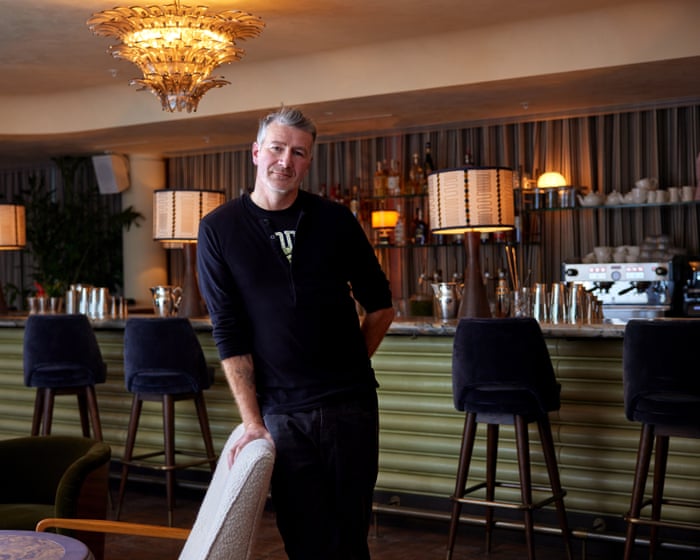
Even if you’ve never set foot in a Soho House, it’s influenced your culture. You might have seen Carrie and Samantha sneak into the New York club’s rooftop pool on Sex and the City. Or recall that Harry and Meghan had their first date at one of the London locations. Perhaps you’ve heard the rumor that Kim Kardashian’s application was rejected when the first LA house opened. (I asked; Soho House doesn’t comment on members.) The man now leading the business, who took over from founder Nick Jones in 2022 after Jones stepped aside following prostate cancer treatment that “changed my perspective and focus,” is a friendly, approachable 51-year-old. He wears a black Henley top with a tattoo peeking out at the cuff, pristine white trainers, and has none of the red-velvet-rope pretension. (He’s a Guardian reader, in fact.) In contrast to the larger-than-life Jones, Carnie is understated. For instance, he mentions he “likes running,” which actually means he recently finished a 155-mile, six-day ultra marathon across the Sahara and is preparing for another in the Colorado mountains next year. He says it’s “a good way of keeping fit.”
What distinguishes Soho House from the centuries-old tradition of members’ clubs, rooted in the armchairs-and-claret enclaves of Mayfair and Piccadilly, is its self-proclaimed identity as a place “for creative people.” This has been both the magic that makes membership feel like a golden ticket—Jones predicted in 1995 that in modern culture, everyone sees themselves as “a creative”—and the element that can irritate some. (Critics might sum it up as “telly wankers.”) According to Carnie, the definition of creative people is broad.”AI is creative. Hospitality is creative. Anyone can apply, and we have members from every industry.” According to Carnie, the Manchester membership tends to attract more entrepreneurs. With annual fees starting at £1,200—consistent worldwide but discounted for those under 27—membership is a privilege, but Carnie emphasizes that they “try not to be exclusive.” In Manchester, he will join a mentorship program that pairs members with local creatives from lower-income or underrepresented backgrounds, offering them access to panels, workshops, and networking events to build their connections, confidence, and experience.
In the late ’90s, Soho House was known for power breakfasts, boozy lunches, and late-night socializing. While these elements still exist, Soho Houses have adapted as lifestyles have evolved. The line between work and personal life has blurred, with constant technology making it impossible to truly disconnect. Soho House’s model—a third space that’s neither work nor home, neither fully public nor private—has become a natural gathering spot for many.
Carnie notes that this shift was “really accentuated coming out of Covid. People had gotten lonely. We are humans, and we like to be around other people.” He adds that when companies allow remote work, many members prefer to work from the clubs. This popularity has led to a new challenge: the houses now “discourage” all-day working, promoting a “laptops in the morning, social in the afternoon” approach. The “no-phones” rule has been adjusted; phones on tables are acceptable, but photography and calls are not.
Wellness has become the new hedonism. Fitness is no longer just a routine workout but a topic of conversation and a stylish part of an aspirational lifestyle. “We all want to be healthier,” says Carnie. “Five or six years ago, that meant cardiovascular fitness like running or rowing. But new science highlights the importance of strength training.” While run clubs remain, Soho House now offers Reformer Pilates, HIIT classes, and padel courts. Contrast therapy with saunas and cold plunge tubs is in high demand, reflecting the growing interest in wild swimming and pop-up saunas across Britain. The next focus is longevity, with Soho Farmhouse in Oxfordshire featuring a “Lazy Lab” that provides IV drips, hyperbaric oxygen therapy, and diagnostic testing to “future-proof” health. “That’s what our members are telling us they want next,” Carnie explains.
However, the future at Soho House isn’t all about strict virtue. Sticky toffee pudding remains the bestselling dessert worldwide. “If we ever try to take it off the menu, anywhere, it’s anarchy,” an executive chef in the Manchester kitchen reveals. “Our members love a great dining experience,” Carnie adds. “They don’t necessarily eat more healthily, but they do care more about where food comes from.” He notes that plant-based options have “plateaued.”
Despite talk of Gen Z avoiding alcohol, drinking isn’t disappearing. There are signs of moderation—such as a £7, 60ml mini-espresso martini on the Manchester dessert menu for those seeking a lighter option—and a “pocket of 26- to 30-year-olds” who drink less, according to Carnie. But the larger trend is toward “clean” cocktails with fewer ingredients and less sugar, moving away from colorful, juice-heavy drinks with confusing names.”I get it,” the bartender tells me. “If I go to a bar and don’t understand the menu, it annoys me. Cocktails aren’t cheap – when I’m spending money on one, I want to know I’m going to like it.”
Soho House’s signature cocktail is the picante: tequila, agave syrup, fresh lime juice, and coriander leaves, garnished with a chilli. For the opening party, they’re preparing a picante trolley where you choose your favourite tequila and one of 15 chillies graded for heat and flavour. The stylish French bartender recommends the bright yellow Peruvian aji limon. Based on Friday night’s party, the picante trolley looks set to be popular.
“In France, we don’t put chilli in everything,” he notes. “But in the UK, you love chilli.” Tequila has also become the most popular spirit everywhere, now outselling vodka and gin – a trend that started in the US and has spread across Britain and Europe.
For the past five years, Soho House has made headlines for financial struggles. After going public in 2021, the company faced difficult years with members complaining about overexpansion and investors concerned about lack of profitability. The demands of being a public company clashed with serving a clientele that valued exclusivity. In 2024, The Guardian called Soho House “a victim of its own success.”
When asked why going public didn’t work, CEO Andrew Carnie responds with slight defensiveness: “I wouldn’t exactly say it didn’t work. We went public for all the right reasons, and the experience helped us figure out how to run the business.” However, in August this year, the company reversed course with a $2.7 billion deal that took it private again, backed by investors including actor Ashton Kutcher.
“We are better as a private company,” Carnie states. “We can slow down growth a bit and focus on making our existing members happy.” Founder Nick Jones remains closely involved in design and creative aspects, but Carnie runs the show as CEO – a job that sometimes involves bringing his three daughters (aged 18, 15 and 10) to visit Soho Houses on weekends. “I work a lot,” he admits.
At Friday’s party, Christine Cort OBE – co-founder of Manchester International Festival and member of Soho House Manchester’s founding committee – is excited to see Primal Scream and try the pool when it opens in a few weeks. She reflects on how Manchester has transformed: “When we set up an arts festival here 20 years ago, people said, ‘Oh, that won’t work in Manchester. That’s a London thing.’ But Manchester has changed dramatically.”
She points out that Manchester has always been a dynamic city – birthplace of both the Industrial Revolution and the Suffragette movement. “Already on the committee I’ve met a florist, stylists, club promoters – people I never would have met otherwise. And because it’s Manchester, it’s really not about famous people or people-watching. It’s about collaboration and friendship – and having a really good time.”
Frequently Asked Questions
Of course Here is a list of FAQs about the shift from hedonism to wellness inspired by a Soho House CEOs comments
General Beginner Questions
1 What does wellness has taken over from hedonism mean
It means that the popular social trend is shifting from pure excessive partying towards a greater focus on health selfcare and mindful living
2 What is a twosip martini
Its a smaller less potent version of the classic martini designed to let you enjoy the social ritual of having a drink without consuming a large amount of alcohol
3 What is an IV infusion drip in this context
Its a method of delivering vitamins minerals and hydration directly into the bloodstream often used to combat fatigue hangovers or boost overall wellness sometimes even at social clubs or beforeafter a night out
4 Why is this shift happening now
People are becoming more conscious of their longterm health mental clarity and productivity The burnout culture has made many prioritize sustainable enjoyment over shortterm destructive highs
5 Is this trend just for the wealthy
While things like IV drips can be expensive the core ideachoosing a mocktail over a cocktail or prioritizing sleep over a late nightis accessible to almost everyone
Advanced Practical Questions
6 How does offering a twosip martini benefit a place like Soho House
It allows the club to cater to members desire for a sophisticated social experience while aligning with their health goals Its a smart business move that keeps the social atmosphere without promoting overconsumption
7 Arent IV drips a bit extreme for general wellness
For most healthy people a balanced diet and proper hydration are sufficient IV drips can be seen as a quick potent reset or boost but they are a medical procedure and should be approached with caution and professional advice
8 Whats the business incentive behind this wellness trend
Theres a huge and growing market for wellness products and services Businesses that adapt can attract a broader more healthconscious clientele increase daytime usage of their spaces and build a brand associated with a modern sustainable lifestyle