From his deckchair, with his arms stretched above his head and his feet sliding back and forth in the sand, Pavlos Beleyiannis watches his grandchildren swim in his favorite bay. It’s a peaceful scene, and the retired truck driver feels a calm he credits to a new sense of safety.
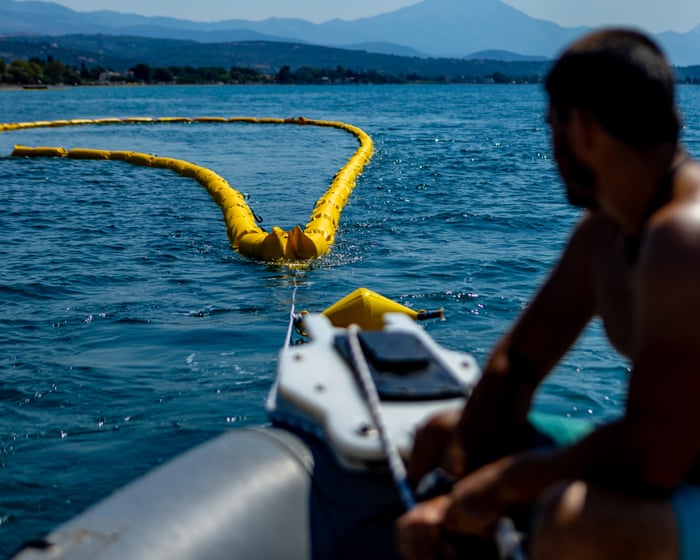
For the first time, a floating barrier has been placed across the bay. The children duck, splash, and play, but they haven’t gone past it. “Thank God it’s there to protect them,” he says, clearly relieved. “When I was a kid, the sea didn’t have dangers like this.”
Until last summer, the main threats in the Gulf of Euboea—the waters between the island of Evia and mainland Greece—were thought to be purple jellyfish. Last year, those mauve stingers caused so many swimmer injuries that pharmacists in Chalkida, the island’s busy capital about 80 miles (130km) north of Athens, had to work overtime.
Now, because of the climate crisis, toxic pufferfish with long teeth have arrived. They can bite through bone, metal, and wood. This new danger led the Greek Red Cross to take an unusual step in June: it issued a public health warning, telling people to seek emergency care if bitten, since the fish’s “beak-like jaws” can cause serious wounds and heavy bleeding.
The warning also said the fish should never be eaten, because its organs and flesh contain a deadly neurotoxin called tetrodotoxin. There is no known antidote. This invasive species can kill predators—giving pufferfish a huge advantage in the food chain—as well as any humans who eat it.
“Our main duty and concern has to be the safety of our citizens,” says Antonis Spanos, Chalkida’s vice-mayor. He oversaw the installation of the floating barrier last month, the first of its kind in Greece. “It’s better to be safe than sorry.”
At 40, Spanos is part of a new generation of proactive local politicians. He says authorities spent months securing funds and putting out bids to make sure the most protective barrier could be installed, before the system was approved by the state general laboratory.
“Two and a half kilometers of this net will be set up in bays around the gulf, so people can enjoy a carefree summer,” he says. “Last year was bad with the jellyfish, but as you say in English, we’ve killed two birds with one stone. Now if pufferfish show up, we’ll be ready for them too.”
The town hall has been flooded with calls from elderly people asking when the systems would be installed. “Just this morning, a woman called saying she’d only feel safe swimming with her grandchildren once it was there.”
Chalkida isn’t alone in this. This week, Nikos Choulieris, 63, who has run a diving school in the town for years, was out with his team in a fast inflatable boat. They were anchoring more floating barriers to the seabed off beaches further up the gulf, as other towns followed suit.
“I’ve been diving for over 40 years and never thought I’d see the day I’d be doing this,” Choulieris says. “Sea temperatures have definitely risen, and that’s made conditions much more favorable for what we’re seeing now.”
In the coming weeks, about 7km of floating barrier will be delivered by truck to the region.From Athens, Choulieris says, “I don’t think anything will get through that net, not even a pufferfish’s fangs. It’s very tightly woven and durable. They’d have to chew on the same spot for a long time to tear it, and I don’t think they’ll do that.”
The Lagocephalus sceleratus, or silver-cheeked toadfish, has spread so much that officials say the entire eastern Mediterranean is falling victim to this aquatic pest. Like lionfish, which originally come from the Indo-Pacific, this torpedo-shaped species is believed by scientists to have been drawn in by the Mediterranean’s warming waters, entering through the Suez Canal from the Red Sea.
Fishermen in Cyprus were the first to report their catches and nets being destroyed by this inedible intruder. In 2024, Cypriot authorities introduced financial rewards to curb its spread under a government-backed eradication program, which has removed over 103 tonnes of the silver-cheeked toadfish from coastal waters.
The island’s fisheries officer, Katerina Georgiou, says the species’ spread is due to its “remarkable adaptability.” She told local outlet Sigma that without a proper count, it’s “impossible to draw reliable conclusions about the overall stock or future population trends.” She added that the pufferfish’s presence isn’t temporary but a new reality that can’t be ignored.
Last week, Athens announced a similar “catch” program, offering €5.33 (£4.57) for each kilogram of this toxic menace handed over to authorities.
Greek fishermen, who also complain about their nets and gear being destroyed by the species, will receive fuel subsidies under the EU-funded action plan. It will initially apply in Crete and the southern Aegean. Once collected, the fish—like in Cyprus—will be frozen and burned in government facilities, says Margaritis Schinas, the agriculture minister and former European Commission vice-president.
The initiative aims to protect the marine environment and support coastal and island communities, and Schinas says it will likely be expanded.
“It’s all too late,” sighs Nikos Ayiaskoufitis, 54, enjoying a glass of wine with other amateur fishermen in a small harbor in Chalkida, where their organization has a squat building. “No measure will work because what we’re seeing is just part of nature’s law. The waters have warmed, these fish have migrated or will migrate this way, and I don’t think the bounty is enough for professional fishermen to focus on catching pufferfish.”
Greek authorities have also faced an unexpected opponent: fans of the species. A club called the Initiative to Save Puffer Fish emerged last week, criticizing the eradication efforts. It argued that these efforts raise “serious ethical questions” for a creature that clearly needs “protection and respect.”
With support from the tourist industry and leading marine fish experts—who say the outcry is overblown—the catch campaign is likely to face challenges.
“Everything we’re hearing is exaggerated,” says Ioannis Batjakas, a marine scientist at the University of the Aegean on Lesbos. In over 15 years of scuba diving, he says he’s only seen one pufferfish, though he admits they are common in the seas around Crete. “Yes, they have long teeth and look scary, and yes, they can be a problem for fishermen and their nets, but like most wild animals, they don’t attack humans. If they do, it’s very rare and only because they’re provoked.”All of this is much ado about nothing. Still, Beleyiannis isn’t convinced as he watches his grandchildren splashing in the bay. “If you ask me, these barriers should be put up all over Greece,” he says. “I saw two jellyfish in the water just outside it this morning. Why not pufferfish? In life, you never know what’s coming next.”
Frequently Asked Questions
Here is a list of FAQs about Greeces floating barrier to keep toxic fish away written in a natural tone with clear concise answers
BeginnerLevel Questions
1 What exactly is Greece doing with this floating barrier
Greece is installing a long floating net or curtain in the sea Its designed to block a specific type of toxic fish from swimming into tourist areas and fishing grounds
2 Why are they calling these fish toxic
The fish in question is the lagoon triggerfish It contains a deadly poison called tetrodotoxin Eating even a small amount can be fatal
3 Where did these toxic fish come from
They are not native to Greece They migrated from the Red Sea through the Suez Canal a process known as Lessepsian migration Warmer Mediterranean waters have helped them thrive
4 How does the floating barrier actually work
Its a physical barrier that sits in the water column It blocks the fish from swimming into shallow popular bays and beaches while still allowing water boats and other marine life to pass
5 Is this barrier dangerous for other sea life
The design is meant to be selective It targets the specific depth and swimming behavior of the toxic fish However environmental groups are monitoring it to ensure it doesnt trap dolphins turtles or other protected species
Advanced Practical Questions
6 Why not just fish them out and remove them
Fishing helps but its not enough The fish reproduce quickly and are already widespread A physical barrier is a better safe than sorry approach to protect specific highvalue areas in realtime while fishing is a slower broader solution
7 What are the specific benefits of a floating barrier over other methods
Immediate protection It stops the fish instantly unlike poisoning or trapping which takes time
Targeted It can be placed exactly where the threat is highest
Low chemical impact It doesnt pollute the water or kill other marine life
8 What are the biggest problems or risks with this barrier