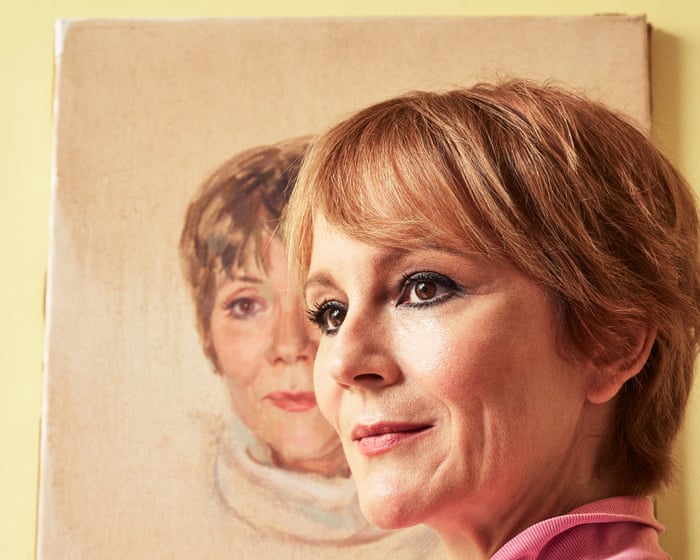
Recently, headlines have portrayed me as some kind of savage who guzzles ashes and devours her mother’s charred remains every night. “Rachael Stirling eats mother Diana Rigg’s ashes before going on stage,” declared a dozen news outlets last month, while others described it as a “strange habit only she really understands” and “Dame Diana’s daughter admits eating her ashes in bizarre tribute.” I’ve written a book about our relationship, All About My Mother, in which I do admit to nibbling a grain or two, but I didn’t expect the press to paint me as a matricidal cannibal.
My mother was Diana Rigg, an iconic actor with a 60-year career. Younger people will know her as the Queen of Thorns from Game of Thrones, delivering the best verbal takedowns on television in her wimple: “I’ve known a great number of clever men. I’ve outlived them all. You know how? I ignored them.” Older generations, meanwhile, get misty-eyed remembering her leather-catsuited triumph as Emma Peel in The Avengers in the 60s—the first woman to perform kung fu on western television. She was also the only woman ever to marry James Bond. She appeared in The Great Muppet Caper because I was deeply in love with Miss Piggy, and her child-murdering Medea was the toast of Broadway. She won an Emmy and a Tony and received countless honors for her many stage performances. She was completely original and very witty too.
I missed her so intensely that I wrote the book to bring her back to life. Mum never wanted a biography during her lifetime, having been put off by a couple of weak attempts that made her seem a bit dull or, worst of all, earnest. My mother was not earnest. She was honest, sometimes painfully so.
View image in fullscreenStirling as a baby with her mother. Photograph: Chris Barham/Daily Mail/ REX/ Shutterstock
I was her only child and followed her into acting. She strongly disapproved of my career choice, and this caused some arguments, I can tell you. We went through the full range of emotions and eventually found our way back to the love we’d had in the early years. In the end, the love between us did conquer all the awful parts, though there are some joyful and some jaw-dropping stories to share.
Which brings us neatly back to the subject of ashes and my ingesting them.
Groucho Marx wanted to be cremated, with one tenth of his ashes to be “given to my agent, as written in my contract.” Dying during the Covid lockdown, my mother wanted to be cremated too, but with no ceremony, and scattered in places she loved. Pragmatic to the last, she even made sure we’d paid for the cremation on her bank card before she died. However, we never thought to decide what container her remains would be returned in, so it wasn’t until after her death that I found myself browsing the selection of “scatter tubes” on offer.
Scatter tubes are cardboard containers of varying sizes. Some are plain, others have images printed on them. These are pretty unoriginal—pictures of doves and sunsets, or was it a sunrise—and images that felt a bit too on the nose to me. It turns out most things are quite on the nose when it comes to death. There isn’t much of a market for irony. Not many skull and crossbones, or red stilettos, or tubes with “I told you I was ill” written on them. In the end I settled for a variety of containers in a variety of sizes, with the least offensive floral decorations on them. I needed quantity, as my mother had many places to go. She was to be scattered from the air across the green fields of England from a biplane by her aviator friend Tracey Curtis-Taylor; she was to be scattered in her garden in France and mine in London; and at the site of the actors’ church in Covent Garden.
I did not expect human ashes to be so heavy. But they are very heavy. I discovered this when my mother’s mortal remains were returned to me one bright September morning.I didn’t expect human ashes to be so heavy. But they are. I found this out when my mother’s remains were returned to me on a bright September morning. When the cremation company arranged the delivery, they warned me that receiving the ashes could be emotional. My beloved mother’s cremated body was certainly the strangest delivery I’d ever received—not something you’d leave on the porch or with a neighbor. So I sat by the front door, waiting like an obedient dog for its owner.
My mother was delivered by the gentlest of men from the cremation firm in Yorkshire, where she was born. He lifted her from the trunk in a box wrapped in plain cloth. His kind eyes searched my face, probably checking whether I was about to burst into tears and drop her, as he handed her to me with the tenderness you’d use for a newborn baby.
Cremation frees families to celebrate a loved one’s life outdoors, away from the stuffy formality of funerals, but things don’t always go as planned. Everyone’s seen a movie where ashes are scattered and the wind blows them back into the faces of the grieving. The best ashes mishap story happened at the scattering of my father-in-law, Donald Garvey—dad to seven wonderful children, the sixth being my husband, Guy Garvey. We gathered to celebrate the much-missed Don with his large family at the Great Orme in Llandudno, where the Garveys had taken many holidays. Don had said he wanted the day to resemble a Jack Vettriano painting—a woman in a red dress dancing with her partner in tails on a stormy beach. Words were spoken on the clifftop, and a brave few went down to the shore. Granddaughter Lucie, in a scarlet off-the-shoulder dress, hiked up her skirts and waded into the unusually clear, calm blue sea to scatter her beloved grandad into the Welsh tide, as he had specifically requested. When Lucie solemnly made her way back to the family on shore, she announced the now-immortal line: “I think I’ve got some of Grandad in mi’ knickers.”
The tiny tube containing my mother was about three inches tall. I have to say, I think scatter tubes are really badly designed. They open the opposite way from what you’d expect, so you can easily scatter a loved one’s ashes by mistake. The contents had—mostly—gone where they were supposed to, though it still held the odd grain or twenty of my mother, so I couldn’t throw it away. It was conveniently pocket-sized, so I started carrying what was left of her everywhere. So far, so normal.
The next play I did was at the same theater where I’d last performed before Covid. It was the last show my mother ever saw: Love, Love, Love at the Lyric in Hammersmith. The new show, Scandaltown, was by the same writer, Mike Bartlett, and also at the Lyric. Everything felt eerily similar, yet between the two plays my mother had died and the whole world had turned upside down. Now here I was, going to rehearsals in the same room, with some of the same people, but without Ma to talk to about how the play was going at the end of the day. A strange new world.
As I put her tube in my backpack on the first day of work on the show, I remember thinking how thrilled she’d be to be back in a rehearsal room. Nearer opening night, I decided she’d enjoy a permanent spot in my dressing room. My mother had used this same dressing room in 1985, when she performed in Little Eyolf, a grim Nordic drama from 1894 by Henrik Ibsen. It’s the “Number One” dressing room, the one nearest the stage, and here she was again, sitting in front of a Hollywood mirror with its necklace of blazing bulbs—though this time in a tube. The only thing she missed was actually going on stage with me. That was her happiest place.After all, I couldn’t hide the tube anywhere in my tight-fitting gold lamé suit without creating a very strange lump in my costume. So she stayed there, in her dressing room, waiting for a call to the stage that never came.
I licked my finger, picked up the few spilled cinders, and put her on my tongue. Grainy, in case you were wondering, but it didn’t feel wrong—it felt completely right.
Actors are an emotional bunch at the best of times, and by opening night I was a wreck. My first opening night without my mother in the audience made me sad, but this was a high-energy Restoration-style comedy, so I had to pull myself together quickly. I looked at the small tube containing my mother’s remains, and I don’t know what I was thinking, but I found myself opening it. The wrong way. A few grains fell onto my dressing table, and as I panicked and tried to put them back one by one with varying success, the PA system blared, “Miss Stirling, this is your call to stage.” It was time to make my entrance. The adrenaline kicked in and my heart was pounding. It was time to go.
In a panic, like a cocaine addict in a movie who can’t bear to waste a single grain of the good stuff, I licked my finger, picked up the few spilled cinders, and put her on my tongue. Grainy, in case you were wondering, but it didn’t feel wrong—it felt completely right. I laughed out loud at myself and the ridiculous situation. And just like that, my nerves disappeared.
I know this sounds insane, but it made complete sense to me. After all, plenty of people believe they’re eating the body of Christ every week, and at least this way I could truly say I took her on stage with me that night, back on the boards where she belonged.
When I told a widow at the party afterward what I had done, her eyes widened in recognition and she whispered urgently, “I do that, too!”
The difference is, she didn’t talk about it. No one talks about it. It’s secret animal behavior, and let’s face it, most people do much worse in private. They just keep quiet. But it felt much more important to tell the truth—and I love feeling that some of her is on stage with me. She had refused to retire, after all, and this was my way of helping her keep going.
I’ve done the same on every opening night since. As the five-minute call comes over the PA before every press night, I open the tube—which I’ve become skilled at—stick my finger in, and whatever I collect goes in my mouth. Some people listen to music before going on; some do push-ups. I eat the last remains of my mother. She was on stage with me on the opening night of Noël Coward’s Private Lives in 2023. Just knowing she was there gave me the confidence to play the part that night, to be joyful, to “Go Fly My Girl,” as she used to write in my opening-night cards.
She would have adored going on to the Hampstead Theatre stage with me when I played Sarah Siddons in The Divine Mrs S, a play about the 18th-century actor whose revolutionary realism in performance caused her audiences to scream and faint. Ma used to quote Siddons to me. She’d say, “If it can be found in nature, I know it can be played,” so of course she’d want to be with me under the spotlights as I said those exact words. Before the opening night of Giant at the Royal Court in 2024, the smash hit show about Roald Dahl’s antisemitism in which I played his wife, Felicity Crosland, opposite John Lithgow’s Roald, once more I nibbled on a crumb. I can’t not do it these days, even though there’s hardly anything left; it’s the thought that counts.
She’s even been back to Broadway, baby. When Giant transferred to New York in March this yearMy mother came with me. Ah, there’s no business like show business. One terrible night, I came back to my dressing room after a show and found a huge leak in the roof right above my chair. Everything was soaked. My first thought was, Oh no, Mum’s turned to mush! But actually, the outside of the tube was only slightly damp, and inside it was completely dry.
Love is animal, and grief certainly is too. Dogs sniff each other’s bums as a greeting; my mum used to bite mine regularly and even said so on national television. “I sink my teeth into her flesh! I bury my nose in her stomach!” she told a bewildered Michael Parkinson. Isn’t that basically the same thing? And is it really so strange that I put my mother—the woman I came from—back into the same mouth she formed in the womb? It’s my own act of faith. “Ashes to ashes, funk to funky,” as Bowie wrote. “I’ve loved all I’ve needed, love. Sordid details following…”
Love made cannibals of us both. A widow I know sees the sense in what I do, but judging by most people’s faces when I tell them, few others agree. Reactions range from sour lemon-sucking grimaces to outright disgust. Even so, I won’t be talked out of it. I will die on the hill of my ash-eating, and to anyone who questions my sanity, I say, “It’s natural! I’m sure it really is! I promise I’m not going mad. It’s what she would have wanted!”
All About My Mother by Rachael Stirling is published by John Murray at £25. To support the Guardian, order your copy at guardianbookshop.com. Delivery charges may apply.
Frequently Asked Questions
Here is a list of frequently asked questions about Rachael Stirlings revelation that she ate her mother Diana Riggs ashes
Beginner Questions
What did Rachael Stirling say she did with her mothers ashes
She said she ate a small amount of her mother Diana Riggs ashes
Who is Rachael Stirling
She is a British actress She is the daughter of actress Diana Rigg
Who was Diana Rigg
Diana Rigg was a famous British actress She was best known for playing Emma Peel in The Avengers and Olenna Tyrell in Game of Thrones She died in 2020
Where did Rachael Stirling say this
She said it in a 2025 interview on the podcast Table Manners
Why did she do it
She said it was a spontaneous emotional act of grief and closeness to her mother It was not planned
Did she eat all of the ashes
No She said she ate only a small amount
What did she mean by I didnt expect to be portrayed as a cannibal
She meant she was surprised that people focused on the shocking idea of eating ashes She felt the media made it sound like a strange or violent act when for her it was a private act of mourning
Advanced Questions
Is eating ashes dangerous
Ashes are not food They can contain minerals and remains that may irritate the stomach or cause nausea Doctors generally do not recommend eating them In this case she said she ate only a tiny amount
Is eating a loved ones ashes common
It is not common but it is not unheard of Some grieving people have reported tasting or swallowing a small amount of ashes as a way to feel close to the person who died
Why did she compare it to cannibalism
She did not compare it to cannibalism herself She said she did not expect others to portray her that way The media used the word cannibal because eating human remains sounds shocking But cannibalism usually means eating flesh not ashes
What was the public reaction
Reactions were mixed Some people were shocked or disgusted Others understood it as a raw expression of grief Many defended her right to