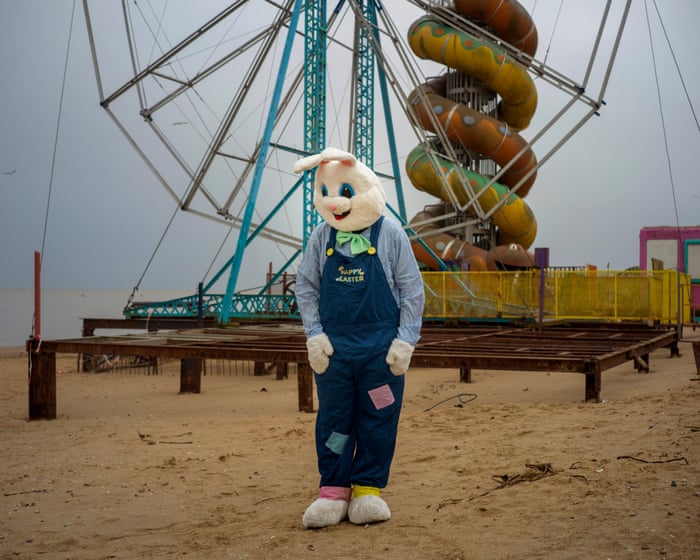
It’s mid-afternoon in Cleethorpes, a seaside town in Lincolnshire, and Cohen is sitting in the back of a car, putting on an Easter bunny costume. A group of teenagers nearby are watching and laughing, but Cohen doesn’t mind. He’s hoping we can take some new photos he can use to promote his mascot business for the upcoming holidays.
Cohen, who is 19, lives with his parents a few miles away in nearby Grimsby. He started Co Co Mascots last year as one of his many attempts to find work. People can hire him in different costumes for birthday parties, events, or surprise doorstep visits for kids. He’s done a few paid jobs so far, which he says has helped boost his confidence. But what he really wants is a permanent job.
For the past year, Cohen—who has a learning disability—has been applying for jobs at holiday parks, in retail, at charity shops, and even at the local football club, Grimsby Town FC, which was hiring a new mascot. He volunteers at a local Scope charity shop once or twice a week and is starting a work placement through college at Morrisons. He hasn’t found paid work yet, but it’s not because he hasn’t tried. “Retail used to be a big thing for a lot of people here in Grimsby,” he says. “But a lot of it is closing down now. It’s mostly vape shops and barbers, not places where you can get a job.”
Grimsby was recently called Britain’s “worklessness capital” by the Telegraph because so many working-age people there claim benefits. A Guardian article quoted the former council leader saying some residents weren’t trying hard enough to find work. That kind of talk feels discouraging to Cohen, who says he’s “throwing everything” at finding a job.
Once one of the world’s biggest fishing ports, Grimsby is still the UK’s largest fish-processing hub—reportedly making every other fish finger eaten in the country. But it has more working-age adults out of work than the national average, and 41% of children under 16 in the town live in low-income families.
For many young people in coastal places like this, finding paid work is hard—and having a disability makes it even harder.
“The hardest thing is not hearing back from a job application and not getting any feedback,” Cohen says. “I start overthinking because I want a job too much. A lot of the time, I think employers see you have a disability and choose someone without one because they think a person with a disability is more work.”
Cohen has been volunteering in charity shops and at food banks for over a year now, and he doesn’t see his disability as a barrier to working.”When I’m working, my mind can wander a bit, so I need a little reminder every now and then. I just need some support until I get used to the job and know what’s expected of me.”
9:07
Vape shops but no jobs: one young man’s search for work in Grimsby
Cohen’s job options are even more limited because neither he nor anyone he lives with drives, so he can’t leave town. “You do have those times when you doubt yourself, but then you get back to it,” he says. “Mum and Dad have always been positive and told me not to put myself down. If I do, they tell me I can do it.”
“There are a lot of kids in Grimsby who will engage, but if they don’t fit into a box, they are never given any hope or support.”
Lynsey Powles
Local graffiti artist Lynsey Powles runs the youth hub TickArt Office and helped Cohen set up Co Co Mascots last year. She worries about people like him being left behind. “There are a lot of kids in Grimsby who will engage, but if they don’t fit into a box, they are never given any hope or support,” she says. “The kids here need opportunities to do things they’re interested in and can aspire to.”
Adults like 35-year-old Lewis, who is living at Grimsby’s YMCA while waiting for council housing, agree. He trained as a technician, but after being made redundant, he ended up sofa-surfing and living on the streets for two weeks.
“When young adults and kids feel lost or mess up, they don’t know who to ask,” he says. “There aren’t enough qualified people here to give them advice.”
He has done bar work in the area in recent years, but after running a food truck on match days at Grimsby FC, he says his long-term dream is to run a village pub, “like Jeremy Clarkson.”
Cohen spends one evening a week at a training session at the local wrestling club, EVO Wrestling Academy, where other teenagers and young adults gather.
“It’s been a bit mixed up growing up here,” he says. “I was bullied, so I didn’t like to leave the house, but with volunteering and wrestling, I’ve started to get out more. I wouldn’t leave my hometown. I’ve been here since birth and don’t plan on leaving.”
It’s not just people who grew up in Grimsby who want to find a way to stay. Lisa February, 25, grew up in London before moving to the coastal town as a child with her mother after her parents split. After always being told to get out of Grimsby, she did the opposite and co-founded the lowercase theatre, working with aspiring artists across north-east Lincolnshire.
“I was always told it was a dead end and there was nothing for me here. I’ve had lots of opportunities to leave Grimsby and see other places for work, but I always want to come back here. I have a lot of family and friends and a community that cares about me here.”
Back on the seafront, Cohen has finished with the photography. He’s happy and looking forward to using the images. Next, he’s off to his one-day-a-week placement at Morrisons, stocking shelves. He’s been told it could eventually lead to a job offer. “I’m kind of nervous,” he says. “I’ve heard they’re all really nice, so fingers crossed it’s all going to be OK.”
Finding paid employment in seaside towns like Cleethorpes can be hard.
The Against the Tide series is a collaboration between the Guardian and documentary photographer Polly Braden.
Frequently Asked Questions
Here is a list of FAQs about the article Im throwing everything at it one young mans search for a job in Britains worklessness capital
BeginnerLevel Questions
Q What is this article about
A Its the true story of a young man in the UK trying very hard to find a job in a town or city with very high unemploymentoften called the worklessness capital
Q What does worklessness capital mean
A Its a nickname for a place with the highest percentage of workingage people who dont have a job Its not a compliment it means the area has serious economic problems
Q Who is the one young man in the title
A A real person who represents many young people in that area He is actively applying for jobs but struggling
Q Why is he throwing everything at it
A He is trying every method he can think ofonline applications walking into shops asking friends retraining and taking any temporary workto get hired
Q Is this a happy story or a sad story
A Its a realistic and often frustrating story It highlights the struggle but also his determination It doesnt usually end with a perfect job offer
Advanced Deeper Questions
Q What specific problems does the young man face in his job search
A Common problems include no jobs in his town employers wanting experience he doesnt have being ghosted after interviews low wages that dont cover rent and competition from hundreds of other applicants
Q What is the benefits trap mentioned in the article
A Its when taking a lowpaid job actually leaves you with less money than staying on government benefits because you lose housing help and other support This makes it feel pointless to work
Q How does the local economy affect his chances
A The area might have lost its main industries and hasnt attracted new businesses There are simply very few employers nearby and public transport to other towns is expensive or nonexistent
Q Does the article blame the young man for being unemployed