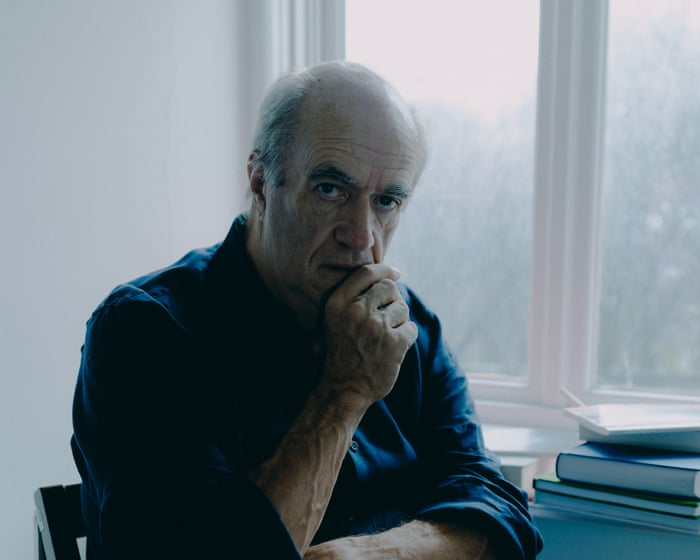
I often jot down the opening paragraph of a story in a notebook, adding to it now and then or letting it sit to see if anything develops. In 2008, while in San Francisco, I went hiking near Muir Woods with three friends, overlooking the Pacific Ocean. At the summit, there was a lodge where you could spend the night and use the kitchen to cook your own dinner. The view was breathtaking.
As we climbed, I started imagining a character—an Irishman who had decided to return home. This was his last big adventure in the landscape. He had been working as a plumber, leaving his mark across the Bay Area in houses where he fixed pipes and installed sinks, toilets, and washing machines. That was his legacy in America. He was someone you could rely on in an emergency, but he was undocumented and heading back.
Over the next few years, the story took shape. If my character left America, he knew he’d never be allowed to return. He had a daughter from a marriage that had ended, and he adored her. Leaving meant losing that connection. I pictured him spending one last day with his daughter in that beautiful place. I wrote a bit more, then set it aside.
Sixteen years later, the story resurfaced. It struck me that Donald Trump’s re-election and the threat of his crackdown on undocumented immigrants would be the push my character needed to finally decide to leave. He would go on Monday, January 20, 2025—the exact date of Trump’s inauguration. The hike with his daughter, now almost a teenager, would happen on Saturday, January 18.
I planned to write the hike scene on the very day it took place. I was in the same time zone, with the inauguration looming, ICE closing in, and Trump growing louder and more ominous. As my protagonist and his daughter left the city, I wrote what they might say and do at that same morning hour. They didn’t know—just as I didn’t—how they’d find parking. But it turned out easier than either of us expected. My goal was to finish that section that day. I could make small changes, but I wanted it to stick so I wouldn’t have to rewrite it later, after Trump had taken office. I aimed to complete the story by then and publish it soon after. It felt superstitious and serious at the time.
Sometimes, a glimpse is enough to start with, or a small detail from a larger story. In his preface to The Spoils of Poynton, Henry James talks about the “germ” of an idea—what he called “a mere floating particle in the stream of talk,” something that carries “the virus of suggestion.” Life, as James saw it, is “all inclusion and confusion,” while art is “all discrimination and selection.” When seeking inspiration for a story, very little is more than enough. A hint—a clue, a suggestion—can do more in the imagination than something spelled out.
About 20 years ago, I interviewed a historian in a remote part of the Catalan Pyrenees called the Pallars. Because the area is sparsely populated, he had managed to document every death there during the Spanish Civil War, along with many small details about injuries, bombardments, and troop movements.
What was strange, he said, was that in the summer of 1938, the town of Pobla de Segur in the Pallars was relatively quiet—the real action was elsewhere. As a result, fascist soldiers could throw parties by the river at night, playing guitar and drinking freely.
The historian invited a general, who had been a young officer in Franco’s army in 1938, to return to the Pallars more than half a century later and show him where certain events had taken place. As the general, now in his 70s, was walking through the town, he met a local woman who was…Out shopping, the two recognized each other immediately, with surprise and a kind of delight. They had known each other in the summer of 1938. She came from a world that was vehemently anti-Franco; no one wanted to remember those parties by the river.
That was all I needed. I almost asked the historian to tell me nothing more beyond that single street encounter. From that, I could begin imagining those nights by the river in that summer of the civil war. And then I could conjure up the woman, years later, being told that the young soldier she had fallen in love with—whom she hadn’t seen for over fifty years—was coming for a visit. He was a retired general now, he remembered her name, and he wanted to see her.
It is important to be ready not to write the drama. At first, I tried to picture what that meeting would be like. Then it struck me that it would be more powerful if the woman and the soldier never met all those years later. He had invited her to lunch, but she didn’t go. The story would center on how she spent those hours, knowing he was so close by, yet not meeting him.
The confrontation that does not happen is often more dramatic than the one that does. At the very end of another story, A Sum of Money, a young man sent home from boarding school for stealing has to face his parents. I sat gazing at a blank page for a long time, working out how to write this fraught encounter, until I realized it didn’t have to be written at all. In the finished story, no one says anything. They almost do, and then think better of it.
But something happens that makes a difference. The lack of open drama allows a shift to take place in someone’s sensibility. My job is to give that shift as much nuance and ambiguity as I can, and also to make it matter—to make the arrow hit its mark.
James wrote about a fellow novelist who had published a much-praised work about French Protestant youth. When asked how she knew so much about them, she replied that once, walking down a stairway in Paris, she looked through a doorway and saw a group of French Protestant youth. That was where her knowledge came from—just that. What James appreciated was the ability “to guess the unseen from the seen, to trace the implication of things, to judge the whole piece by the pattern.”
In the spring of 1988, I decided to find a small apartment in Barcelona. One day, as I waited to view a possible rental, three women in their sixties joined the queue. We spoke for only two or three minutes, but it was enough for me to learn they were sisters, Catalans, who had returned after living many years in Argentina. They found Barcelona prices very high. They finished each other’s sentences.
I waited thirty years to write The Catalan Girls. At 30,000 words, it is the longest story in my latest collection. I imagined the lives of those three women I had fleetingly encountered. I dreamed up how and why they went to Argentina, how each of them lived there, and how they came back to Catalonia. I made the middle one a lesbian, the youngest dreamy, and the eldest bossy. I gave them lovers and husbands. I imagined the bossy one insisting her two younger sisters get the same hairdo as hers before they traveled back to Spain.
I also moved closer to what I knew. I imagined the three sisters attending the same festival in the village of Tírvia in the Pallars that I attended in July 2017. I could easily have seen them if I had looked over. I knew what music the band was playing.
Other elements in the story came from memory. The house where the middle sister lives on the outskirts of Buenos Aires is precisely where I stayed in the spring and early summer of 1985. Her room is my room. The apartment where the youngest sister lives, paid for by her lover, is where I also lived in the spring of 2013.
In writing stories, I draw energy from rooms I once knew but no longer live in, from things that have gone.Some places feel strangely haunted, lingering in memory or returning in dreams. In A Sum of Money, much of the story unfolds in the dormitory known as The Attic at St Peter’s College in Wexford—a room I haven’t seen since 1971.
In the early 2000s, I taught for a semester at several American universities in cities I will not live in again. So, in a story like Barton Springs, I could summon Austin, Texas, and in Five Bridges, the city of San Francisco. In Sleep, I could step back into an apartment I sublet near Columbia University in 2012 and 2013. I placed my protagonist in my own bed, had him look out the same window I did, with its view of the George Washington Bridge. When I bring him back to Dublin, he spends time in the long living room in Ranelagh that once belonged to the feminist writer June Levine and her husband, the psychiatrist Ivor Browne. The bar in Barcelona in A Free Man is a place I once knew well. And The News from Dublin opens in the back room of the house where I grew up—a house long since sold, one I will not return to.
By the time I wrote those stories, those spaces could only be visited in memory or imagination. Other places, like the room where I now sit in New York, have not yet been written about. They are not lost to me. I do not miss them or feel regret. They are not part of a world that feels complete, ready to be framed or quietly entered, the way a ghost might drift into a story.
Someday, if I live long enough, I will see this room as though framed and finished. It will belong to memory and history. Then I will be able to write about it. This is the room where I learned firsthand not only what evil is like, but how evil is tolerated. What feels strange about being in America in the time of Trump is how ordinary it all seems—how what was unimaginable just over a year ago has become, shockingly, no surprise at all.
For Five Bridges, I imagined an Irishman living illegally in San Francisco, realizing the danger if he stayed. A year after the story was published, elements of it came true. On February 9, the Guardian reported on Seamus Culleton from County Kilkenny, who entered the United States on the same visa as my character and likewise built a life over decades.
Culleton was arrested by ICE in September while buying supplies at a hardware store in Massachusetts. After being held in facilities near Boston and Buffalo, he was flown to El Paso, where he was placed in a cell with more than 70 men. He told the Irish Times the detention center was cold, damp, and squalid, with fights breaking out over insufficient food—”like a concentration camp, absolute hell.”
That is a fate my character in Five Bridges managed to avoid. In stories of the future, such characters may not be so lucky.
The News from Dublin by Colm Tóibín is published by Picador on 26 March. To support the Guardian, order your copy at guardianbookshop.com. Delivery charges may apply.
Frequently Asked Questions
FAQs Ive seen for myself how people can accept evil Colm Tóibín on Life in Trumps America
BeginnerLevel Questions
Q What is this article or quote about
A Its about Irish author Colm Tóibín reflecting on his experiences living in the United States during Donald Trumps presidency He observes how ordinary people can rationalize or tolerate actions and rhetoric they might otherwise consider morally wrong
Q Who is Colm Tóibín
A He is a celebrated Irish novelist essayist and playwright known for books like Brooklyn and The Master He has spent significant time living and teaching in the US
Q What does he mean by accept evil
A He doesnt necessarily mean people actively embrace monstrous acts Instead hes describing how people can become numb to excuse or normalize behaviorlike dishonesty cruelty or undermining democratic normsby prioritizing political loyalty economic gain or cultural identity
Q Is this just a critique of Trump supporters
A Not exclusively While focused on the Trump era Tóibíns observations are a broader commentary on human psychology and societal dynamicshow groups everywhere can gradually accommodate disturbing ideas when theyre framed in a certain way
Q Whats the main benefit of reading this perspective
A It offers a thoughtful literary outsiders view of a turbulent period in American life It can help readers step back and think about the social and moral forces that shape politics beyond daily headlines
Advanced Analytical Questions
Q How does Tóibíns status as an outsider shape his perspective
A It gives him a dual viewpoint He is intimately familiar with American culture but retains the critical distance of someone not born into its political battles This allows him to see patterns and national traits that might be invisible to those fully immersed in them
Q What literary or historical parallels might he be drawing on
A As a student of history and literature Tóibín is likely invoking themes from works that explore the banality of evil moral compromise and how societies slide into authoritarianism Hes examining the everyday mechanisms not just the dramatic moments