Gyula, a peaceful and scenic town in eastern Hungary, is famous for its sausages. Though it lacks a direct train link to Budapest, it boasts a library and a castle. Soon, it will also have an official replica of a Nobel Prize medal.
Billboards in the town declare, “Congratulations to László Krasznahorkai, the first Nobel winner from Gyula,” honoring the 71-year-old author who won this year’s Nobel Prize in Literature for “his compelling and visionary body of work.”
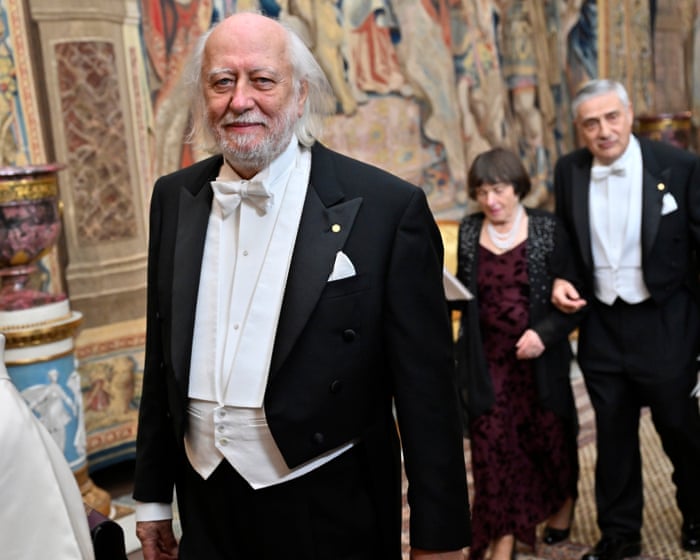
In December, when he received the medal at the Swedish Academy in Stockholm, many of his fellow Hungarians watched live, including a crowd gathered in Gyula’s wood-paneled library. The town celebrated with a week of readings, workshops, and an exhibition dedicated to Hungarian Nobel laureates.
The author himself was not there—not only because he was accepting the award. Like many Hungarian artists and writers today, Krasznahorkai no longer lives in his homeland.
As Viktor Orbán’s far-right Fidesz government faces its toughest re-election campaign since taking power in 2010, authors and rights groups say it is fostering an increasingly hostile and repressive environment. The state has taken control of one of the country’s largest publishers, homophobic laws have reshaped bookstores, and writers report dwindling opportunities.
In an interview with Swedish broadcaster SVT after winning the Nobel, Krasznahorkai compared Hungary to an alcoholic parent. “My mother drinks, she loses her beauty, she fights,” he said. “Still, I love her.”
Many Hungarian intellectuals have left the country. Among them is award-winning author Gergely Péterfy, who moved to southern Italy and founded an artists’ community. He said the move was partly out of curiosity and a love for the Mediterranean lifestyle, but also due to politics. “Over the past 15 years, it has become very difficult to live in Hungary because of Orbán’s anti-culture stance,” he explained.
Since Fidesz came to power, government-aligned actors have gained control over universities, galleries, and major media outlets. The national cultural fund, led by the culture and innovation minister, has shifted money from independent unions and magazines to pro-government journalists and writers.
The independent literary outlets that remain are struggling to survive as the state’s influence over advertisers grows, leaving publications with less revenue and unable to pay contributors fairly.
“I don’t know any young writer in Hungary who makes a living,” said Csenge Enikő Élő, a 32-year-old author.
Élő writes prose and poetry, and her first book was published last year by an independent publisher. She laments the polarization in literature: “One side receives a disproportionately large amount of funding, and the other very little.”
The Fidesz government has also invested hundreds of billions of forints into Mathias Corvinus Collegium (MCC), a conservative educational institution chaired by Orbán’s political director. MCC has several international branches and its own publishing house.
In 2023, MCC acquired 98.5% of the shares in Libri, Hungary’s leading publisher and bookstore chain. That same summer, Libri stores wrapped books in plastic if they depicted same-sex relationships, in line with Fidesz’s “child protection” law, which bans the promotion and display of homosexuality and gender reassignment.
“A significant portion of literary works were effectively banned for the sake of a political campaign,” said Krisztián Nyáry, a writer and creative director of Líra, the country’s second-largest bookstore chain and publishing group. Líra has been fined multiple times for defying the anti-LGBTQ law and is challenging the penalties in national and international courts.While Le Nyáry finds some reassurance in the fact that Libri has retained the same staff since its acquisition by MCC, he remains cautious. “There are Chekhovian rifles hanging on the wall here,” he said. “No one has fired them yet, but we know that if there’s a rifle on stage, sooner or later someone will fire it.”
The Fidesz government has faced criticism for promoting right-wing and controversial writers, including them in the national curriculum and pushing for their official recognition. In 2020, teaching unions were outraged when the state’s list of required texts included works by József Nyírő, a member of Hungary’s far-right government during World War II, while excluding Imre Kertész, a Holocaust survivor and the country’s first Nobel laureate in literature.
In contrast, Krasznahorkai’s editor, János Szegő, noted that the government had done little to promote the author internationally. Despite Krasznahorkai’s criticism of the government—recently describing it as “a psychiatric case” for its ambivalent stance on Russia and Ukraine—his Nobel Prize was celebrated across the country, transcending political divisions.
“It makes one’s heart skip a beat when a person of Hungarian descent receives the Nobel,” said Szegő. “It’s a great affirmation for a small language that is always wary of extinction.”
Ernő Görgényi, the Fidesz mayor of Krasznahorkai’s hometown, Gyula, stated: “For us as a community, the greatest recognition is that books featuring locations and people from Gyula have now found their way onto bookshelves around the world.” The local administration plans to install a plaque on the house where Krasznahorkai grew up and name a school library after him. Eventually, they aim to organize Krasznahorkai-themed tours of the city, inspired by Dublin’s Ulysses walk.
“There’s no need to bring politics into this,” said Márta Becsiné Szabó, 75, a Gyula resident who participated in the town’s Nobel celebrations. “The important thing is that he is from Gyula, and that he is Hungarian.”
Frequently Asked Questions
FAQs Hungarian Authors and the Unwelcoming Climate
BeginnerLevel Questions
1 What does the phrase life has grown hard refer to in this context
It refers to the growing sentiment among many Hungarian writers journalists and intellectuals that the current political and cultural climate in Hungary is increasingly hostile to free expression critical thought and artistic independence
2 Why are Hungarian authors speaking out
They are speaking out because they feel their ability to work freely is under threat They cite issues like government control over media and cultural funding campaigns against independent voices and a general atmosphere that marginalizes dissent
3 What is an unwelcoming climate for authors
Its an environment where authors may face public smear campaigns loss of funding or publishing opportunities exclusion from statesupported cultural life or legal pressures if their work is seen as critical of the government or its policies
4 Is this just about politics or is it about culture too
Its deeply intertwined The authors lament that a specific nationalconservative cultural vision is being promoted by the state while alternative liberal or critical cultural perspectives are being sidelined making the broader cultural landscape less diverse and open
5 Are authors leaving Hungary because of this
Yes some prominent authors and intellectuals have chosen to emigrate citing the pressure and a feeling that there is no longer a place for their work in Hungary Others continue to work from within under difficult conditions
AdvancedLevel Questions
6 How does the government influence literature and publishing
The government exerts influence primarily through funding Key cultural funds and institutions are led by government allies Publishers and theaters that receive state support may avoid controversial works while loyalist authors and projects are generously funded This creates a powerful economic incentive for selfcensorship
7 What is the Nemzeti Kultúráért award and why is it controversial
Its a state award created to honor artists who promote national values Critics see it as a tool to create an official governmentapproved canon of art and to reward ideological loyalty over artistic merit further dividing the cultural community
8 What role does the media play in this climate
A large portion of the Hungarian media is under direct or indirect government control This media often portrays independent critical intellectuals as foreign agents S