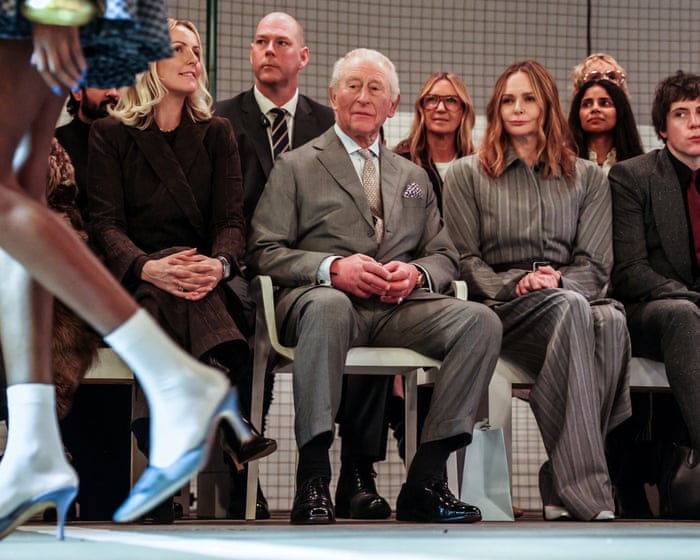
As Andrew Mountbatten-Windsor was taken into police custody last week, his brother King Charles made a “surprise” appearance on the front row at the opening of London Fashion Week. Styled in one of his staple jaunty ties, a clashing pocket handkerchief, and a British-made suit, his look sent a clear message: business as usual.
That message continued when, at the BAFTAs over the weekend, the Prince and Princess of Wales presented a united front in coordinated burgundy velvet—what the New York Times called “Pantone diplomacy.” Catherine’s blush Gucci gown not only showed solidarity in color but also, arguably, signaled her ethics during a week when the royal family faced criticism: she had worn the dress before on a previous outing.
“The king’s whole look—with his British bespoke tailored suit—might be seen as putting on a brave face and keeping calm during yet another existential crisis,” says Justine Picardie, former editor-in-chief of Harper’s Bazaar UK and author of the new book Fashioning the Crown: A Story of Power, Conflict and Couture. “For Catherine, it is another expression of her sustainable approach, showing restraint rather than excess.”
The House of Windsor has long used fashion as a tool during times of crisis, Picardie notes, pointing to “similar tactics used after the abdication crisis in 1936, when Queen Elizabeth (the Queen Mother) was dressed by Norman Hartnell in an idealized vision of traditional Englishness to counteract the hard chic of the pro-Nazi Duke and Duchess of Windsor.”
“Clothes are used to express power and many other things—emotion, vulnerability, grief, birth, death, loss… whether it’s a wedding dress or attire for a funeral,” she says. But what Picardie, who previously documented the hidden histories of Chanel and Dior, hadn’t fully appreciated until researching this book was “dress diplomacy.”
On tours and official occasions, the royal family often uses fashion as a form of soft power. For example, the Princess of Wales attended a state reception in New Zealand wearing a black Jenny Packham dress embellished with silver fern leaves—a national emblem. At a Commonwealth Day service at Westminster Abbey last year, she wore head-to-toe Canadian red, and she never misses a chance to wear clover-green when visiting Ireland. Princess Diana chose a dress dotted with red circles, mirroring the Japanese flag, during a 1986 tour of the country. In Saudi Arabia, she wore a dress emblazoned with gold falcons, another national symbol.
Picardie’s book also highlights examples from Queen Elizabeth II’s playbook. From hats dramatically adorned with ostrich plumes for official visits to South Africa, to her wartime-inspired habit of wearing outfits multiple times, Elizabeth understood “the sartorial art of royalty and the ways in which visual iconography could safeguard the sovereign.”
In later years, Elizabeth II’s outfit choices—which shifted from pastels to primary colors—were closely scrutinized for hidden political messages. When she wore a blue and yellow hat for the State Opening of Parliament in 2017, with Brexit at the top of the agenda, some suggested it echoed the EU flag. Although the palace denied any intentional message, Picardie says, “for someone trained in the art of sartorial codes, it is plausible that she knew.” Royal watchers also speculated about the meaning behind the queen’s brooches, most memorably when she selected one for a particular occasion.Queen Elizabeth II wore a brooch given to her by the Obamas during President Donald Trump’s 2018 state visit to the UK. The careful consideration behind such wardrobe choices seems even more plausible given that the Queen appeared far more comfortable in very different attire. Justine Picardie met her on several occasions—her second husband, Philip Astor, was Prince Philip’s godson—including at Balmoral, where the Queen seemed completely at ease in traditional Scottish country clothes: a tartan skirt and tweed jacket.
Once, Picardie gathered the courage to ask the Queen about Hardy Amies, one of her favorite designers, who was rumored to have served as a senior intelligence officer during World War II. The Queen replied, “Of course, it was excellent cover for a spy, to be a couturier.” Picardie was struck by the remark: “In general, she was so enigmatic, so discreet, so guarded… it was very interesting that it took that subject for her to slightly open up—a combination of war, jeopardy, and the man she chose to design for her.”
Royal fashion can also be overtly political. Picardie points to an example from 1947, when, after World War II, Prime Minister Clement Attlee expressed concern over whether the silk for Princess Elizabeth’s wedding dress came from Japanese or Italian silkworms. Fortunately, the fabric was sourced from China.
Even when royals aren’t trying to draw attention to their style, it remains hard to ignore. A year ago, Kensington Palace announced that the Princess of Wales would no longer release details of her outfits, hoping to shift focus to her causes rather than her clothes. Yet she recently collaborated with Johnstons of Elgin to design a tartan-like fabric, demonstrating her support for British textiles and design. Whether or not she shares what she’s wearing, there is meaning behind her choices.
Picardie describes Catherine as “the most valuable ambassador for British fashion” and praises her emphasis on rewearing outfits and sustainability. “Last year, at the state banquet for Trump at Windsor Castle, she wore a gold Phillipa Lepley lace gown—a female designer, British dressmaker, British textiles. That was absolutely spot on.” Earlier this month, during a visit to a textile mill in Wales that produces blankets and throws, she wore a vintage Welsh wool coat.
Further evidence that royal dressing is a deliberate tool, not an afterthought, comes from the Duchess of Sussex’s comments about the freedom she felt after stepping back from royal duties. Now, Picardie notes, Meghan “can wear whatever she wants, because she’s not a working royal.” Since leaving her official role—though she and Prince Harry retained their titles—the Duchess has spoken about the inauthenticity she felt adhering to royal protocol, including being expected to wear nude pantyhose.
As for Prince Andrew, aside from losing his title and military roles, “it is the ultimate stripping off to have his uniform taken away,” says Picardie. He has since been seen in the casual, off-duty style visible in photos from Epstein’s album.
For those who remain in the House of Windsor—at a time when its future may be hanging by a thread—expect more coded messages through clothing.
Fashioning the Crown: A Story of Power, Conflict and Couture by Justine Picardie is published by Faber (£25). To support the Guardian, order your copy at guardianbookshop.com. Delivery charges may apply.
Frequently Asked Questions
Of course Here is a list of FAQs about the captivating nature of royal fashion framed around the idea of putting on a brave face
General Beginner Questions
1 What does putting on a brave face mean in royal fashion
It refers to royals using their clothing posture and public appearance to project confidence stability and duty even during times of personal difficulty family turmoil or public scrutiny
2 Why is royal fashion so closely watched
Its a powerful nonverbal form of communication Every choicecolor designer symbolismcan send a message of solidarity tribute diplomacy or continuity making it a key part of their public role
3 Isnt it just expensive clothes Whats the big deal
While the items are often luxurious the big deal is the intentional messaging A repeated outfit signals frugality a local designer supports a countrys industry a specific color honors a cause The clothes are a uniform for a unique job
4 Who are the most talkedabout royals for fashion right now
Currently Catherine Princess of Wales and Queen Letizia of Spain are consistently analyzed for their modern strategic style The late Queen Elizabeth II was also a master of symbolic dressing through her iconic colorful coats and hats
Advanced Strategic Questions
5 How does fashion function as soft power for royals
By wearing designers from a country they are visiting they build diplomatic goodwill By championing sustainable brands or rewearing outfits they align with contemporary values boosting their relevance and public approval
6 Whats an example of a particularly clever fashion message
Catherine Princess of Wales often wears the color green when visiting Ireland Princess Dianas revenge dress the night Prince Charles admitted adultery was a powerful statement of independence and resilience
7 How has social media changed royal fashion
It has amplified the speed and scale of analysis Outfits are dissected in realtime meanings are debated globally instantly and royals can use platforms like Instagram to control their image more directly
8 Do royals have stylists or do they choose their own clothes
Most senior working royals have a dedicated stylist or a highly trusted assistant who works with them This