When Mark Zuckerberg walked into a Los Angeles courtroom on February 18, surrounded by staff wearing Meta Ray-Bans, some people laughed. If this was meant to promote the company’s latest smart glasses, it came across as awkward and poorly timed: Zuckerberg was about to testify in a major lawsuit arguing that Instagram and YouTube are designed to be addictive, and he had passed a group of grieving parents on his way in. But the prosecution team, led by Mark Lanier, wasn’t laughing.
This was a serious trial. For the first time, the biggest names in social media were being held responsible for how their platforms are built, not just for the content on them. They were accused of deliberately and harmfully designing products that keep children hooked, with serious consequences for young people’s mental health. It was a landmark case—a big tobacco moment for big tech.
But there were specific reasons why the prosecution was deeply troubled to see Meta Ray-Bans in court. “We had fought hard for an anonymous jury. We didn’t want their names shared in a way that Google could look up their Gmails, or Meta could find their Facebook accounts,” Lanier tells me in his warm Texas drawl. “Then Zuckerberg shows up with security guards wearing Meta glasses. They can easily use facial recognition to figure out exactly who the jurors are.” This wasn’t product placement, Lanier says—it was using the most relentless form of digital surveillance the world has ever known.
The prosecution appealed to the judge, pointing out that Zuckerberg’s team was breaking rules that banned cameras in the courtroom. “The judge made them swear they hadn’t taken any pictures,” Lanier says. “And then they took the glasses off.”
The case of KGM v Meta et al was always going to be as high-tech as it was high-stakes. KGM—also known by her first name, Kaley—claimed that an addiction to social media, starting with YouTube at age six and Instagram at age nine, caused her to develop body dysmorphia, anxiety, and depression. (Snapchat and TikTok, named in Kaley’s original complaint, had settled out of court for an undisclosed amount before the trial began.) Lanier’s team had to convince the jury that Meta and Google designed their products to be addictive. It was a test case that could pave the way for thousands more.
“I’d never been in court before,” Kaley, now 20, tells me in her first newspaper interview. “Seeing all those people, and having all their eyes on me, was very overwhelming.”
Lanier knew this was a case like no other—and that his opponents were ready to use every tool they had to win, including artificial intelligence. Google and Meta have their own AIs: Gemini and Meta AI, respectively. Lanier was determined to beat them at their own game. (A self-described “AI zealot,” his firm has a team of five whose only job is to give him a weekly report on AI advances from the past seven days.) Lanier asked a company called BoodleBox to create a custom AI that combined Gemini, Claude, ChatGPT, and other existing models. He used it in “30 different ways” for Kaley’s case, he says, but when he tells me about just one of them, my jaw drops.
The jury might have been anonymous, but the legal teams were able to gather a lot of data about each member during jury selection, Lanier explains. “We have questionnaires they filled out that tell us their age, gender, work history, and family status. But it gives us more insight: it asks, who are three people you most admire and why? Who are three you…””Who do you admire the least and why? How would you rate this or that on a scale of one to ten?” With a detailed file of information, Lanier’s AI created profiles of each juror—”a demographic and psychological model” of each one—that let him test potential arguments on individual members. At the end of each day in court, he would feed the transcripts to his AI shadow jury and ask questions. What did juror number 11 think of the witness? What did juror number seven find important? Where did juror number three get confused? “Pretty cool,” he says with a grin.
AI can be used for good or abused for evil, Lanier says—just like litigation, which he has practiced for 42 years, or religious faith, which guides everything he does. A devout Christian, Lanier believes he is on a divine mission to take on companies that get rich by exploiting the vulnerable.
“The other side had unlimited resources. They had dozens of lawyers in the courtroom. Calling it a David versus Goliath story might be giving David too much credit, but it’s the best way I can describe it,” he says. The gap between him and his opponents was even bigger than the biggest mismatch in biblical history. “This was a righteous case, without a doubt. It was a holy war.”
View image in fullscreen: Lanier with his daughters Rachel (left) and Sarah (right), who worked with him on the case, on the steps of the courthouse. Photograph: Ted Soqui/EPA/Shutterstock
“Politicians will never hold these people accountable. The only thing they fear is a jury.”
On March 25, when the (real, human) jury returned its verdict, Lanier stood on the steps of the courthouse with two of his five children—daughters Sarah and Rachel, who worked with him on the case—and called it “a righteous moment.” The jury found Google and Meta liable on all counts and awarded Kaley $6 million: $3 million in compensatory damages and an extra $3 million in punitive damages, because Meta and Google were found to have “acted with malice, oppression or fraud.” Meta will pay 70% of the bill, with Google covering the rest. But these damages are just the beginning: more than 2,000 similar lawsuits are now being brought against social media companies, accused of harming children’s mental health with products that are addictive by design, using the legal path Lanier proved viable in Kaley’s case.
Ever since they stood behind Trump at his second inauguration, the power of the tech giants has seemed more unshakable than ever. (Lanier tells me big tech now hires one lobbyist for every six members of the 441-member US House of Representatives.) But Kaley’s legal victory is a reckoning—one that could threaten the entire social media business model.
“Politicians will never hold these people accountable. The only thing they fear is a jury,” Lanier says. “I get 12 ordinary people, and they’re empowered. And when they hear that evidence and take their oath seriously—bam!—they can do something.”
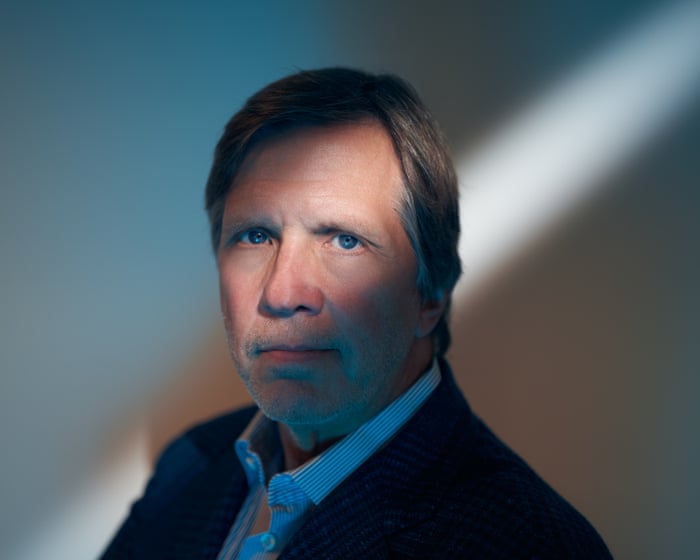
I meet Lanier at Yarnton Manor, a grade II-listed estate in Oxfordshire, built in 1611 by Sir Thomas Spencer, a distant ancestor of Diana, Princess of Wales. He lounges on a teal sofa in one of the wood-paneled rooms, sometimes with a leg dangling over the sofa’s arm, sometimes hugging one of the velvet cushions, often leaning forward to gesture with animated excitement as he shares a biblical reference or a damning piece of trial evidence. It’s a swelteringly hot day in late May, and Lanier, 65, flew in from Houston yesterday, but he looks fresh as a daisy. He only needs four hours of sleep a night. “Sleep’s a bonus, but not one that’s necessary.”
Lanier’s charitable foundation bought Yarnton in 2021 and turned it into a center for religious study. He preaches in a Baptist church every Sunday; he has another study center in Houston. “In the US at least, Christian faith has a bad reputation of being vib…””Ranting only happens among uneducated, unenlightened, bigoted, and narrow-minded people. Those of us who hold onto a faith have a responsibility to bring out the good it can offer—not the self-righteous stuff that creates division,” he says. “I’m a lawyer, and I’ve funded all of this by going after people whose behavior has been destructive.” He draws a rectangle in the air above his head, tracing the corners of the ornate, coved ceiling. “The Johnson & Johnson case paid for this,” he grins. “My wife and I call it the J&J Manor House.”
Normally, I want a shocking verdict that makes Wall Street pull back, gets in-house lawyers fired, and forces companies to change how they operate. Before he took on Google and Meta, Lanier was involved in some of the most high-profile landmark lawsuits in big pharma history. In 2018, he won $4.69 billion (later reduced on appeal to $2.12 billion) for 22 women with ovarian cancer and their families, after Johnson & Johnson failed to warn them about the cancer risk from the talc in their Baby Powder. Natural talc is often mined near carcinogenic asbestos; Lanier argued that Johnson & Johnson had known this for decades without telling the public. (Johnson & Johnson said in 2018: “J&J’s baby powder is safe and does not cause cancer. Studies of tens of thousands of women and thousands of men show that talc does not cause cancer or asbestos-related disease.”) In 2019, he won a last-minute $260 million settlement from opioid manufacturers and distributors, just before what would have been the first federal trial in the history of the opioid epidemic.
Lanier says his “bread and butter” involves common, household-name products that can cause serious harm, which the companies behind them know about but choose to ignore. “Normally, I want a shocking verdict that makes Wall Street pull back, gets in-house lawyers fired, and forces companies to change how they operate,” Lanier recently told a podcast.
When he started his career at a big Houston law firm, he just liked winning. He learned the psychological skills and rhetorical techniques that helped him excel in court: how to make things memorable, how to read a room and shift its energy, “how to choose words that trigger gut reactions, how to use stories to bypass people’s natural defenses.” But after five years of straight wins, he lost—in a case where he knew his client was in the wrong. As he drove home, licking his wounds, he had a revelation. “I thought, what am I doing? Did I almost use my gifts, my talents, my skills to cause an injustice?” At age 29, Lanier started his own firm so he could choose what he considered “righteous” cases. “You can do horrible things with this power, or you can do good.”
Lanier estimates that settlements from drug companies following his landmark opioid litigation now exceed $10 billion. His victory in the Johnson & Johnson case opened the floodgates to tens of thousands of claims from people with cancer and their families—including one currently in the High Court of England and Wales, with more than 7,000 claimants. J&J deny the allegations.
After Kaley’s win against Google and Meta, former Facebook employee turned whistleblower Frances Haugen claimed that Meta could be on the hook for $1 trillion in future damages from tens of thousands of people harmed by using their platforms as children. That might be an overestimate, Lanier says. “But tens of billions, easily. Part of it is also: are they willing to make real change? Reasonable change is something many of us would value highly.”
At the time of the Johnson & Johnson verdict, Lanier noted that suing in an initial test case with only a small group of plaintiffs allowed him to maximize the emotional impact of their stories on the jury.”It’s easier to get justice in small groups,” he said. “In small groups, people have names, but in large groups, they’re just numbers.”
Kaley was the only person bringing the case, and she didn’t want to be a pioneer. Her mother was the one who brought her situation to the attention of lawyers. (In court, Kaley was only referred to as KGM because the harm she suffered happened when she was a child.)
“I was really scared,” Kaley tells me over a video call; she chose to keep her camera off. “I was really anxious that they would delete my accounts as punishment. And that did happen, at least with Snapchat.”
There’s a contrast in how Kaley speaks: testifying in the trial has made her able to answer tough questions about the hardest parts of her life, and that, along with her quiet voice, can make her sound older than 20. But her answers are often short and choppy, and she sometimes struggles to find the right words, like a teenager.
“I was on Instagram from the moment I woke up until I went to bed. I was on my phone during class – I’d get in trouble, I got bad grades.”
Raised by a single mother in Chico, California, along with an older brother and sister, Kaley grew up with learning disabilities in a home without much extra money. By the time she was nine, she had uploaded hundreds of videos to YouTube, and soon had dozens of accounts on both YouTube and Instagram. “I liked that I could post my own stuff and see how many likes I got. I liked being able to see what my friends were doing.” When Kaley wasn’t posting, she was scrolling. She stopped spending time with her family. She stopped leaving her house. Once, she spent more than 16 hours on Instagram in a single day.
“I was on it every day from the moment I woke up until I went to bed. I was on my phone during class – I’d get in trouble, I got bad grades because I wasn’t paying attention.” She was terrified of anything happening to her phone. “If I was walking near a lake or something, I’d be so scared that I’d drop my phone and lose my social media.”
Her mother tried to step in, setting screen time limits or taking Kaley’s phone away completely. “But I would freak out,” Kaley says. “I had withdrawal symptoms. It was just so hard to do anything else.” She would get up in the middle of the night to look for her phone, or “beg and beg and cry” until she got it back. When her mother removed Instagram from Kaley’s phone, Kaley secretly took an old phone from her older sister so she could download the app again without her mother knowing.
Almost as soon as she joined Instagram, Kaley started using filters to make her eyes bigger and her nose shorter. “I’d take a selfie with a filter on, and then see myself – how I actually looked – and I would just feel really ugly,” she says. “It gave me all these new insecurities, and made me see myself in a way that others didn’t actually see me.” At age 10, Kaley started cutting herself. She was later diagnosed with depression, anxiety, and clinical body dysmorphia.
Lanier didn’t want Kaley to sit through the entire trial. She gets distracted easily, he says; plus, it was his job to convince the jury that she had been seriously harmed by Google and Meta’s products. He didn’t want her to leave thinking she was permanently damaged.
During his opening statement, Lanier stacked three wooden ABC toy blocks on top of each other. “I thought, I’ll tell the jury this case is as simple as ABC – Addicting the Brains of Children,” he explains. “There’s a principle in psychology and learning called cognitive ease: we automatically believe things that are easier to understand. There’s a principle in rhetoric: the power of threes. Threes just seem to stick.”Deep within our souls and minds. ABC, one, two, three.” (During his opening statement at the Johnson & Johnson trial, Lanier used Scrabble tiles to make the point clear to the jury: “Asbestos, Breathed or internalised, causes Cancer.”)
Then Meta’s lawyer, Paul Schmidt, gave his opening statement, pushing back. “Was it Instagram or other causes?” he asked. He told the jury that the root of Kaley’s mental health issues was her chaotic upbringing—that her home life and learning disabilities meant these problems would have been part of her life regardless. Lanier dismisses this idea. “Just because someone has a headache doesn’t give you the right to hit them over the head with a rock and say, ‘They already had a headache! Don’t blame me!'”
Lanier wasn’t allowed to respond to the defendants’ opening statement in court. But as he walked out of the courthouse that day, he spoke to the crowd of media waiting there. “The next morning we get to court, and the bad guys want to have a discussion with the judge off the record.” In the judge’s chambers, he says, Meta’s team complained that Lanier’s rebuttal to their opening statement was being widely reported in the press, and they asked the judge to stop him from talking to journalists.
Once again, Lanier used the power of three. “I said, ‘First of all, I didn’t do it in court—I was on the sidewalk outside. Second of all, you’ve told the jury not to read any of the media. Third of all, the defendants in this case are social media. They’re putting out press releases! They’re posting on Instagram!'” (During the trial, Meta had worked hard to spread the message that the company took young people’s welfare seriously, both on their own platforms and in their broader public communications.) “It makes my little comment on the courthouse sidewalk look pretty small.” Meta’s lawyers eventually backed down. “The judge said, ‘You do realize there are four billboards around the courthouse with your ads on them, talking about how you care for children in everything you do—and you’re complaining about Mr. Lanier?'”
[Image: Lanier photographed in the library of Yarnton Manor, Oxfordshire. Photograph: Gareth Iwan Jones/The Guardian]
“It’s very naive to think parents can stand up against trillion-dollar companies and the most aggressive technology in human history.” The bereaved families outside the courthouse each day—some holding signs that read “We are KGM”—wanted the bigger picture of Kaley’s struggles to be recognized. But the defendants had argued that Lanier shouldn’t be allowed to mention other young people who had been harmed by social media. “They wanted to make her the exception,” he says. “The sad part is, we’ve got a whole generation of Kaleys. Go to a restaurant and look at how many people her age are sitting there like this…” He takes his phone from the coffee table and hunches over it. “It’s such a waste of human potential. All to make money flow to a handful of rich white guys who want to run the world.”
Parents buy the phones those kids are hunched over, I say. Shouldn’t they be able to set and enforce ground rules? Lanier smiles. “It’s very naive to think that we have such amazing parents in this world that they can stand up against trillion-dollar companies—with their algorithms and their deceptive tools—and be well enough informed to fight the most aggressive technology in human history. Kids get on YouTube at school. Kids go to their friends’ houses. Kids have lunch with other kids. Does parenting make a difference? Of course it does. Can parents beat the machine? No way.”
[Skip past newsletter promotion | Free newsletter | Weekly | Sign up to Inside S]The only way to get a behind-the-scenes look at the Saturday magazine. Sign up to receive exclusive insights from our top writers, along with all the must-read articles and columns, delivered to your inbox every weekend.
Preview the latest
Enter your email
Sign up
After the newsletter promotion
Lanier also wasn’t allowed to discuss the content hosted on social media. In the eyes of the law, YouTube and Instagram aren’t publishers, so they aren’t responsible for the content they host. “But that content is part of what they use to get you hooked,” he says. Imagine walking into a bookstore and casually picking up a book from a display table, he explains, only to see every book on every table change into something statistically proven to appeal to people interested in that kind of book—including some that might shock, anger, or excite you. Touch another title, and all the books change again, as the bookstore narrows down your interests as effectively as possible. Unlike bookstores, social media algorithms want you to keep browsing forever.
“The algorithms are amoral—they’re machines. They’re relentless. You’ll never find them hesitating, running low on energy, or getting distracted. Their entire purpose is to keep your attention on their platform. They’re scary.”
Meta and Google were condemned by their own documents: the millions of pages of evidence the judge required them to hand over, plus a few others leaked by whistleblowers. “Through the hard work of many young lawyers reading, and the hard work of AI, we were able to find the gold,” Lanier says. It was an embarrassment of riches.
Internal documents showed that the companies had deliberately sought out “casino science” to turn their products into what Lanier calls “addiction machines.” Instagram, YouTube, Snapchat, and TikTok all use intermittent variable rewards, giving users small, unpredictable dopamine hits—just like slot machines with their small payouts that keep you hoping for a big jackpot that may never come, endlessly scrolling on your phone instead of pulling a lever. A 2012 Google memo about YouTube said its “goal is not viewership; it’s viewer addiction.” Another Google document referred to its products as “slot machines.” “These are attention casinos,” it read. “The house always wins.”
There were documents from Google and Meta revealing the “dark patterns” they use to manipulate users’ behavior. Take the features Kaley’s mother wanted to use to protect her daughter: they weren’t easy to find and were turned off by default. “You have to figure out there’s a protective feature, go find it, and turn it on,” says Lanier. “The toggle itself is subject to dark patterns: people will toggle differently if there’s a blue dot when you toggle, versus if it doesn’t change color.”
This makes me think of my own efforts to control my Instagram feed by toggling the button that asks it not to show me suggested content. I have to go into my settings and toggle it again every 30 days, and since it doesn’t change color, I’m never really sure it worked. “It’s insidious,” Lanier says. “And let’s say, as a parent, you do this for your kid. Did you set a calendar reminder to go back to your kid’s phone 30 days later when it defaults back?” Even if you were organized enough to do that, he adds, the platforms change their settings so often that it’s impossible to keep up.
There was a Meta document from 2018 that read: “If we want to win big with teens, we must bring them in as tweens”; a YouTube slideshow featuring children as young as four and suggesting that parents could use the platform as a “digital babysitter”; and a 2019 research report commissioned by Meta that found teens had “an addicts’ narrative about their Instagram use,” and that “thThey wish they could spend less time worrying about it.
Then there was the testimony given in court. During a memorable exchange with Lanier, Instagram boss Adam Mosseri said that spending 16 hours a day on the platform might be “problematic,” but he wouldn’t call it an addiction. “You can call it problematic use. You can call it tweedledee,” Lanier says. “The issue wasn’t the magic word ‘addiction’ – it was the harm.”
Social media bans are becoming popular. But it’s too late for my son and me | Dave Schilling
Read more
But the prosecution had to prove that Kaley’s social media use caused the harm to her mental health, and that was difficult. “Social media companies have filled the research with stuff that says their product is beneficial. For decades, big tobacco said, ‘Tobacco doesn’t really cause lung cancer – look at all these studies!’ And what you didn’t know is that big tobacco had ghostwritten or funded them,” Lanier says. A psychiatrist and a therapist both testified that, in Kaley’s case, her body dysmorphia was caused by her social media use. “The other side argued it was the result of bad parenting.” The sad part, Lanier says, is that Meta’s own documents show they know that when teenage girls from low-income backgrounds with existing mental health issues spend a lot of time on social media, their mental health gets worse.
When Zuckerberg took the stand – the first time he had testified in front of a jury – Lanier told him that he “saw dollar signs written on the backs” of vulnerable kids. He showed Zuckerberg an internal document, which revealed that in 2015, a third of all 10- to 12-year-olds in the US used Instagram, even though kids under 13 weren’t supposed to have accounts, and an email from an executive that said, “Mark has decided the top priority for the company is teens.” Zuckerberg said this was no longer how the company operated, and that he had worked for years to address “problematic use” of his platforms “because it’s the right thing to do.”
At the end of questioning, six prosecution lawyers unrolled a 50-foot-wide collage of some of the hundreds of selfies Kaley had posted on Instagram. Urging Zuckerberg to look at the heavily filtered images, Lanier asked him if Meta had ever investigated Kaley’s account for problematic use. Zuckerberg did not answer.
Lanier had planned to question YouTube CEO Neal Mohan on the stand, but ran out of time – the judge had given the prosecution only 43 hours to try the case. “I decided I didn’t need him,” Lanier says. But Google is just as guilty as Meta in Kaley’s case, he adds. “YouTube was a gateway drug.”
Time pressure was one of the reasons they decided to settle with Snapchat and TikTok before the case went to trial. “I could have gotten a good verdict against them,” Lanier says, a little wistfully. He planned to compare the safety features that exist in the Chinese version of TikTok but not in its international platform: a limit on nighttime use, no infinite scrolling, mandatory time-outs after users have been on the app for a certain amount of time, and the use of AI to determine if users are children, “based on factors including what you’re looking at, the size of your finger when you’re scrolling, and how fast you scroll. There are tons of ways they are required to be safer over there.”
Google claimed that the entire case misunderstood YouTube – that it is a streaming platform, not a social media site. “You can message, like or dislike, comment, and follow. It’s not just media – it’s social media,” Lanier declares. But just in case that argument wasn’t enough, the prosecution team asked Google’s own AI what it thought. Gemini’s response was clear – YouTube is social media.When Kaley heard the verdict, her main feeling was relief—for herself and for everyone who can now follow her lead. “I knew it meant other cases could go to court, so I felt happy for the other families,” she said. The thousands of cases that were waiting to be filed against social media companies if she won have now been set in motion. She hasn’t received any damages yet; Google and Meta are appealing, and Lanier says the process will take seven years. “However long it takes is however long it takes,” Kaley says. “I’m okay with that.” Even though she still struggles with her self-image, her victory has helped her see the difference she can make in the world and how much people value her.
If the case ends up at the Supreme Court, Lanier doesn’t think the politically appointed judges will see it as a partisan issue. “It crosses party lines. Republicans in the US are usually friendly to big business, but some of the strongest supporters of this issue are Republicans. It matters to anyone who’s a parent.”
In the meantime, Lanier is helping other legal teams that are bringing cases against social media companies, while his firm is getting new inquiries from people who say they’ve been harmed by compulsive social media use. “If someone has a legitimate case that I can take on, I’ll represent them. It has to be a child who was addicted. We need counseling or psychiatric records. If it wasn’t serious enough to see a professional, then it’s not serious enough to bring a case. Within that framework, I’ll take those cases.”
Why does the focus have to be on kids? “Children’s brains are still developing, and the last part to develop is the ability to control impulses and see future consequences,” Lanier explains. “With adults, it’s hard to win. The jury will think, ‘You’re an adult, you should be able to weigh the consequences.’ The problem is, once you’re addicted, those addictive pathways can easily transfer to other addictions. A child addicted to social media can easily become addicted to pornography, sex, gambling, or pills. Your body is just craving the dopamine.”
Of course, Lanier won’t be the lead lawyer on the thousands of new cases being brought against Google, Meta, Snapchat, TikTok, and other social media companies. He’s clearly very good at what he does, with the skills to win against giants in big pharma and big tech. I wonder if his groundbreaking victory for Kaley can be repeated in other courtrooms by other lawyers.
“That’s a fair question,” Lanier replies. “There’s a compliment in there—so thank you, that’s kind. Does the skill of the lawyer make a difference in these cases? Yes, it does. Am I the only lawyer who can win these? Absolutely not. I’m not necessary—but I’m useful.”
In June, Keir Starmer announced a social media ban for under-16s, set to take effect in early 2027, after nine out of ten respondents to a government survey supported it. Lanier thinks Starmer’s plans are “brilliant. It eats away at the fabric of our society if children have access to materials they’re not mature enough to handle.”
“I think it’s the first step in the right direction,” Kaley says. “But kids are sneaky, and they might still find a way to get back on it.”
Some who oppose the ban—including campaigner Ian Russell, whose 14-year-old daughter Molly took her own life after being flooded with suicide and self-harm content—say the only way to protect children is to force social media companies to change their business models.They rely on addictive features and algorithm-driven content. Litigation may be the only way to force change, Kaley says. “They’re only going to change if someone makes them.”
Lanier’s firm is now working on a claim against OpenAI, brought by grieving parents who say ChatGPT played a role in their son’s suicide. He also has a forthcoming lawsuit against Roblox, the most popular online game platform for 8- to 14-year-olds in the UK. “It’s a breeding ground for child exploitation, a forum that allows child predators to thrive and connect,” he says. The platform’s addictive features will also be part of that case.
Kaley tells me she has no idea what the future holds for her. She’s still on social media, on the platforms that haven’t banned her in retaliation for taking legal action. She still posts selfies and videos; she thinks she always will, even though she hopes one day she won’t have to. “It’s very difficult.”
Lanier is considering writing a book about Kaley’s case. A documentary might also be in the works. He has already played himself in a movie—the 2011 Chris Evans film Puncture (released as Injustice in the UK). It tells the true story of Michael Weiss, a Houston-based lawyer who led a class-action lawsuit against hospital syringe distributors in the US. After Weiss died from a drug overdose in 1999, Lanier took over the case and won a landmark settlement in 2004.
Lanier is the first to admit that, at least in the past, he loved attention. “When I was a younger man, probably the quickest way to get hurt was to get between me and a camera,” he says, with a twinkle in his eye. Maybe that’s why, despite everything he’s learned, Lanier is still on Instagram.
“I do a video thought for the day, five days a week, based on some biblical idea. They get posted there for distribution and availability,” he says when I bring it up. “I’m not someone who thinks social media is inherently evil. It’s like any tool: it can be used for good or for evil.”
His 15-year-old granddaughter watches his videos, he tells me. So how does Lanier see the future for her, and his 11 other grandchildren? Will the digital world be safer for them after Kaley’s victory?
“The optimist in me says yes. The realist in me says not so fast.” He leans forward. “Mark Zuckerberg has immense power, and power is as addictive as any drug. Do we really think he’s going to willingly give up some of that power? The realist in me says this is going to be a war that will last my lifetime—and the lifetimes of others.”
In the UK, the youth suicide charity Papyrus can be reached at 0800 068 4141 or email pat@papyrus-uk.org. In the UK and Ireland, Samaritans can be contacted on freephone 116 123. In the US, the 988 Suicide & Crisis Lifeline is available by calling 988 or chatting online for support. In Australia, the crisis support service Lifeline is at 13 11 14. Other international helplines can be found at befrienders.org. In the UK, the charity Mind is available at 0300 123 3393 and Childline at 0800 1111. In the US, call or text Mental Health America at 988 or chat at 988lifeline.org. In Australia, support is available at Beyond Blue on 1300 22 4636, Lifeline on 13 11 14, and MensLine on 1300 789 978.
Frequently Asked Questions
Here is a list of FAQs based on the quote This was a just cause A holy war the lawyer who took on Meta and Google and won
BeginnerLevel Questions
Q Who said This was a just cause A holy war
A A lawyer who successfully sued Meta and Google for antitrust violations
Q Why did the lawyer call it a holy war
A Because they felt the fight was not just about money but about protecting fairness competition and the rights of regular people against massive tech companies
Q What did Meta and Google do wrong
A They were accused of using their market power to crush smaller competitors control user data unfairly and prevent other companies from competing which is illegal under antitrust law
Q Did the lawyer actually win against Meta and Google
A Yes While the details of settlements vary the lawyer secured a significant legal victory forcing changes to how these companies operate and often resulting in financial penalties
Q Is this a criminal case
A No This is a civil antitrust case Its about business practices that harm competition not about breaking criminal laws like theft or fraud
IntermediateLevel Questions
Q What specific just cause was the lawyer fighting for
A The cause was stopping monopolistic behaviorlike Google paying billions to be the default search engine or Meta buying up competitors to eliminate threats The cause was restoring a fair open marketplace
Q How did the lawyer win against such powerful companies
A By proving that the companies actions hurt consumers and violated federal antitrust laws They used internal company emails and data as evidence
Q What were the main legal arguments used
A The arguments focused on
Exclusionary conduct Blocking rivals from competing
Market power Controlling a huge share of the market
Consumer harm Showing that innovation suffered and prices went up
Q What changes happened because of this case
A Depending on the specific ruling changes included
Google being ordered to stop paying for default search status
Meta being forced to