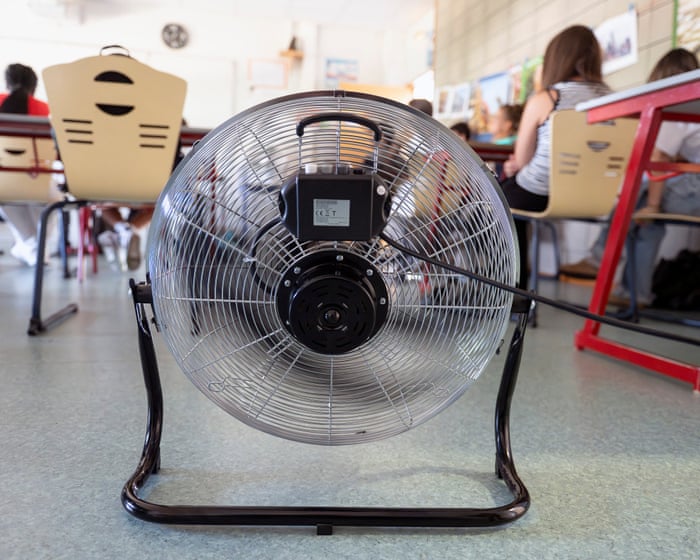
The extreme heat that has hit the UK twice in recent weeks has left teachers struggling to cope, with temperatures in some classrooms climbing above 40°C. Both students and staff have been suffering from heatstroke, nausea, and headaches.
Teachers say they have been desperately trying to keep children safe. Some have covered younger students in wet paper towels while they lie on the floor, and older students have been given trays of water under their desks to cool their feet. Staff say that learning on the hottest days is nearly impossible, as students’ behavior and attention quickly get worse.
Some teachers and students have fainted, and others say they have had to buy fans and window shades with their own money to try to stay safe. One primary school teacher said: “Everyone was lying or sitting on the floor with their water bottles, sweating, moaning, and feeling tired, complaining of headaches and nausea. The adults could barely cope, and most of the children were calling for their parents. There was no learning—just surviving as best we could.”
Many school buildings simply can’t handle the heat. They have little or no shade and lots of glass. The buildings are often old and poorly insulated, with artificial grass or concrete in playgrounds that makes the heat worse. Many schools also don’t have air conditioning.
Some staff have reported that students and teachers sit on the floor in any shaded classroom they can find, with the lights off. In May, the government’s climate advisers said air conditioning should be installed in all schools within 25 years, and that the country was “built for a climate that no longer exists.”
“No one seems to know how to cool the buildings,” one teacher said. “We need changes to the building itself and more trees planted instead of the hot, open playground. I’ve worked for three years in much hotter countries, but they had four ceiling fans in each room and rules about windows, blinds, and doors that made the environment livable.”
This year, western Europe experienced its hottest June on record as the fossil fuel-driven climate crisis accelerates. The UK entered its third heatwave of the year this week, with temperatures peaking at 35°C. The current high temperatures are expected to last for a sweltering 10 days. The oppressive heat on land has been accompanied by high global ocean temperatures, which experts warn could cause “mass-mortality events” for some species.
The extreme weather led to more than 1,000 schools in England and Wales either closing or partially closing during the peak of the June heatwave, according to figures from PA Media. Department for Education (DfE) statistics show that one in five school sessions in England were missed—the highest daily absence rate so far during the 2025-26 academic year.
Experts say closing so many schools puts pressure on the entire community and the economy. The Round Our Way group estimated that the economic cost of the June heatwave was between £100 million and £200 million. They said its impact spread beyond schools and teachers to parents, who may have had to take time off work, and the wider community.
Roger Harding, the group’s co-director, said it shouldn’t be left to individual schools and teachers to deal with the realities of the climate crisis. “We need to see a plan from the government to protect people, including children in school, when extreme weather hits,” he said.A newsletter promotion:
“This needs to go hand-in-hand with measures to cut the pollution causing this climate change in the first place, to make sure this extreme weather doesn’t keep getting worse.”
A survey of 1,000 UK parents, carried out on behalf of Round Our Way, found that during June’s heatwave, more than half had at least one child miss a day of school. 40% said their children came home overheated and exhausted, 46% said their kids couldn’t play outside because it was too hot, and nearly two-thirds said summers in the UK were “starting to feel genuinely unsafe for children.”
Teachers were also asked about the impact of the June heatwave in a survey by Round Our Way, in partnership with the UK’s largest education union, the National Education Union (NEU).
Jenny Cooper, a teacher and NEU safety representative for London, said recent heatwaves had taken a serious toll on the capital’s schools.
“I heard about colleagues fainting, and others shared photos of thermometers in their classrooms showing temperatures way over 10 degrees above safe working levels,” she said.
“Our schools should be places where we can learn and teach safely. A place for children whose homes aren’t safe. Extreme heat and other climate impacts are putting that at risk.”
Lorna Powell, an NHS urgent care doctor in east London and co-director of the climate group Mothers Rise Up, said as both a parent and a medic, the recent “onslaughts of heat” had been frightening as she struggled to keep her two children and her patients safe.
She said the closure of so many schools was changing people’s mindsets. “Most people I know don’t really think or talk about climate change. But when our primary school closed in June, it became a regular topic of conversation. One mother said to me: ‘We just didn’t have summers like this when we were young, did we?’”
Powell said people were also starting to connect the fossil fuel industry, its funding of political parties, and extreme weather events.
“Once people start to understand that huge coal, oil, and gas interests support the political parties calling for more drilling, it’s a lightbulb moment.
“It all makes sense, and they can see through the false information suggesting that more expensive oil and gas will lower our bills and provide energy security, when in reality it’s making the world much more dangerous and expensive for all of us.”
A spokesperson for the Department for Education (DfE) said schools were responsible for deciding whether it was safe to stay open, but they should do so “wherever possible.”
The spokesperson added: “Schools have well-established measures to manage hot weather, including making sure children stay hydrated, adapting uniforms where appropriate, and avoiding strenuous activity during the hottest parts of the day.”
Frequently Asked Questions
Here is a list of FAQs based on the headline Children were calling for their mummies UK students struggle in classrooms over 40C
General Beginner Questions
Q What does children calling for their mummies mean in this context
A Its a very direct way of saying that the heat was so intense and uncomfortable that young children were crying out in distress for their parents It highlights how extreme the situation was for them
Q Is 40C a normal temperature in UK classrooms
A No not at all The UK has a temperate climate and classrooms are typically much cooler 40C is an extreme heatwave temperature and most UK schools arent designed for it
Q Why are UK schools struggling with this heat
A Most UK school buildings were built to retain heat in cold weather not to cool down in a heatwave They often lack air conditioning have large windows that let heat in and poor ventilation
Q Is it dangerous for children to be in a 40C classroom
A Yes it can be It significantly increases the risk of heat exhaustion dehydration fainting and heatstroke It also makes it very hard for children to concentrate or learn
Problems Impact Questions
Q What specific problems did the children face in these hot classrooms
A Common problems included severe headaches dizziness nausea feeling faint struggling to breathe and being unable to focus Younger children often became very distressed and tearful
Q How does 40C heat affect a childs ability to learn
A Extreme heat makes it physically and mentally exhausting The brain works slower concentration plummets and children become irritable and lethargic Learning effectively becomes nearly impossible
Q Why are children more vulnerable to heat than adults
A Childrens bodies heat up faster than adults because they have a larger surface area relative to their body weight and they sweat less efficiently making it harder for them to cool down
Q What happened when schools tried to keep children inside
A Keeping children inside in a hot stuffy classroom often made the situation worse The air becomes stagnant and hotter leading to more cases of illness and distress
Practical Tips Solutions