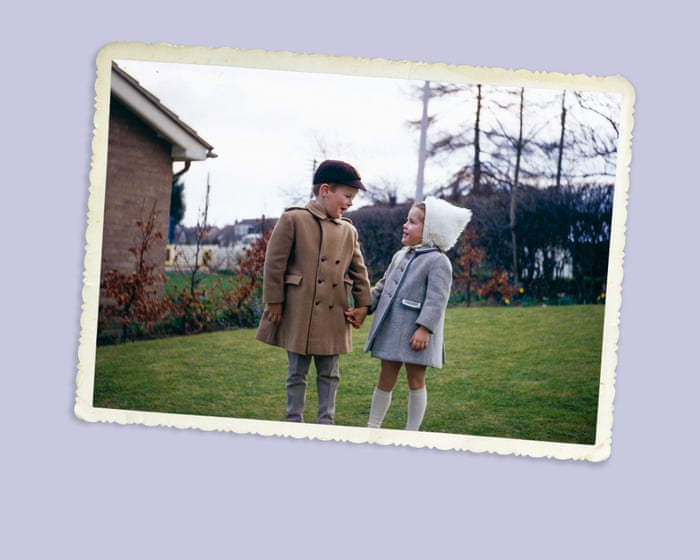
Looking at faded photographs of English life in the 60s and 70s—grandmothers in cardigans eating picnics beside Morris Minors, pale men sunbathing in shoes and socks on striped deckchairs, Raleigh Choppers and caged budgies and faux leather pouffes—I feel a wave of something that can’t really be called nostalgia. After all, the last thing I’d want is to go back to that time and those places where I was often deeply unhappy and would have been desperate to escape if I could. So why this longing, this echo of remembered comfort?
Is it because, as children, we live inside a bubble of intense attention that makes everything within it fiercely memorable? The way you could lie on a lawn and peer down into the jungle of grass, watching earwigs and woodlice lumbering between the pale green stems like brontosauruses moving through ferns and gingkos in the Late Jurassic. Or how a rumpled bedspread could become a mountain range beneath the wings of a badly painted Airfix Spitfire. Or maybe it’s that objects, in their constancy, offer consolation in a world where adults are unpredictable, distant, and unloving?
For the first 15 years of my life, I lived with my parents and my younger sister Fiona at 288a Main Road, New Duston, on the outskirts of Northampton. Dad didn’t design it, but it was an architect’s house all the same—a touch of Scandinavian modernism in the external wood panelling, the semi-open-plan ground floor, and the boxy glass lobby. Hinged teak double doors separated the dining room from a living room dominated by an uncarpeted staircase with open risers. The chimney breast was a broad, floor-to-ceiling stack of chunky sandstone blocks straight out of The Flintstones.
Under the stairs stood a Philips radiogram. If I listen carefully, I can still hear King Size! by André Previn’s jazz trio, Paul Simon, and Play Bach No 2 by the Jacques Loussier Trio. What I can’t hear, beyond the occasional outburst—“Jesus wept!”, “Wait till your father gets home”—are conversations. It wasn’t so much that no one spoke, but that no one really talked. I never heard an adult tell or ask another adult something that truly mattered. Maybe I wasn’t listening hard enough, but I don’t think anything was being said that was worth hearing—certainly nothing as interesting as the story of the Apollo space programme or the lyrics of “Me and Julio Down by the Schoolyard.” The most important things happened inside my head, and those weren’t things you shared with others. Did the same things go on in other people’s heads? How could you ever know?
I have a vivid childhood memory of being woken by screaming on the other side of the wall. My sister was having a nightmare. I got out of bed and went into her room. Mum was standing there, unsure what to do. Fiona had stopped screaming by then. She opened her eyes, sat up, and shuffled back against the padded plastic headboard. I thought she was awake. We heard footsteps outside. Mum said, “That’s Daddy coming to see how you are.” My sister screamed at the top of her voice, “No! He’s got the knife!” Fiona would have this dream—of Dad chasing her with a knife—for the next 45 years, and it only stopped when his Alzheimer’s became unmanageable and he moved into a care home.
Like Fiona, I had recurring nightmares as a child. In one, I was standing at a crossroads on a ruined, post-apocalyptic plain in fading light while giant insects walked relentlessly toward me from all four directions. In another, I had been flushed down a toilet wearing an antique diving suit—waxed canvas, lead boots, a spherical brass helmet with hinged circular portholes—and was drowning after getting jammed in a narrow bend of the pipes.A photo of Mum on a beach in Devon or Cornwall, taken by Dad. They were either newly married or about to be. She looks stunning: fuchsia lipstick, freckles, simple white earrings like peppermint Mentos that match a plain white shoulderless dress or swimsuit. She radiates something I never saw in real life, or in any later photos—even the ones where she’s smiling and seems happy. Part of it is those freckles, which she grew to hate, covering them with foundation and avoiding the sun for fear it would trigger a migraine. But the real difference is inside. The woman on the beach seems confident in her own beauty and at ease in the world.
Maybe the picture is deceptive, but I think that soon after it was taken, some kind of light went out in her. She had a bawdy side—she enjoyed saucy gossip and a Benny Hill double entendre. Sometimes she’d wear a fun wig to dinner dances and could relax in the right company with a Cinzano Rosso in one hand and a Consulate cigarette in the other. But those felt like distractions. Was it postnatal depression? Was it some deep sadness that romance had briefly kept at bay? Was there, from early on, an uncrossable gap between them?
My sister once asked Mum, “Why does Dad hate me so much?”
“You have to remember,” Mum said, “that he only wanted one child.”
Shortly after my first adult novel, The Curious Incident of the Dog in the Night-Time, was published, I mentioned in an interview that I’d been an anxious and depressed child. It seemed an ordinary thing to say—I knew many people who felt the same. I forgot about it until I called my parents a couple of weeks later and, surprisingly, Dad answered. He told me Mum was “crying herself to sleep and waking up crying in the morning” because of something I’d said in the interview. I asked for details and told him to put Mum on the phone so we could talk. He disappeared for a moment, then said, “I’m afraid she’s weeping too much to come to the phone right now.”
Mum voted Tory all her life. She was an ardent Brexiter before the word existed, detested the idea of being connected to France by the Channel Tunnel, and swore she’d never use it. She believed working women caused unemployment and was happy to say so, even to a female friend and neighbour who had a full-time job. People with strong Northampton accents, anyone overweight, or people with tattoos would draw either mocking laughter or a theatrical shudder of disgust. She couldn’t stand men with beards, or the Welsh. She had a golliwog fridge magnet and referred to gay men as “lovely boys.” When an old friend of theirs developed Alzheimer’s, she complained that his sister wasn’t helping because “she’s too busy having chemotherapy.”
She was frightened—of change and difference, of pain and discomfort, of decay and disease. One reason her health was so poor in her final years was that she refused to follow medical advice. She never did the exercises her physios recommended. She kept smoking and drinking. I was with her during one of her many hospital admissions after an ambulance ride. The young doctor asked if she took any exercise. She thought for a moment before saying, “It was a long walk to school.” She liked cleanliness, tidiness, and predictability. Until she had to move into assisted living, she kept a garden as neat as the inside of the house. When we had a cat, she would put folded cloths in its favourite spots to protect the furniture and sometimes sneak up from behind to spray its back end with Marks & Spencer vaginal deodorant—something the cat did not enjoy. She didn’t read books. She didn’t listen to music.
Mum had no interestIn my writing, my mother rarely spoke about it, with just a couple of minor exceptions, and she certainly never asked questions. The only book of mine she ever read was The Curious Incident of the Dog in the Night-Time, which she read on holiday with my dad shortly after it was published. Her complete review was: “I thought there was too much swearing in it. Then I had to drive around Menorca in a car with your father, and it seemed quite realistic.”
For years before Curious Incident and for quite a while after, she made it clear she would have preferred me to have a “proper job.” Once, I pressed her to be specific about what kind of job would make her happy. She thought for a while, trying hard to reconcile our very different worldviews, then suggested I could perhaps “design tools to help disabled people.”
My dad was proud of being an academic failure—he once earned just one point on an English paper because he at least managed to write his name. The house at 18 Cranbrook Road, where he grew up, was not a bookish home. Aside from a Bible, a prayer book, and eight volumes of Newnes’ Pictorial Knowledge (likely bought in instalments from a door-to-door salesman), there was only the Sun and the Radio Times. However, he was a prodigious sportsman. He learned to swim by watching Johnny Weissmuller in the Tarzan films and went on to play water polo, sprint, hurdle, swim, box, and play rugby. He was also a fine draughtsman. After national service, he set up his own architectural partnership, designing buildings for the Open University, Carlsberg, and Ikea. He weathered the building slump of the 70s by designing abattoirs, which meant we ate a lot of free pork pies as children. I suspect he took my later vegetarianism as something of a personal insult.
He was a big man with a short fuse. My sister once asked my mum, “Why does Dad hate me so much?” Mum replied, “You have to remember that he only wanted one child.”
Later, Mum would tell Donna, one of her favourite care assistants, during their daily visits filled with gossip, Silk Cut cigarettes, and honey-roasted cashews from Waitrose, that she, too, had only wanted one child. In truth, I don’t think she wanted children at all. But she had a lifelong fear of being different or standing out. In their social circles in Northampton in the early 60s, a woman unable to have children would have been pitied, but a woman who chose not to have children would have been seen as eccentric at best, or a pariah at worst.
I think we were simply too much hard work for her. She once admitted to my sister, Fiona, “I don’t know how you cope with three children. I couldn’t cope with two.” From the ages of six (me) and five (my sister), I walked my sister the mile to school every day. Dad made us breakfast, while Mum stayed in bed until we left the house. Mum also had a weekly cleaner, something unheard of among our friends. On Sundays, Dad would take us both to church and then to his parents’ house, leaving Mum at home alone. On Saturdays and during school holidays, he often took Fiona to the golf club or rugby club while he trained or played, and she was looked after by Snowy the groundsman, so Mum only had one child at home. But that didn’t mean she was actively parenting. I would usually be in the garden, alone in my room, or at a friend’s house. Often, she suffered from cluster headaches, took Solpadeine, and spent long periods lying down in a darkened bedroom.
I think Mum and Dad embraced the idea of me as a freakishly clever child because it lessened their need to understand me.
Before Dad died and before Mum had the stroke that would put her in a nursing home, I would regularly drive to Northampton to visit them. Dad spent most of his time sitting in the armchair in his room. On one occasion, the only other male resident of the memory unit picked…He picked up a sewing box from a sideboard and, for reasons known only to himself, walked into Dad’s room and tried to hit him over the head with it. Dad knocked him down with a single punch, telling his favorite care assistant Judith afterwards, “I’ve still got it.” It was Judith who told me that the digital picture frame I’d brought, far from entertaining him or helping his memory, was confusing him. He found it hard to tell the difference between people who had actually come into his room and people whose pictures appeared on the little screen. In particular, he kept thinking that a younger version of Mum had been visiting. “That woman’s been in again, coming on to me,” he said to Judith once. “She doesn’t stand a fucking chance.”
Visiting Mum was harder work. She would often greet me by pointing out that I was losing more hair, and pay me backhanded compliments about being unexpectedly smart if I was wearing a collared shirt. She asked what my children were up to, and that would occupy us for a few minutes. Mostly we talked about her life. It was not a life she was enjoying. We avoided news and politics where possible. I was glad when there was some financial, practical, or bureaucratic problem I could help her sort out. I think she found me boring most of the time. Sometimes she would say, “Don’t look so glum,” or, “Entertain me.” She cried every time I left and clung to me when I gave her a brief hug. I was embarrassed by how uncomfortable this made me and how hard it was to respond in kind. I’m sure, deep down, it was because I had no memory of being hugged by her, no memory of Mum saying she loved us, no memory of her showing us real affection as children, and because there was a good deal of self-pity in her sadness. But this is just post-rationalization. What I felt at the time was disgust, of a kind I’ve never felt about anyone else.
To say that I was the favorite would imply actual liking. I certainly got preferential treatment on account of the double blessing of being both the older child and a boy. Dad allowed Mum to hit Fiona, for example, but not me. She did so regularly, once pulling down Fiona’s pants at a bus stop to smack her when she was seven years old.
I think Mum and Dad embraced the idea of me as a freakishly clever child because it lessened their need to understand me. I was off in my own world of encyclopedias and star charts, a world whose language was alien to them and in which I would know best how to look after myself. In contrast, they treated Fiona as a burden, and because she wasn’t as academic as me, she was unable, in those early years, to earn the affirmation at school that she was missing at home.
When, many years later, Fiona was taken into Kingston Hospital with meningitis and was awaiting the results of a lumbar puncture to find out whether it was viral or bacterial (the latter can be rapidly fatal), she rang home, but Mum said they couldn’t visit because “Your father has golf in the morning.” They kept finding reasons not to visit for the entire week she was in the hospital.
Neither Mum nor Dad went to her degree show when Fiona got a distinction in her MA in production design for film and television, and when she later got a job at the BBC, Mum’s reaction to the news was, “You’ve already got a job looking after three children.”
The last words Mum spoke to Fiona in person were, “I’ve never believed a word you’ve said.”
We assume it’s hard when a loved and loving parent dies, but it can be just as hard when you lose a parent whom you don’t love and who never loved you. When Mum and Dad died, it was a relief for me. For my sister, it was the moment when she knew for certain that she would never hear them say sorry.
What does it mean, the injunction not to speak ill of the dead? Which dead? For how long after their passing are we meant to hold our tongues?What do people mean by “speaking ill”? And does it refer to telling lies or telling the truth? My mother was deeply concerned with how others perceived her. When someone in our village was knighted, I addressed my next letter home to “Lord and Lady Haddon,” not realizing how upset she would be—worried that people might think we were mocking our newly elevated neighbors. Blend in, don’t make a fuss, don’t complain or rebel or stand out unnecessarily. Propriety was everything. They bought a large antique 18th-century oil painting of an anonymous local gentleman in a heavy gold frame. To some, Mum joked it was one of her ancestors. To others, she said nothing and let them assume exactly that. Like Dad, she had risen a long way and found herself in a place that never quite felt like solid ground. She assumed others would judge her just as she judged them—by the way she spoke, the way she dressed, the cream carpets, the framed maps of the county.
It never seemed to occur to her that people might look at her and ask, “Was she kind? Did she care about others? Did she love her children?”
Frequently Asked Questions
FAQs To say I was the favorite would imply I was liked Mark Haddon on a Loveless Childhood
Q1 What is this quote from and who said it
A This is a line from the novel The Porpoise by Mark Haddon Its a reflection by a character named Darius looking back on his emotionally barren childhood
Q2 What does this quote mean in simple terms
A It means that the idea of being a favorite requires that someone actually cares about you The speaker is saying their childhood was so devoid of genuine affection that even the concept of having a favorite childwhich usually involves some degree of fondnessdoesnt apply They werent just less liked they feel they werent liked at all
Q3 Why is this quote so powerful or memorable
A It captures a profound and painful emotional truth with stark logical clarity Its not a dramatic outburst but a quiet devastating observation that defines a childhood by the complete absence of love not just by its conflicts
Q4 Is this quote autobiographical Is Mark Haddon writing about his own childhood
A No not directly Mark Haddon is a novelist and this line is spoken by a fictional character However like all good writers he taps into universal human emotions allowing readers who have experienced emotional neglect to see their own feelings reflected
Q5 What is the context of this quote in The Porpoise
A The character Darius grows up with a wealthy cruel and narcissistic father The quote comes from his realization that his father saw his children merely as possessions or extensions of himself not as individuals worthy of love There was no favorite because there was no authentic affection to begin with
Q6 Whats the difference between a difficult childhood and a loveless one
A A difficult childhood might involve hardship arguments or strictness but it can still have underlying love or concern A loveless childhood as described here implies a fundamental absence of emotional warmth attachment or care from a parenta feeling of being invisible or merely an object