On a typical school day, 17-year-old Mohammed wakes up at 6am to help his single mother, a security guard, care for his younger siblings. He then takes two crowded buses and a local train to his high school in Sevran, a low-income suburb northeast of Paris. “There aren’t enough chairs or desks, so some students have to stand,” Mohammed said. “Classes are so packed you can’t interact with the teacher. During this year’s heatwaves, it felt like 40 degrees in overcrowded classrooms with no shade or curtains. It was so hot my brain couldn’t function.”
The 17-year-old, in his final year of high school, wants to study management and digital communication at a Paris university. But he said conditions are so poor that he feels the odds are stacked against him and his classmates. “Some of us go months without teachers when absent staff aren’t replaced,” he said. “One class had no French teacher for several months right before the French baccalaureate, so they couldn’t even study all the set texts for their exam. Recently we needed a teacher for a subject taught in English, but when that teacher arrived, they didn’t speak English.”
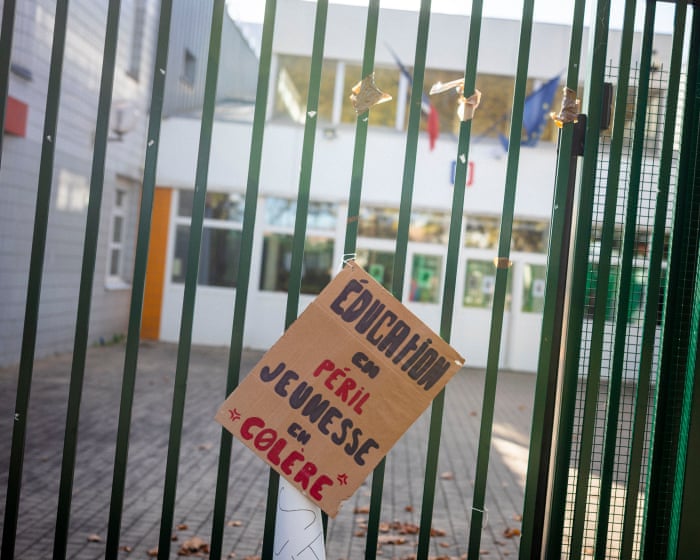
This week, the biggest youth protest movement in the country in decades brought hundreds of thousands onto the streets across France, demonstrating against inequality in the French education system, crumbling schools, a lack of teachers, and large class sizes. Hundreds of schools were blockaded, thousands of teenagers were arrested, and rights groups warned of alleged police brutality, with one child losing the use of an eye and another losing a hand.
Mohammed and his classmates, often supported by their parents and teachers, have been at the forefront, barricading their school, Lycée Blaise-Cendrars, which is in one of mainland France’s poorest departments, Seine-Saint-Denis. They have voted to continue their protests next week, taking their grievances to the local mayor, elected officials, and education representatives. Many local politicians have supported their demands. Even the French prime minister, Sébastien Lecornu, conceded that teenagers had “legitimate” concerns.
Photos on the Sevran students’ phones showed broken classroom chairs, holes in walls and ceilings, mould, buckets to catch leaks, and faulty lights. They said basic needs weren’t met, with some toilets broken, others missing doors, and often no toilet paper or soap. Video projectors and science equipment were lacking.
“We’re not asking for luxury, just the basics to learn in decent conditions,” Mohammed said. “And yet police on horseback charged us when we gathered to protest outside our school, firing teargas and making arrests. It’s so dangerous to be charged by a horse, it could kill you. I just ran, I was trying to help my classmates.”
The high schools of Seine-Saint-Denis, a suburban area bordering northern Paris, have been a driving force in the protests. The area has the youngest population in mainland France, one of the highest birthrates, and among the lowest average incomes. Local high schools have a high turnover of young teachers.
Despite co-hosting the 2024 Paris Olympics and numerous government plans to tackle long-standing inequality and poverty, the area northeast of Paris remains disadvantaged compared with the capital.
In 2005, Seine-Saint-Denis was the starting point for weeks of unrest on housing estates across France, leading to a state of national emergency being declared after the death of two young boys hiding from police in an electricity substation. This week’s protests have shown that inequality and discrimination in the Paris suburbs have not been addressed.The distrust between young people and the police persists. Sevran’s Lycée Blaise-Cendrars, with over 1,000 students, has been at the center of protests about school conditions before. In 2024, students and teachers made a viral video about the state of classrooms, toilets, and equipment. The local Île-de-France region said it had launched a major renovation project for high school buildings. But the teenagers said key issues had not been addressed.
View image in fullscreen
Lycée Blaise-Cendrars has been at the heart of protests about school conditions before. Photograph: Ed Alcock/The Guardian
“We’re starting at an unfair disadvantage because our parents aren’t as rich as others—they can’t buy us books, they can’t take us to films,” said Ilian, 17, whose family has Moroccan roots and whose father is a traffic warden. “We’re missing school during these protests, we risk falling behind in an exam year, we’re desperate to get back into class to study, but the conditions we’re facing are so bad we can’t stop until the government promises action.”
The education ministry this week promised 3,000 teachers to urgently fill gaps, but teachers’ unions expressed doubts and said longer-term plans and more funding were needed, even if the government argues there is little spare cash.
Children’s mental health is also an issue in Seine-Saint-Denis. Ilian has been waiting months to see a child psychiatrist. At the high school, there was no school nurse and a lack of support staff for children with disabilities, he said.
“The police look down on us as if we’re animals,” Ilian said. “They talk to us with such cruelty.” He told local politicians that some teenagers alleged police had made racial insults against them during protests.
Stéphane Troussel, the Socialist head of the Seine-Saint-Denis département council who met the pupils this week, said: “It’s intolerable that policing is causing part of the difficulties.” He called for the police to stop using a type of rubber-bullet launcher, after they suspended use of stun grenades following injuries. The French interior minister, Laurent Nuñez, has defended policing tactics.
View image in fullscreen
Stéphane Blanchet, the local mayor, meets students at the town hall. Photograph: Ed Alcock/The Guardian
Stéphane Blanchet, the mayor of Sevran, said he supported the school protesters’ demands. He said many in his town of 52,000 people, with a higher than average poverty rate, felt “relegated” and forgotten by the state.
Sarah, 17, who wanted to study at an elite Paris engineering faculty, and whose warehouse worker father was proud she was protesting and meeting the mayor, said teenagers in the banlieue “really feel abandoned.”
She said: “We’ve been surprised and so appreciative of other teenagers in better-off places in France marching in the streets to support us this week. We know we’re disadvantaged and that we have to work 10 times as hard as others to escape discrimination against our postcode. But we can’t learn properly in these conditions when we’re not even guaranteed a chair to sit on in school.”
Students’ names have been changed.
Frequently Asked Questions
Here is a list of FAQs based on the article Were not asking for luxury School protesters in a Paris suburb feel abandoned by the French state
Beginner Questions
What is this protest about
Parents students and teachers in a Paris suburb are protesting because they say their schools are falling apart and the government is ignoring them
Where is this happening
It is happening in a suburb of Paris France These suburbs are often called banlieues
Who is protesting
Parents students and teachers are protesting together
What do the protesters want
They are not asking for anything fancy They want basic things like working heating safe buildings and enough teachers
Why do they feel abandoned
They feel the French government does not care about their neighborhood and gives better schools and more money to richer areas
Intermediate Questions
What are some specific problems with the schools
Some schools have broken toilets leaky roofs no heat in the winter and not enough staff Some buildings are even falling apart
What does Were not asking for luxury mean
It means the protesters are not demanding expensive or special things They just want the same basic safe conditions that other students in France have
How is this related to bigger issues in France
It shows a bigger problem people in poor suburbs many of whom are immigrants or minorities often feel like the government treats them like secondclass citizens
What has the government done so far
The government has sent some officials to talk but the protesters say nothing has really changed They want action not just words
Are these protests violent
Mostly no The protests have been mostly peaceful with people holding signs and marching But there have been some tensions with police
Advanced Questions
What is the historical context of this feeling of abandonment
For decades French suburbs with large immigrant populations have suffered from poor housing high unemployment and underfunded public services This has led to repeated protests and riots like the big ones in 2005
How does this fit into Frances idea of égalité
France promises equality for all citizens But the protesters say the reality is differentstudents in poor suburbs get worse schools fewer resources and less attention from the state