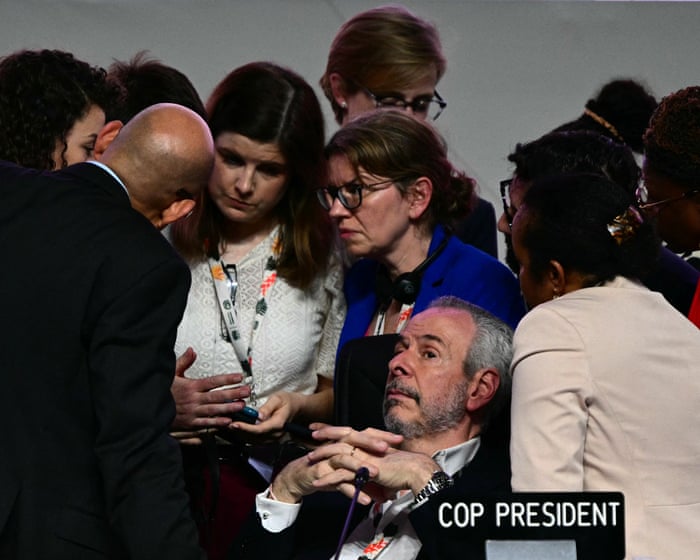
The 30th Conference of the Parties (COP30), the annual UN climate summit, has just concluded. Stakeholders are now in the media, attempting to portray the outcome as a success. For example, Simon Stiell, the UN’s climate change executive secretary, praised COP30 for demonstrating that “climate cooperation is alive and well, keeping humanity in the fight for a livable planet.” But let’s be clear: the conference was a failure. Its result, the decision text called the Global Collective Effort, is essentially a form of climate denial.
In 2023, the Intergovernmental Panel on Climate Change (IPCC) found that the world has already developed or planned too much fossil fuel to stop global warming at 2°C. It recognized that to limit warming to this level, fossil fuel assets must be stranded—meaning abandoned and unused. Yet the COP30 decision text ignores this entirely; it doesn’t even mention fossil fuels.
This failure is especially disappointing because COP30 initially showed promise in addressing the “transition away from fossil fuels” commitment from COP28. Ahead of the conference, Brazilian President Luiz Inácio Lula da Silva stated that the world needs “roadmaps to help humanity fairly and systematically overcome its dependence on fossil fuels.”
Lula’s appeal was supported by around 90 other nations. The UK’s energy secretary, Ed Miliband, noted, “This is a global coalition, with countries from the global north and south uniting to say that this issue cannot be ignored.”
After a press conference where 20 ministers and climate envoys called for strengthening and adopting the roadmap language in the initial draft, the EU proposed incorporating it into the final text. By Friday, 89 countries backed the roadmap for phasing out fossil fuels. However, all references to it vanished from the second draft released that same day. Thanks to COP30, the fossil fuel era will simply continue.
It’s clear that petrostates, led by Russia and Saudi Arabia, opposed the phaseout and prevailed. If they view the phaseout as a threat to their economies and sovereignty, they should consider how the climate crisis is making the Middle East uninhabitable. During COP30, Iran’s president, Masoud Pezeshkian, announced that Tehran, a city of 16 million, must be abandoned and relocated due to water shortages after years of climate-driven drought.
These states likely have support from Donald Trump, president of the world’s largest fossil fuel producer, who calls the climate crisis a “con job.” Although the U.S. was not officially part of the negotiations, Trump’s alliances with Saudi Arabia and apparent closeness to Russia bolster their ability to push their energy interests.
But would their influence be as strong if the world’s “climate leaders” showed more courage? It’s striking that while the EU was supposedly fighting to include a fossil fuel phaseout roadmap in the COP decision, European Commission President Ursula von der Leyen told a G20 press conference, “We are not fighting fossil fuels; we are fighting the emissions from fossil fuels.” This not only undermines her negotiators but is also illogical—like saying, “We’re not giving up eating ice cream; we’re giving up absorbing its calories.”
Moreover, von der Leyen’s words closely mirrored those of Saudi Arabia’s deputy environment minister, Osama Faqeeha.A journalist inquiring about the Cop30 roadmap was told by a representative that “the issue is the emissions, not the fuel.” This reflects the long-standing Saudi position that the world can continue using fossil fuels while simply removing the economy’s 600 million metric tons of annual carbon dioxide emissions through carbon removal technologies. However, this is merely fossil fuel propaganda.
For starters, the capacity to safely store CO2 underground is limited. The fact that a commission president repeats such unfounded claims highlights why efforts like Cop30 repeatedly fall short: so-called climate leaders actually show deep uncertainty about phasing out fossil fuels, ultimately uniting global climate politics around the false idea that we can keep using them and still address the climate crisis.
But what about China? Isn’t it becoming the world’s first electrostate and stepping up as a global climate leader while the U.S. embraces fossil fuel authoritarianism? Well, China appears hesitant too, at least for now. It didn’t block the text on the roadmap to phase out fossil fuels, but it also didn’t push to ensure its inclusion. Despite its dominance in solar, wind, and electric vehicles, China acts more as an “all of the above” energy giant, prioritizing its own economic growth above all.
A positive development from Cop30 is that Colombia and the Netherlands, supported by 22 other nations, will independently advance a roadmap to phase out fossil fuels, starting with a conference in April 2026. This initiative could be transformative. Since UN rules require all Cop decisions to be approved unanimously, petrostates have veto power over global climate policies. Creating a fossil fuel roadmap outside the Cop process might establish a trading bloc that could impose sanctions on countries—and banks—that refuse to reduce fossil fuel use.
However, such a bloc will be ineffective if its leaders aren’t compelled to overcome their hesitation about phasing out fossil fuels. That’s where we come in. Everyone must do their part by putting world leaders under intense and continuous public pressure. The challenge of leaving trillions of dollars in fossil assets behind and rebuilding the world is immense. Naturally, global leaders and officials will take the easier, cowardly path if they can. As we pass the 1.5°C threshold into unknown climate conditions, we must force them to wholeheartedly fight for a fossil fuel phaseout. Ultimately, it’s up to us to shape a global politics that will finally save the world for future generations.
Genevieve Guenther is the founding director of End Climate Silence and the author of The Language of Climate Politics.
Frequently Asked Questions
Of course Here is a list of FAQs about the issue of climate summits and the alternative path forward written in a natural conversational tone
BeginnerLevel Questions
1 Why do people say climate summits keep failing
They often fail to produce the strong binding agreements needed to rapidly phase out fossil fuels This is usually because countries with major fossil fuel industries lobby to weaken the agreements and many political leaders are hesitant to make bold commitments that might be economically or politically difficult at home
2 What exactly are fossil fuel interests
This refers to the companies that produce coal oil and gas and the groups that represent them They have a strong financial incentive to keep the world dependent on their products and often use their wealth and influence to slow down the transition to cleaner energy
3 What is the alternative path forward youre talking about
Its a path that doesnt rely solely on slowmoving international negotiations It focuses on action from the ground up driven by communities cities businesses and grassroots movements pushing for change directly through policy innovation and consumer choices
4 What are the main benefits of taking this alternative path
The benefits are huge a healthier planet with less pollution the creation of new jobs in green industries greater energy independence for countries and more stable resilient communities
5 This all sounds overwhelming What can I as one person actually do
You have more power than you think You can vote for leaders with strong climate plans reduce your own energy consumption support businesses that are environmentally responsible and join local community groups advocating for clean energy and sustainable policies
Advanced Detailed Questions
6 How do fossil fuel interests actually derail these summits
Their tactics include funding disinformation campaigns to create public doubt directly lobbying government delegates to remove or weaken specific text and promoting technologies like carbon capture as a silver bullet to justify continued fossil fuel use
7 Arent world leaders supposed to be representing us Why the timidity
Leaders are often caught between longterm global needs and shortterm national pressures They may fear economic disruption job losses in traditional industries or backlash from voters and powerful corporations if they enact rapid transformative climate policies