Washington and Kyiv have moved closer to a mutually agreed framework to end the war in Ukraine, despite ongoing uncertainty over Moscow’s response and several unresolved issues.
In an update on the U.S.-brokered peace talks, Ukrainian President Volodymyr Zelenskyy appears to have secured key revisions to an earlier, pared-down plan following intensive discussions with American negotiators. Whether or not Moscow accepts it, the revised draft represents a success for Kyiv in reworking an initial U.S. proposal that had been criticized as overly favorable to the Kremlin. Zelenskyy said he expects U.S. negotiators to contact the Kremlin on Wednesday.
The latest version of the peace plan includes Ukraine’s acceptance of a demilitarized zone in its eastern regions—a longstanding point of contention—provided Russia agrees to a comparable pullback of its own forces.
Details have been relayed to Russian President Vladimir Putin via his envoy, Kirill Dmitriev. A Kremlin spokesperson stated that Moscow is preparing its response and will not comment publicly for now.
Kremlin spokesman Dmitry Peskov confirmed that Dmitriev briefed Putin on his recent trip to Miami for talks with Trump’s representatives. Peskov declined to elaborate on Russia’s reaction to the proposals or the documents’ exact format, emphasizing that the Kremlin would not negotiate through the media.
“All the main parameters of the Russian position are well known to our colleagues from the United States,” Peskov told reporters.
Putin has reiterated in recent weeks that his conditions for peace include Ukraine ceding around 5,000 square kilometers of the Donbas region it still holds and formally abandoning its pursuit of NATO membership.
In the intricate back-and-forth of negotiations, Ukraine is prepared to make several difficult concessions. These include pulling back some troops from the eastern frontline and relinquishing its long-held goal of NATO membership in exchange for U.S.-European security guarantees similar to NATO’s Article 5. The precise nature of those guarantees remains unclear, at least publicly.
The updated plan also calls for Russian forces to withdraw from Dnipropetrovsk, Mykolaiv, Sumy, and Kharkiv regions, with international troops stationed along the contact line to monitor compliance.
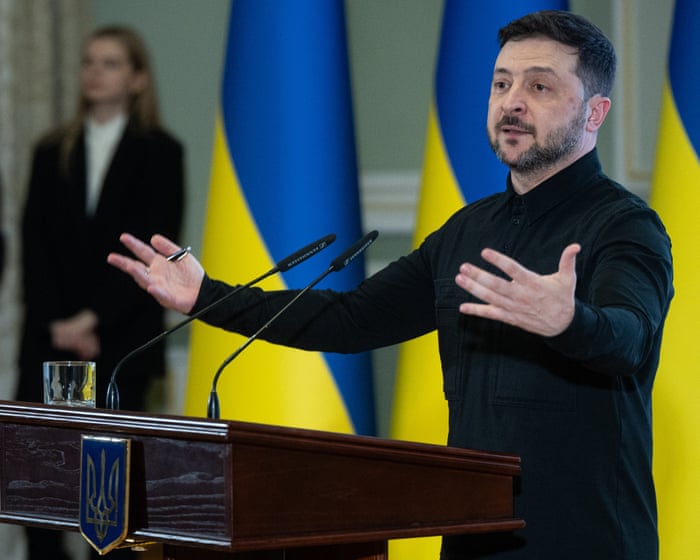
Zelenskyy outlined the proposal during a two-hour briefing with journalists, referencing a highlighted and annotated version. He suggested the terms strengthen Ukraine’s position, noting that Moscow risks facing significantly increased U.S. arms deliveries to Kyiv and escalated sanctions if Putin rejects the plan.
“Moscow cannot tell President Trump, ‘Look, we are against a peaceful settlement,’” Zelenskyy told reporters. “If they try to obstruct everything, then President Trump would have to arm us heavily while imposing all possible sanctions against them.”
Regarding the latest draft, Zelenskyy stated, “In the Donetsk, Luhansk, Zaporizhzhia, and Kherson regions, the line of troop deployment as of the date of this agreement is de facto recognized as the line of contact.”
He added, “A working group will convene to determine the redeployment of forces necessary to end the conflict, as well as to define the parameters of potential future special economic zones.”
This indicates the plan creates a pathway for—but postpones decisions on—troop withdrawals and demilitarized zones, options Ukraine had previously been hesitant to consider.
“We are in a situation where the Russians want us to withdraw from the Donetsk region, while the Americans are trying to find a way,” Zelenskyy said.”They are proposing a demilitarized zone or a free economic zone—a format that might be acceptable to both sides.”
During a Russian drone attack on Kyiv on December 23, people took shelter in a metro station.
President Zelenskyy added that any plan requiring Ukraine to withdraw its troops would need to be approved by a national referendum. “If we are discussing a free economic zone, then we must go to a referendum,” he said, referring to proposals to turn areas from which Ukraine pulls back into a demilitarized free-trade zone.
On the topic of NATO, Zelenskyy stated: “It is up to NATO members to decide whether to accept Ukraine. Our choice is already made. We have removed proposed amendments to Ukraine’s constitution that would have banned us from joining NATO.”
Russia, however, has long demanded full control over Donetsk, and it remains highly uncertain whether Moscow would accept either a demilitarized buffer zone or a withdrawal of its own forces. Other unresolved issues persist, including control of the Zaporizhzhia nuclear plant, which Kyiv insists should be jointly managed by the U.S. and Ukraine.
Zelenskyy’s press conference followed repeated attempts by Donald Trump to broker an end to the four-year war, which began with Russia’s full-scale invasion in 2022.
The conflict has resulted in tens of thousands of deaths, devastated eastern Ukraine, and forced millions from their homes. Russian forces are currently advancing on the front lines and relentlessly targeting cities and Ukraine’s energy infrastructure with nightly missile and drone attacks. On Wednesday, the Russian defense ministry announced the capture of another Ukrainian settlement in the southern Zaporizhzhia region.
In 2022, Moscow declared the annexation of four Ukrainian regions—Donetsk, Kherson, Luhansk, and Zaporizhzhia—in addition to the Crimean peninsula, which it seized in 2014.
Frequently Asked Questions
FAQs USUkraine Strategy to End the War
BeginnerLevel Questions
1 What does a shared strategy between the US and Ukraine mean
It means the United States and Ukraine are aligning their plans and goals for how to end the war They are working together to coordinate military support diplomatic efforts and a vision for Ukraines future security and recovery
2 What are the main goals of this strategy
The primary goals are to ensure Ukraine can defend itself restore its territorial integrity and build a position of strength for any future negotiations It also aims to weaken Russias military capacity to threaten Ukraine again
3 Why is Moscows reaction unclear
Because Russia has not officially and definitively stated how it will respond They might publicly reject the strategy use it to escalate propaganda or adjust their own military and diplomatic tactics behind the scenes Their true next steps are uncertain
4 Does this mean peace talks are starting soon
Not necessarily A strategy to end the war can include preparing for eventual negotiations but the current focus appears to be on ensuring Ukraine is in as strong a position as possible first Talks are not imminent unless the battlefield situation changes dramatically
5 How is the US supporting Ukraine in this strategy
Support includes providing weapons intelligence training financial aid for the government and leading efforts to impose economic sanctions on Russia The US is also helping to coordinate support from other allied nations
Advanced Practical Questions
6 What are the biggest challenges in creating a shared USUkraine strategy
Key challenges include aligning timelines defining specific end goals managing the risk of escalation with Russia and sustaining Western political and financial support over time
7 Could this strategy lead to direct conflict between the USNATO and Russia
Both the US and NATO have been clear they seek to avoid direct military conflict The strategy is designed to support Ukraine without NATO troops fighting Russian troops However miscalculations or incidents could always increase the risk of a wider war which is why the strategy is carefully calibrated
8 What role do other countries play in this
The EU is a crucial partner in sanctions and aid