What is the appropriate punishment for hateful social media posts? Should someone lose their account, their job, their citizenship, go to jail, or even face death? For those leading a campaign against the British-Egyptian writer and activist Alaa Abd el-Fattah, no punishment seems too severe.
I am not defending the offensive tweets Abd el-Fattah posted in the early 2010s. Many are indefensible, and he has “unequivocally” apologized for them. He has also written poignantly about how his views have evolved over the years—years that included more than a decade in prison, much of it in Egypt’s notorious Tora prison, where he endured torture. He missed his son’s entire childhood and nearly died during a months-long hunger strike.
Yet, for his accusers, this suffering is not enough. They want him and his family to endure even more punishment. They are demanding that he be stripped of his British citizenship—a right he holds because his mother was born in the UK—and deported back to Egypt, the country that already robbed him of 12 years of freedom. Such a fate could amount to a death sentence.
I do not believe that decent British people consider piling more torment on top of torture to be justice, let alone a proportionate punishment.
Alaa Abd el-Fattah first gained global attention as a leading figure in the 2011 pro-democracy revolution, which turned Cairo’s Tahrir Square into a surging sea of young protesters. They chanted, “Down with corruption,” “Down with autocracy,” and “Down with dictators.” When the uprising succeeded in toppling Egypt’s dictator Hosni Mubarak, the world, including Europe and North America, rejoiced. Abd el-Fattah became a prominent media voice for the part of the movement committed to building an accountable, participatory democracy from the ground up.
But the victory in Tahrir Square was short-lived. The military seized power and violently turned on the young protesters. Hundreds, perhaps thousands, were killed, and tens of thousands were thrown in jail. Alaa Abd el-Fattah was among them, and it soon became clear that keeping him behind bars was a top priority for the generals who ultimately replaced Mubarak. #FreeAlaa became a global rallying cry for well over a decade—until this past September, when Alaa finally walked free.
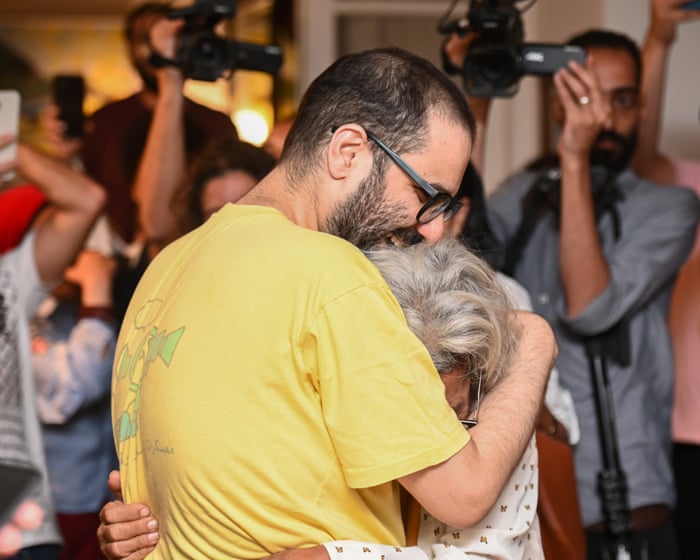
A travel ban imposed by Egypt still prevented Abd el-Fattah from leaving the country and reuniting with his son in the UK. Then, on Boxing Day, he landed at Heathrow, soon to celebrate his son’s birthday for the first time in 12 years. But that joy was short-lived: calls for his deportation began less than 24 hours after he arrived.
Abd el-Fattah’s old tweets surfaced online on December 27 and were quickly picked up by British far-right activist Tommy Robinson and Reform UK leader Nigel Farage. The next day, the Sunday Telegraph launched a campaign with a front-page headline: “Starmer welcomes ‘extremist’ to Britain.” Robert Jenrick, the shadow justice secretary, had spoken to the Telegraph for the story, saying, “This awful extremist should never have set foot in the UK again.” By Monday, the Tories were reportedly calling for the deportation of “scumbag” Abd el-Fattah and the revocation of his citizenship. Conservative party leader Kemi Badenoch stated that citizenship decisions “must take account of social media activity, public statements, and patterns of belief”—a stance reminiscent of Donald Trump’s United States. Reform UK also set up a website with a petition calling for Abd el-Fattah’s deportation.Alaa Abd el-Fattah’s removal from the UK has sparked a manufactured controversy. Many following the uproar know little about him or his role in a historic revolution for democracy and human rights. Instead, they see only ugly screengrabs designed to portray him as a religious sectarian who hates Jews and white people and celebrates terrorism against civilians. Many attacks on him invoke the horrific antisemitic crimes at Bondi Beach during Hanukkah and at a synagogue in Manchester on Yom Kippur, outrageously implying that this pro-democracy, anti-sectarian human rights activist poses a similar danger. This strategy works: many people feel vulnerable and frightened because these are frightening times. That fear is the whole point of the campaign—to make people afraid of Abd el-Fattah and, by extension, Muslims and migrants. Like so much in today’s politics, both in the UK and elsewhere, it tightens the circle around who is considered a “real” citizen.
Those who curated these posts for maximum fear and shock don’t want us to see other tweets Abd el-Fattah posted during the same period. For example, when he confronted people who blamed Jews for the actions of the Israeli state, writing: “We stand against Zionism, never against a religion, and there are many brave anti-Zionist Jews.” Or when he highlighted the voices of young Jewish descendants of the Arab and Islamic world living in Israel who, he wrote, were “demanding a just solution to the Palestinian cause that includes them.”
They also overlook the many times Abd el-Fattah spoke out against terrorism targeting civilians, including attacks committed in the name of Islam. In one post, he wrote: “To me, the context never justifies killing civilians”; in another, “I’m saying killing civilians is never justified”; and in yet another: “It doesn’t matter at all who started it; there’s no reason in the world that justifies raising an automatic weapon against civilians in front of their homes.” He also wrote in 2013: “Islamic terrorism is really ramping up its efforts these days, and … all the victims are unarmed civilians.”
Do these posts cancel out the ones that say the opposite? No. But they do make it harder to turn Abd el-Fattah into the unrecognizable, menacing “anti-white Islamist” figure currently flooding the internet. Further complicating this caricature are the staunchly anti-sectarian, egalitarian actions he took as a human rights advocate in the real, non-online world.
For instance, in October 2011, the Egyptian military violently attacked a peaceful protest by the Coptic Christian minority, killing 28 people and injuring hundreds more. To cover up these crimes, state media tried to foment a religious war, “turning neighbors against each other, Muslims against Christians, and transforming the hospital into a sectarian site under siege,” as reported by the Tahrir Institute for Middle East Policy.
Abd el-Fattah, who is Muslim, stood with his Christian comrades, spending the night rushing from morgue to hospital, desperately trying to ensure evidence of the military’s crimes was not buried with the bodies of the fallen. He comforted families and argued with clerics. “I smell of morgues, dead bodies, and coffins; I smell of dust, sweat, and tears,” he wrote the next day. “I don’t know if I can wash it all away.” For these acts of solidarity, he was thrown in jail—not for the first time, nor the last.
When hasty elections briefly brought the Muslim Brotherhood to power and a new wave of repression began, Alaa Abd el-Fattai again raised his voice against the thwarting of the revolution’s dream of real democracy. Again, he was arrested. But the real nightmare began when the military, led by General Abdel Fattah al-Sisi, overthrew the Muslim Brotherhood in a coup in 2013.
The top priority of the al-Sisi regime, which remains in power to this day, has been to…To crush the liberatory dream of the Arab Spring, the regime kept Alaa Abd el-Fattah imprisoned almost continuously, often under maximum security. Even when the world gathered in Sharm el-Sheikh for the 2022 UN climate summit, and #FreeAlaa became a rallying cry—even as film stars and Nobel laureates called for his release—the regime refused to relent.
The justifications shifted, the charges changed. In 2013, he was imprisoned for allegedly organizing a peaceful protest, receiving a five-year sentence. Later, he was given another six years for “fake news” after sharing a Facebook post about another prisoner’s torture. Everyone knew his real crime never changed: he remained the most prominent symbol of the dream for a non-sectarian, decolonial, democratic Egypt. As he once tweeted, “I’m the ghost of spring past.”
Keir Starmer seems surprised by the criticism and embarrassed that he and his staff did not review every one of Abd el-Fattah’s social media posts before advocating for his release from unjust imprisonment and welcoming him to the UK. The prime minister said the government was “taking steps to review the information failures in this case.”
That will be a monumental task. In his time, Alaa Abd el-Fattah was what you might call extremely online. He posted 280,000 times on Twitter alone. When colleagues compiled an anthology of his writing, they estimated his social media output could fill a hundred books, each 300 pages long.
Perhaps the government could skip the retroactive scrutiny and judge Alaa Abd el-Fattah not by his best or worst tweets, but by the dignity and steadfastness with which he has fought for freedom—for the Egyptian people and for himself. Maybe they could even trust that they did the right thing in the first place.
Alaa is not a saint. But he is a hero of a stolen revolution and a powerful symbol of hope for millions still living under brutal dictatorship. His freedom is a hard-won victory for justice at a time when such victories are rare. He deserves to enjoy it in peace.
Frequently Asked Questions
FAQs Alaa Abd elFattah Misinformation and the British Right
BeginnerLevel Questions
1 Who is Alaa Abd elFattah
Alaa Abd elFattah is a prominent EgyptianBritish activist blogger and software developer He is a leading figure in Egypts prodemocracy movement and has been imprisoned for much of the past decade by the Egyptian government for his activism and criticism of the regime
2 What tweets of his are considered wrong
In the past he made some offensive and inflammatory tweets including some with antisemitic tropes and comments celebrating violence against the state He and his family have since explicitly disavowed and apologized for these statements stating they do not reflect his core beliefs or lifes work
3 What is an antiwhite Islamist
This is a politicized label implying someone who is both radically Islamist and specifically hostile to white people as a racial group Its a reductive and often weaponized term used to smear critics by associating them with two different forms of extremism
4 So if hes not an antiwhite Islamist what is he
He is best described as a secular prodemocracy activist His activism focuses on human rights free speech and government accountability not on establishing a religious state His imprisonment is widely condemned by major human rights organizations globally
Advanced Analytical Questions
5 Why would the British rightwing media or politicians promote this antiwhite Islamist narrative
They often use this framing to discredit a highprofile political prisoner and undermine public sympathy for his case By painting him with the broad brush of Islamist extremism and antiwhite racism they aim to
Delegitimize his cause Make his fight for freedom seem unworthy of support from a Western audience
Avoid criticizing an ally Egypt is a strategic partner and pushing for his release criticizes the Sisi government Smearing Alaa shifts the blame to him
Fuel culture war themes It fits a narrative of defending the West against supposed internal enemies mobilizing a certain voter base
6 Whats the difference between criticizing his past tweets and calling him an antiwhite Islamist
Criticizing specific wrong