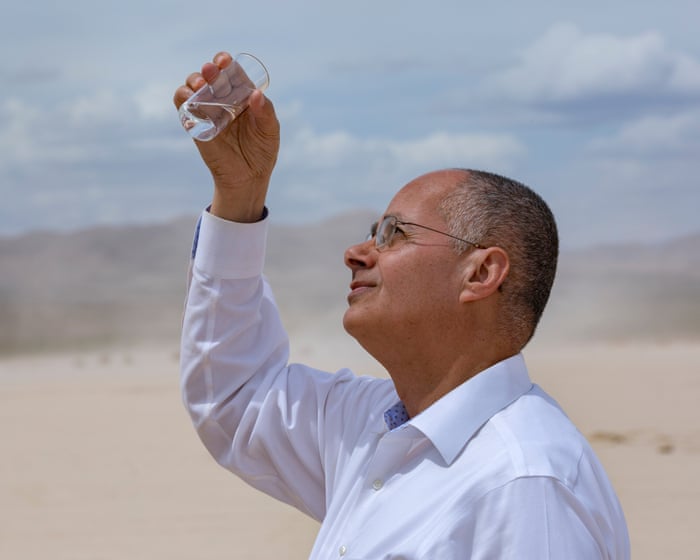
A Nobel laureate’s environmentally friendly invention, which provides clean water when central supplies are disrupted by hurricanes or drought, could be a lifesaver for vulnerable islands, according to its creator.
The invention, developed by chemist Professor Omar Yaghi, uses a field called reticular chemistry to create molecularly engineered materials. These materials can extract moisture from the air and harvest water even in arid, desert-like conditions.
Atoco, the technology company Yaghi founded, says their units—each about the size of a 20-foot shipping container and powered entirely by ultra-low-grade thermal energy—could be placed in local communities. Each unit can generate up to 1,000 litres of clean water daily, even if centralized electricity and water sources are cut off by drought or storms.
Yaghi, who won the Nobel Prize in Chemistry in 2025, believes his invention will change the world and benefit drought-prone Caribbean islands. He added that it could provide a solution for delivering water to isolated communities after hurricanes like Beryl and Melissa, which left thousands without access.
“Hurricanes such as Melissa or Beryl unleashed heavy flooding, destroying homes and crops and impacting thousands of lives in the Caribbean,” Yaghi said. “This devastation is a stark reminder of the urgent need for enhanced water supply resilience in vulnerable areas, particularly small island nations susceptible to extreme weather events.”
Yaghi noted that the invention offers a climate-friendly and sustainable alternative to other water sourcing methods, such as desalination, which can threaten ecosystems when concentrated salty brine is released back into the ocean.
Last month, a UN report warned that the planet has entered a “global water bankruptcy era,” with nearly three-quarters of the world’s population living in countries classified as water-insecure or critically water insecure. “Around 2.2 billion people still lack safely managed drinking water, 3.5 billion lack safely managed sanitation, and about 4 billion experience severe water scarcity for at least one month a year,” the report stated.
In Grenada, a three-island Caribbean nation devastated by Hurricane Beryl in 2024, Yaghi’s invention offers a ray of hope—especially for Carriacou and Petite Martinique, which bore the brunt of the disaster and face a triple threat of storms, drought, and coastal erosion.
“The technology’s ability to function off-grid using only ambient energy is particularly compelling for our context,” said Davon Baker, a Carriacou government official and environmentalist.
Carriacou and Petite Martinique, still recovering from Beryl, are forced to import water from Grenada to cope with dry seasons that seem to grow more intense and longer each year.
“We’re currently considering comprehensive recovery and resilience strategies, and the atmospheric water-harvesting technology Prof Yaghi developed addresses several critical challenges we face,” Baker explained. These include “the high cost and carbon intensity, as well as the contamination risk, of water importation; vulnerability of centralized systems to hurricane damage; and the need for decentralized solutions that can operate when traditional infrastructure fails.”
Yaghi, who grew up in a refugee community in Jordan, was inspired by the hardships of living in a home without running water or electricity. In his Nobel prize banquet speech, he recalled how water would arrive from the government to his desert community only once every week or two.
“I remember the whisper through our neighbourhood, ‘the water is coming,’ and the urgency…”As I hurried to fill every container I could find before the water stopped flowing, he described the invention as “a science capable of reimagining matter.” He called on leaders to “remove barriers, protect academic freedom,” and “welcome global talent.”
“On climate,” he said, “the time for collective action is already here. The science is clear. What we need now is courage—courage equal to the scale of the challenge—so that we may leave the next generation not only with carbon capture technology, but with a planet worthy of their hopes.”
Frequently Asked Questions
Of course Here is a list of FAQs about a Nobel laureate inventing a machine that extracts water from dry air designed to sound like questions from real people
Beginner General Questions
Q Is this for real Can you actually get water out of thin air
A Yes its real The technology uses special materials to capture water vapor thats always present in the air even in dry climates and condense it into liquid water
Q Who invented this and why is it a big deal
A It was pioneered by Professor Omar Yaghi a Nobelcaliber chemist and his collaborator Evelyn Wang Its a big deal because it provides a potential solution for water scarcity that doesnt rely on existing water sources like rivers or wells
Q How does this machine work in simple terms
A Think of it like a supersponge It uses a porous material called a MOF that acts like a sponge for water vapor at night During the day sunlight heats the device releasing the collected vapor which then condenses into clean drinking water
Q Does it need electricity to run
A The most groundbreaking versions are solarpowered They use only sunlight to drive the cycle of collecting and releasing water making them ideal for offgrid areas
Q Where would this be most useful
A Its ideal for arid regions remote villages disaster relief zones and places with contaminated groundwater It could also be used in homes to reduce reliance on bottled water
Technical Advanced Questions
Q What exactly is a MOF and why is it special
A A MOF is a synthetic crystalline material with an incredibly high surface arealike a microscopic sponge with millions of tiny pores Scientists can design these pores to specifically attract and trap water molecules very efficiently even in lowhumidity air
Q How much water can one device actually produce
A Early lab prototypes produced milliliters but field devices have scaled up Current solarpowered units about the size of a small suitcase can produce several liters of water per dayenough for a persons basic drinking needs Scaling is an active area of research