Riz Ahmed was multitasking. It was February in London, and the actor was doing an interview with a men’s magazine while on his way to pick up his child from school. So far, so glamorous. “Here’s the reality,” Ahmed says now, slamming his palms down hard on the table. “I’m late for the school run. I’m stuck in traffic. I’m supposed to be at my laptop, but I’m having to do it on my phone, in my car. I’m double-parked on a double yellow line, doing the interview, looking over my shoulder. The traffic warden’s coming, it’s rush hour. He tries to move me along. I try to get out of there while I’m talking on the phone to this guy.”
Distracted, Ahmed hit another car. The driver jumped out, furious. “He’s like, ‘What the fuck are you doing?!’” says Ahmed, who had been trying to continue the interview. “I’m now going off video, saying, ‘Oh, my signal’s a bit bad!’ while going on and off mute to negotiate car insurance details. On the phone, I’m saying, ‘Absolutely, it was just such an honour getting to tell my story with these amazing collaborators,’” he adds, his voice dropping an octave and turning smooth.
He muted the call and rolled down the window. “Take my license plate, bro!” he yells, his accent slipping back to his born-and-raised-in-Wembley roots. “I’m not trying to fight you! Take my details, please!”
Ahmed tried to explain that he was in the middle of an interview, but the driver wasn’t having it. “He goes, ‘You drive like that? I hope you don’t get the job.’”
Ahmed bursts out laughing. That day, he says, he felt the gap between the persona he needed to perform and the person he really is. It’s a familiar feeling for one of Britain’s most versatile actors. The film version of Hamlet he developed, released in February, elegantly reimagines the grieving prince as the son of a wealthy South Asian property mogul in modern-day London, with Ahmed starring in the title role, delivering full Shakespearean verse. Later this year, he’ll appear alongside Tom Cruise in Digger, the new Alejandro González Iñárritu film. A youthful 43, Ahmed’s particular mix of intensity, soulfulness, and wit has even put him in the conversation for James Bond, if the franchise were willing to take a chance on a 007 who isn’t white.
That also happens to be the premise of Bait, the madcap TV comedy show Ahmed is about to release on Prime Video after developing it for the better part of 10 years. Ahmed plays Shah Latif, a struggling actor who botches his Bond audition but somehow ends up in the running for the role. It’s the opportunity of a lifetime, and not just for Shah. His cousin Zulfi (a brilliant Guz Khan) sees it as a way to promote his new minicab business, Muber (“But Uber in London is already Muslim,” Shah quips), and his mum (played by Bollywood actor Sheeba Chaddha) might finally have something to brag about.
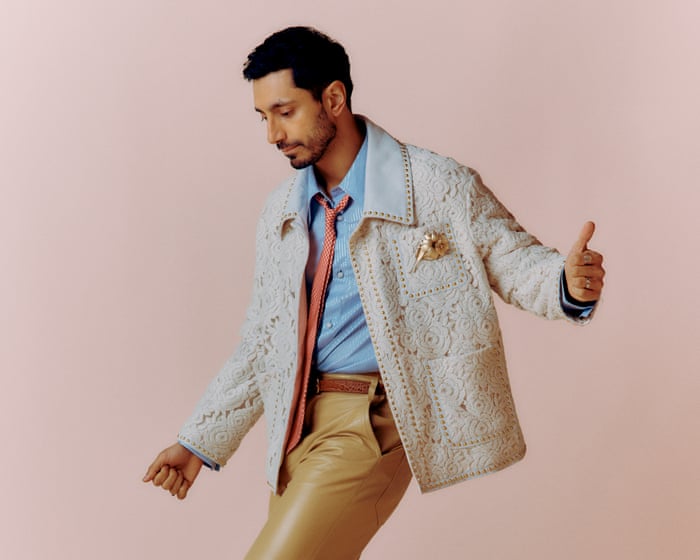
When we meet on a sunny Monday afternoon in east London, Ahmed is casual and comfortable in black sweats, a grey T-shirt, and a burgundy jacket from the Indian designer brand Kartik Research. Slung across the bench we’re sitting on is a beat-up 1950s aviator jacket from Front General Store, his favorite vintage shop in New York. In person, Ahmed laughs easily and listens closely, his gaze intense.
I’m interested in his choice to open his TV show with an audition. In a 2016 essay about being typecast as a terrorist, Ahmed compared the airport interrogation rooms where he was frequently stopped to audition rooms. “They are also places where you are reduced to your marketability or threat level, whereThe length of your facial hair can be a deal-breaker, where you are seen—and therefore see yourself—through reductive labels,” he wrote. In Bait, Shah feels confined by his various roles, destined to perform different versions of himself for the people in his life.
“Wow, this is like therapy,” Ahmed says playfully. “You’re connecting dots I’d never even considered! Send me the invoice later, yeah?”
Bait, he continues more seriously, is about how life can feel like one big audition. “I hope that’s relatable to people outside of just actors,” he clarifies. “Even people who aren’t performers—we all have to perform in some sense, right?” Ahmed outlines his thesis: “We’re all projecting a version of ourselves that’s usually quite different from who we really are or how we really feel, just to prove to people that we’re enough.
“Maybe it’s been made worse by the age we live in and social media. We’re made to feel like we have to constantly reassert our importance, our relevance, our likability, our very existence. Social media has rewired our brains in a way where we all feel pressured to do that.”
Ahmed has spent two decades proving his skill and range as an actor. His filmography spans satirical comedies and westerns, sci-fi and sensitive, culturally specific dramas. When asked to describe the different eras of his career, his eyebrows narrow. “I really hoped I wouldn’t have to,” he says with mock seriousness. “Can you do it?” he teases.
Well, first came the breakout years, where he played with Muslim stereotypes post-9/11 in films like his 2006 debut The Road to Guantánamo, Shifty as a drug dealer, and Chris Morris’s cult comedy Four Lions, about a quartet of lovable, incompetent jihadists.
His Hollywood era began with a supporting role in the Jake Gyllenhaal thriller Nightcrawler and led to a high-profile role as a tortured taxi driver and murder suspect in HBO’s 2016 TV crime drama The Night Of, which won him an Emmy. Around the same time, he appeared in Rogue One: A Star Wars Story and Marvel’s Venom, as well as an underrated cameo as a surf instructor and love interest in Lena Dunham’s Girls (look up the clip of him rapping Twista’s verse from Kanye West’s “Slow Jamz”). What’s clear is that Ahmed has never wanted to be, or do, just one thing. “I made a very deliberate choice to do Four Lions and Sound of Metal, to do Nightcrawler and The Night Of,” he says. “That comes from my own restlessness.”
More recently, the actor has focused on telling stories from his own distinctive point of view. In 2020, he co-wrote, produced, and starred in Mogul Mowgli, about a British Pakistani rapper suffering from a mysterious chronic illness, and in 2022, he and Aneil Karia won an Oscar for their sobering short film The Long Goodbye, which depicts an ordinary South Asian family preparing for a wedding when their home is violently raided by police. The pair also made the London-set Hamlet together, which Ahmed describes as a 15-year labor of love. “Hopefully now you’ll see an era where I get things made a bit quicker, now that I’ve figured out how to do it.”
In 2015, when the Hollywood Reporter announced the cast for Rogue One, Ahmed’s phone started blowing up. “People were texting me like, ‘Brooooo! Oh my God!'” he remembers. Yet the very next day, he says, “I got banned from Tesco for suspected shoplifting.” His washing machine had broken, he explains. Fresh out of clean clothes and on his way to the laundromat, he’d popped into the supermarket to buy his brother a birthday cake. “I was in fluorescent cycle shorts, a massive green padded jacket, and, like, a string vest from Carnival.”You know those checkered tartan laundry bags? I’m just dragging one in.
I bought him a pizza instead of a cake because they didn’t have any good cakes there—don’t judge me. I didn’t scan it properly at the self-checkout, the alarm went off, I looked like a crazy person, and I had a pizza buried under piles of dirty underwear and socks. Ahmed tells this story like it’s a well-practiced part of a stand-up routine; I suspect he’s told it before.
Throughout our conversation, Ahmed is keen to emphasize that, just like everyone else, he too is “chaotic, messed up, vulnerable, hilarious, and messy.” But the gap between his impressive public persona and the chaotic version behind the scenes has been widening for some time. “It became so big and so stressful that it turned absurd, and quite funny. So I started writing these things down.”
He noted awkward moments like being mistaken for actor Dev Patel (“it happened again in a black cab last week”) and almost fist-bumping the late Queen. “I’ve always been a fan of comedy that comes from stress,” he says. “I’ve always been able to see the funny side while I’m in these incongruous situations. As I started writing about it more personally, I realized how universal that feeling is.”
With stand-up, the gloves are off… You live or die. There’s no fourth wall. It’s about truth, honesty, connection, performance. Ahmed is a naturally gifted comedian, with a lean, wiry physicality and impeccable comic timing. Yet his more recent, and more praised, roles have been serious rather than funny. “Of course, the dream is to be a stand-up comedian, but everyone who knows me says, ‘Please don’t do that,’” he says, breaking into a pleading whisper. Comedy, he insists, is the purest kind of performance. “I see people like Hasan Minhaj or Ramy Youssef, or Bill Hicks growing up, or Chris Rock, and the gloves are off. You live or die. There’s no fourth wall. There’s no politeness from the audience; it’s that moment-to-moment.” He snaps his fingers. “It’s about truth, honesty, connection, performance. I mean, there’s a reason my first rap song was a comedy rap.”
“Hi kids, welcome to fun-fun-fundamentalist / In the breaks, Nike’s advertising bomb-proof kicks / They’re even showing Bin Laden’s cave on Cribs!” he rapped gleefully as Riz MC on “Post 9/11 Blues,” released back in 2006. It caught Chris Morris’s attention, who later cast him in Four Lions.
At school, Ahmed says his behavior was “quite ADD”—he was bored, restless, and disruptive. He was often sent out of class for making other students laugh. The boys he grew up with were his brother’s age, three years older than him. As the runt of the group, Ahmed’s way of getting noticed was to play the joker. “I had big ears,” he says. “I could do a Prince Charles impression. I remember I would do this,” he adds, pulling his ears forward goofily.
“The things that were my hobbies became my jobs,” he says. “Music and acting, writing and producing—it can kind of grow and grow and not leave much time for other things.” Ahmed says he’s okay with that. At this stage in his life, “it’s mainly about spending time with my wife, my kid, my parents, my cousins.”
In 2020, Ahmed married American novelist Fatima Farheen Mirza, whom he met…He was in New York preparing for Sound of Metal (the film that would earn him an Oscar nomination) when they met. They now have a toddler together, though he doesn’t share the child’s age or gender. How does he balance acting, writing, producing, and fatherhood? “Great question,” he says, gently deflecting with humor again. “As my therapist, do you have any solutions for how we can work this out?”
Balance, he says, is the biggest question in his life right now. “I think balancing how much you choose to work in one place so we don’t all get uprooted and have to move around the globe… that’s one question. But I guess another question I’ve been thinking about more recently is one of modeling versus presence.” He explains: “There’s something powerful in just being present with a kid. Not doing anything, just literally spending time breathing the same air, making eye contact, hanging out. That’s so nourishing, especially for kids. That’s what I mean by presence.” At the same time, he wants to model for his child what it means to do what you love in a way that aligns with how you see the world. An actor friend once told him they chose not to work when their child was small, opting to stay home instead. “They’ve regretted some of those choices,” he says.
Ahmed, who is second-generation Pakistani, has been reflecting on how his own parents raised him. “They had a lot fewer resources and choices than I do. I think of their labor, love, and sacrifice as truly heroic.” His father was a shipping merchant, and his mother took care of him, his brother, and his sister. “My father worked on boats for much of his life, so he often had to be away.” He was gone for long stretches, sometimes months at a time. Did he miss him? “Yeah, massively, of course. Hugely,” he says. “I’m very aware of, on one hand, learning from his example in knowing what it means to sometimes bite the bullet to provide for your family, while also not wanting to repeat some of the pitfalls of that. In our adult lives, we’re all trying to climb back into the same treehouse we grew up in and fix it.”
How often does he see his parents these days? “All right, Auntie. Jesus Christ! You’ve got me on the hook here. Let me get my calendar out,” he says, pretending to reach for his phone. “I try to see them very regularly,” he adds. Every week? Every month? Ahmed looks at me quizzically. “Are you Asian?” he asks, noting my own Punjabi-Sikh heritage. “You’d have a chappal flying at you through space and time if it was every month.” A chappal is a slipper, humorously used by Asian parents of all backgrounds as a form of discipline. “Of course, at least every week. A few times a week.”
Lately, Ahmed has been trying to improve his cooking. His wife, he says, is a really good cook—the kind who can glance at a recipe and then improvise. “I think I’m a good cook, but she doesn’t. The problem is, when I cook, I’m the only one who eats it.” What has he made that she’s turned down? “I made fish curry the other day,” he says. “I thought it was nice. I rate it; I’m trying to back myself. She didn’t think so.”
Ahmed describes Mirza as “a truly creative person” whose writing “floors me every day,” though he says they try not to discuss work too much at home. “I probably try to hassle her for her opinion on things a lot more than she needs to hassle me for mine on writing. She doesn’t want my GCSE English ideas,” he says, self-deprecatingly.
But while he…Ahmed may wear his intellect lightly, but it is no secret. A working-class British Pakistani kid from Wembley, he won a scholarship to private school, studied politics, philosophy, and economics at Oxford—a star-making degree favored by politicians, broadcasters, and public intellectuals. He has never felt like a natural fit for the establishment but has always found a way to navigate it.
“There is a part of me, and I dare say a part of all of us, that chases external validation. Trophies and awards are a tangible version of that,” he says. But the best part of winning an Oscar was seeing it in his family home. “It felt really good to be able to show up to my mum’s house and give it to her.”
Last month, Ahmed presented at the Baftas, performing a skit with rapper Little Simz. He was in the room when Tourette’s campaigner John Davidson involuntarily shouted a racial slur while actors Michael B. Jordan and Delroy Lindo were on stage. “It was a very confusing, awkward, tense, baffling moment for everyone,” he says. Asked about how Bafta and the BBC handled it, he replies, “Not well. Not well at all.” He adds that he was glad to see Jordan later win a Sag award for his film Sinners—less for what the award means, and more as a message of respect and solidarity from the creative community. “No matter what position we get to in life, I think harsh words can land harshly.”
That night, the BBC also cut the words “Free Palestine” from outstanding debut director Akinola Davies Jr.’s winning speech. Ahmed has long been outspoken on the issue, signing an open letter to Keir Starmer before he became prime minister, calling for a halt to arms sales to Israel, and performing at Wembley Stadium for the Together for Palestine fundraiser. When asked if he has faced repercussions in Hollywood for his political views, his expression turns reflective. “That thought does cross your mind. I’m sure some people didn’t like what I’ve said… But in life, you have to make choices. I’m a father, and I want to model a way of being that aligns with my values. I don’t think calling for respect for international law, human rights, the protection of civilians, women and children, or the Geneva Convention is aggressive or controversial.”
He returns to safer ground discussing filmmaking. He describes being “blown away” by Tunisian documentary-maker Kaouther Ben Hania, director of The Voice of Hind Rajab, and the latest film by Jafar Panahi, It Was Just an Accident. “What they’re about really matters. They were made against the odds, speaking truth to power. But it’s also how they’re playing with form, innovating, subverting tone. First and foremost, it’s how they’re doing it,” he says, comparing their artistry to “doing wheelies.”
Ahmed himself is a restless, perpetual student. Fluent in English, Urdu, and French, he practices the latter through “boring stuff” like watching the news, listening to podcasts, and seizing chances to speak French. In our conversation, he references the Sufi poet Rumi, the Hungarian-American psychologist Mihaly Csikszentmihalyi (“the guy who wrote about flow states”), and more.In his 1968 book The Empty Space, British theatre director Peter Brook argues that what makes Shakespeare truly great is actually his lack of tonal consistency. “You’ve got dick jokes next to the meaning of life. You’ve got prose next to poetry. There’s a sense of whiplash. The neurons are just firing. It’s like, ‘What am I watching?’ That’s something that excites me.”
Ahmed has never liked being pinned down for many reasons, either. “I’ve spent my whole life and my whole career, first probably subconsciously and now quite consciously, trying to defy categorisation.” That’s why his new show is at once a comedy and a psychological thriller, a love story and a family drama, a coming-of-age story, and a tale of ambition. Tonally, it falls somewhere between the film industry satire of The Studio and the personal, distinctive storytelling of a drama like Michaela Coel’s I May Destroy You. “I’ve always had this maximalist sensibility, and I wanted to put it all in,” he says. “I want to kill categories. I want the things I do to smash through those genres.”
First, though, Ahmed needs to smash through today’s to-do list, starting with another trip across London to collect his child from school, hoping to dodge any traffic wardens this time. “You don’t raise your kids, they raise you,” he says earnestly. Being a parent is “constant learning.” That’s exactly why he’s enjoying it so much. “Friction is where meaning comes from.” Bait is out on Prime Video on 25 March.
Frequently Asked Questions
FAQs Riz Ahmed on Chaos Comedy and Defying Labels
Q1 What is this quote from Riz Ahmed all about
A Its from an interview where Riz Ahmed talks about his early unfulfilled dream of being a standup comedian He jokes that everyone who knew him told him Please dont highlighting the tension between his internal creative drive and how others perceived him
Q2 Why does Riz Ahmed connect comedy with chaos
A He sees comedy as a tool to navigate and make sense of lifes chaos For him finding humor in difficult or absurd situations is a way to process complex emotions and realities especially those tied to identity and societal expectations
Q3 What does he mean by defying labels
A Ahmed often resists being put in a single boxlike actor rapper Muslim actor or political artist He believes labels can limit creativity and how people are perceived He advocates for the freedom to be a complex multifaceted person without being reduced to a category
Q4 Is Riz Ahmed actually bad at comedy Is that why people told him not to do it
A Not necessarily The please dont reaction is more of a humorous way to illustrate that his talents and intensity might have been better suited for other avenues It speaks to how others saw his potential not necessarily a lack of skill
Q5 What are the benefits of using comedy to deal with serious topics as Ahmed describes
A It can make heavy subjects more accessible disarming for an audience and create a shared sense of understanding Its a survival mechanism that allows for truthtelling without being overly didactic or bleak
Q6 How has Ahmed defied labels in his actual career
A By moving seamlessly between independent films and big blockbusters releasing acclaimed music creating groundbreaking projects like The Long Goodbye and using his platform for activismall while refusing to be pigeonholed
Q7 Whats a common problem or challenge when trying to defy labels like he does