If you ever decide to spend a night at Coimbra’s Monastery of Santa Clara-a-Nova, keep in mind that the place is almost certainly haunted. Ghostly children’s voices echo through the first floor of this 17th-century convent, which sits on a hill in the Portuguese university city, overlooking the medieval center from across the Mondego River.
In the garages, dry leaves are arranged in geometric shapes, as if set up for a Wiccan ritual. You’d need the nerves of a ghost hunter to walk through the pitch-black ground-floor corridor of the dormitory wing, lit only by a neon strip at each end, where tortured wails surprise you from the monks’ cells. Sung in Albanian, Chinese, Kurdish, Kyrgyz, and Turkish, these laments are part of an installation by US artist Taryn Simon, but they feel like ghostly reminders of the nuns who lived in these quarters for two centuries.
After the last nun died in 1891, Santa Clara-a-Nova served as a barracks for the Portuguese army for nearly a century. Since 2015, the convent has been the main hub of Anozero, a biennial art festival that fills its 9,650 square meters for three months with works by artists from around the world. But since the government recently granted a private company the right to turn the semi-abandoned building into a hotel, that arrangement could soon end.
“You can have people living here, but it should be centered around art,” says Anozero’s co-founder and director Carlos Antunes, speaking to me outside a makeshift bar in Santa Clara’s lush gardens on the eve of the festival’s opening. He threatens to cancel the festival if plans to renovate the convent as part of the Portuguese government’s Revive program go ahead in their current form. “I don’t have a plan B. This is my fight. If the biennial gets canceled, it will be a huge problem for the city.”
With that in mind, this year’s ghostly edition of the festival can be seen as a warning to the developer taking over the building: these spirits will give sleepless nights to your investment bankers on their golf holidays, Simon’s installation seems to whisper. But given art biennials’ own complicated relationship with gentrification, it’s whispered for a reason.
The idea of a city hosting an international art exhibition at regular intervals dates back to the first Venice Biennale in 1895, when the capital of Veneto aimed to revive the Italian art market after the decline of the Grand Tour tradition. The festival attracted visitors who would later return as tourists, while also giving locals access to world-renowned artworks and offering curators a freedom to experiment that institutions rarely allowed.
In the 1990s, fueled by cheap air travel and politicians chasing the Bilbao effect, every city wanted its own biennial. Alongside blockbuster events like Kassel’s Documenta, New York’s Whitney Biennial, and the Bienal de São Paulo, there are now over 200 such festivals worldwide, from Andorra to Yokohama.
But the boom brought backlash: the suspicion that biennials were mainly an excuse for an international art crowd in tote bags to descend on a city for a few weeks, leaving a large carbon footprint but little meaningful connection with locals. “Can the Biennial Serve a City, or Just ‘Big Art’?” asks Artforum magazine in its current issue, dedicated to the biennial identity crisis.
Worse is the suspicion that art biennials help rather than hinder gentrification. In some cases, they’ve brought forgotten spaces to life that later became permanent art institutions, like the former margarine factory that is now Berlin’s KW. In others, they’ve added a cool sheen to buildings that developers then snapped up. Squatters living in a disused rail shed in Lagos were evicted after it served as the site of the inaugural 2017 biennial.Despite only being around since 2015 and working with a fairly modest budget of €800,000 per edition, Coimbra’s Anozero has been leading the way among art festivals trying to rethink their format. A 2023 manifesto stated that biennales should no longer just be “places to launch artists and visual production styles,” but instead should be experiments in communal living and thinking, imagining new uses for historic sites. “In Portugal, we tend to live off past glories,” says Antunes. “The biennial is meant to be a door to the future.”
This year, Anozero’s curators Hans Ibelings, John Zeppetelli, and Daniel Madeira propose a new cure for biennale fatigue: anarchism. Its title, Segurar, dar, receber (“To hold, to give, to receive”), might sound like the trendy language of therapy and emotional vulnerability that contemporary curators love. But it’s actually inspired by Peter Kropotkin, the Russian anarchist philosopher. Here, anarchism doesn’t mean chaos but cooperation: Kropotkin’s big idea was that mutual aid is more important to evolution and progress than Darwin’s survival of the fittest.
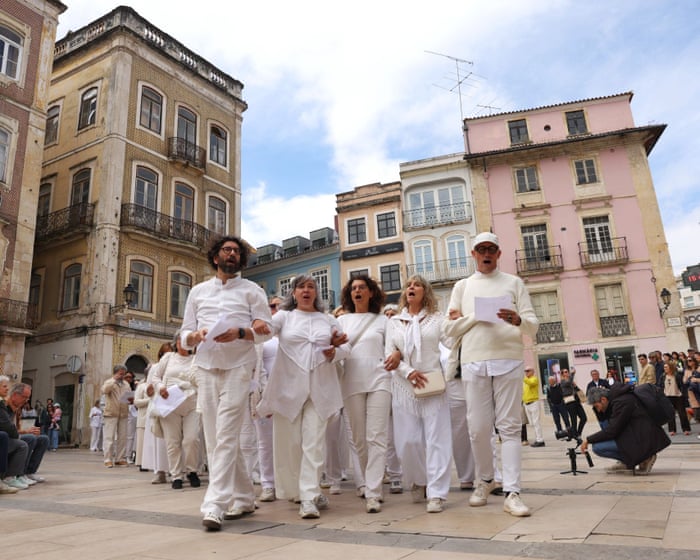
Anozero gets funding from local municipalities and Coimbra University, but it also tries to give back. For the opening, Portuguese artist Vasco Araújo led a group of 260 singers, all dressed in white and from local choirs and music groups, on a march from Coimbra’s central square to the convent. They sang a chorus from Verdi’s opera Nabucco—a pied-piper-style march meant to draw the townspeople up to the temple of contemporary art.
Some works here could be called “festival art” in a derivative way—variations of Taryn Simon’s installation Start Again the Lament have appeared at the Park Avenue Armory in New York, the Cisternerne at the Frederiksberg museum in Denmark, and a secret crypt under Islington Green in London. But at the Santa Clara nunnery, it gains power from the oppressive feel already built into the architecture. It lives up to the manifesto’s promise to create art “which can only happen here and nowhere else.”
Once you come out of the darkness at the end of the long corridor, you can go down brittle stone stairs into the gardens. There, Amsterdam-based architectural designers Inside Outside have cleared weeds from what might have been a washing area, planted citrus and kumquat trees that will grow over the coming years, and set up chairs to “encourage conversations with strangers.” “We understand that the biennale is an attempt to keep the convent grounds open to the public,” says Inside Outside’s Aura Melis. “So we tried to create something that will still be here in two years.”
The intentions are good, but for now all they have to show is a table and some empty chairs. And unless Anozero manages to stop the hotel development, the same space could easily hold a swimming pool before the kumquat trees bear their first fruit.
At times, the biennale seems unsure how forceful a protest it wants to be. In two of the cells, curators have set up twin beds where visitors can stay overnight and watch two long experimental films: Belgian director Chantal Akerman’s La Chambre and Finnish artist Juha Lilja’s Sleep. Is it a parody of the Santa Clara’s upcoming transformation into a hotel? Or a trial run for a compromise? The wall text just calls it an “allusion” to Santa Clara’s “uncertain future.”
Coimbra is home to one of Europe’s oldest universities. If you walk up or down its steep cobbled streets, you pass students in old-fashioned gowns, some carrying large wooden spoons in keeping with age-old student traditions.But it also has a long history of protest culture. The city is unique in Europe for having more than 20 left-wing and anarchist student fraternities, known as repúblicas. With poetic names like Republic of Ghosts and Palace of Madness, these self-managed communal housing projects provide shelter and food for students from disadvantaged backgrounds. They also offer gentler welcoming rituals for first-year students, unlike the hazing practices of more conservative groups. These are places that put mutual care into practice.
View image in fullscreen
‘The biennale attracts a certain elite’ … facade of one of the repúblicas in Coimbra. Photograph: Xavier Dealbert/Alamy
Given Anozero’s anarchist theme, there’s an obvious connection here – some of the repúblicas are right outside the festival’s venues, and many students who live in them work behind the scenes of the biennale. But they are oddly missing from what’s on display. Instead, the curators have filled rooms of the nunnery with books on anarchist town planning in display cases and flow charts showing Kropotkin’s influence on important architects.
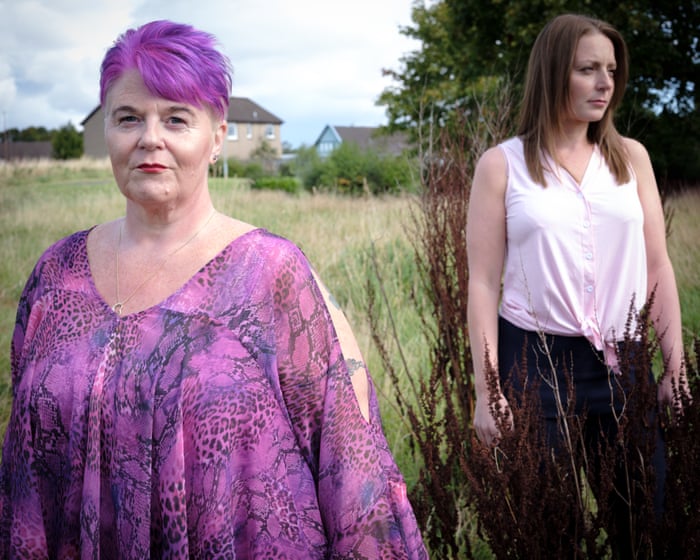
On opening day, two república veterans have made the climb up the hill. Jaime Miranda, 53, and João Paulo Bernadino, 57, stand out among the stylish art crowd. “The biennale attracts a certain elite,” says Miranda. “Young people who live in the repúblicas don’t usually get invited here.” But they’re glad they came. “Now I understand why they’re determined to stay here,” he says, marveling at the building complex. The housing project where they used to live, Real República Boa-Bay-Ela, once faced an uncertain future too. When Portugal’s rental law changed, the students were threatened with eviction. Former residents responded by pooling their money and buying out the landlord.
For its next edition in 2028, Anozero is partnering with Manifesta, the nomadic cultural biennale that moves to a different European city every two years. To make sure it won’t be the last one, they could do worse than learn from the locals. Anozero runs at the Monastery of Santa Clara-a-Nova and various venues across Coimbra until 5 July.
Frequently Asked Questions
Here is a list of FAQs based on the article Has the world gotten tired of art biennials Looking for a cure a Portuguese festival is turning to anarchism
BeginnerLevel Questions
Q What is an art biennial
A Its a large international art exhibition that happens every two years Famous examples include the Venice Biennale
Q Why are people getting tired of art biennials
A Critics say many have become too commercial predictable and disconnected from local communities They feel like a global art fair circuit rather than a genuine cultural event
Q What is the Portuguese festival mentioned in the article
A Its called Anarquivo happening in the city of Porto
Q How is this festival using anarchism as a cure
A Instead of a topdown curated exhibition Anarquivo is embracing a decentralized antihierarchical model Artists collectives and the public are invited to selforganize and create the program together
Q Does anarchism here mean chaos or destruction
A No It refers to the political philosophy of anarchism which focuses on voluntary cooperation mutual aid and rejecting rigid authority or centralized control The festival uses these principles for its structure
Advanced Questions
Q What specific problems with biennials does Anarquivo aim to solve
A It targets issues like the spectacle culture the dominance of bigname curators and galleries exorbitant costs that exclude local artists and the lack of real community engagement
Q How does Anarquivo practically apply anarchist principles
A Key methods include open calls for anyone to propose events a flat decisionmaking process shared resources and a focus on DIY workshops and collective actions rather than polished gallery installations
Q Is this festival the first to try an anarchist model
A No but its a rare explicit case in the contemporary art world It draws inspiration from historical avantgarde movements and radical political experiments but applies them to the specific