Sebastian Brandt, the head technician at Immanuel Hospital in Berlin’s leafy, upscale Wannsee district, knew something was off the moment he opened his window on the morning of January 3rd and smelled diesel. It was a freezing Saturday, and luckily, the hospital across the street had few patients that post-holiday weekend. Looking out, the diesel fumes told him the emergency generator—a huge, deafening machine in the basement that was decades old—had kicked in. That meant the hospital had lost power from the grid. And that meant Brandt’s quiet weekend was over.
An emergency generator can keep a hospital running, but it has limits. Surgeries have to be canceled, and while generators are tested regularly, no one knows for sure what happens when they run for days straight. The generator tank at Immanuel held about 3,000 liters of diesel, and Brandt figured it would burn around 550 liters a day. When the grid operator told the hospital the outage might last until the end of the next week, Brandt was quickly sent to get more diesel from the nearest gas station that still had power. Meanwhile, he heard that a nearby hospice was planning to move its patients to the hospital too.
What Brandt didn’t know—and what would have made his mood even worse—was that his hospital had lost power because, a few hours earlier at around 6 a.m., about 12 kilometers away, someone had set fire to five high-voltage cables attached to the underside of a bridge over the Teltow Canal. This long waterway cuts through the southern part of Berlin.
Almost all of Berlin’s 22,400 miles of power cables are buried underground, but there are weak spots, especially where they cross water. These five cables, each 10 centimeters thick, ran from a natural gas power station and supplied about 45,000 homes, 2,200 businesses, and four hospitals. A photo released later that day by Stromnetz Berlin, the city’s state-owned grid operator, showed them burning brightly as they hung over a pile of burning debris.
Four districts of the city were affected—some of Berlin’s wealthier suburbs, though not exclusively. Power was restored to 10,000 homes by the next day, but the other 35,000 went without electricity for five more days. Whoever did this caused the longest power cut Berlin had seen since World War II.
“I think the people who did this didn’t fully anticipate what would happen,” someone said. “This didn’t hit the system, it hit normal individuals.”
A few kilometers from Immanuel, the attack caused its own problems for Michael Schmidt, director of Hubertus Hospital. This was a much larger hospital, and several surgeries were planned for that morning. “It was good that it happened before 8 a.m., so no one was actually on the operating table,” he told me, sitting in his office a few weeks later.
Within hours, Schmidt was making plans to evacuate the 150 patients in the building. The generator had kicked in, but the heating system had failed. It turned out the pumps that supplied gas to the heating system were outside the hospital grounds and weren’t connected to the generator. “The outside temperature that morning was around -1°C. If the temperature dropped too much, we would have had a problem,” Schmidt said.
In the end, the hospital’s technicians found a way to reroute power to the gas pumps, and the city’s grid operator managed to use emergency power lines to restore electricity to all four hospitals by the next morning. And Brandt didn’t have to spend his week hauling cans of diesel.The surrounding homes stayed dark for another five days. Some elderly residents had to be moved to emergency housing, and local TV news was full of people angry about the lack of information and how the authorities handled things. “It felt a bit dystopian around here,” says Schmidt, remembering how he traveled to and from work by the light of the last few Christmas decorations still glowing on people’s balconies. A blackout that lasts a few days can make people feel less safe—extra security was briefly hired to guard the hospital—but it also brings the community together: locals started showing up at the hospital door, hoping to charge their devices, and the cafeteria became a temporary meeting spot.
Within about a day, Schmidt learned that the blackout was caused on purpose, apparently for political reasons. He pauses when I ask how he feels about that. “I think the people or group behind this maybe didn’t fully expect what would happen in this supposedly wealthy area—not everyone here is rich,” he says thoughtfully. “There are elderly people who need help, in hospitals and at home. This didn’t just hit the system; it hit regular people, and we’re lucky we got away with just a black eye.”
How this act of sabotage was carried out is fairly clear, but who did it is still a mystery, and why is a matter of debate. About 24 hours after the lights went out, a confession was sent to media outlets and posted on left-wing platforms like Indymedia.org, which allow anonymous, untraceable texts to be uploaded and published. The rambling statement, nearly 4,500 words long, was titled “Shutting down fossil fuel power stations is handiwork. Take courage. Militant new year’s greetings.” The author was named as “Volcano Group: Turn off the juice of the rulers.”
This byline placed the blackout in the context of a series of sporadic attacks on Berlin’s critical infrastructure over the past 15 years. There have been at least seven “Volcano Group” attacks in and around Berlin since 2011. The first was apparently inspired by the disruption caused by the Eyjafjallajökull volcano in 2010, which grounded air travel across much of central and northern Europe for several days. The Volcano Group has caused much less damage and inconvenience, and no injuries or directly linked deaths. The first wave of attacks, between 2011 and 2013, targeted railway power lines and cable boxes, and each early confession named a different Icelandic volcano—there was “The Roar of Eyjafjallajökull,” followed by “The Hekla Reception Committee – Initiative for More Social Eruptions” and “Anonymous/Volcano Katla.” The actual name “Vulkangruppe,” or Volcano Group, seems to have been adopted only in 2018, in confessions to later attacks—and even then, the names vary: “Volcano Group against continuing destruction” or “Volcano Group: Tear up net authority.”
View image in fullscreen: An emergency generator provides a supermarket in the Zehlendorf district with electricity during the blackout. Photograph: Christian Ender/Getty Images
After an apparent break between 2013 and 2018, there were more Volcano Group attacks in Berlin, as well as two, in 2021 and 2024, on the power lines supplying the Tesla Gigafactory just outside the city. The latter sabotage was claimed by “Volcano Group shut down Tesla” and cut the factory’s power for several days, causing Elon Musk’s car company financial losses “in the high nine-figure range,” according to a Tesla official at the time.
Investigations into all these acts of sabotage have been taken over by Germany’s federal state prosecutor’s office, meaning they are being treated as serious crimes.At large. But internet sleuths weren’t so sure. Linguists analyzed the Volcano Group’s statement and decided some of the German sounded off. They pointed to misspellings of well-known names—JD Vance, for example, was written as “Vans.” Reddit threads popped up where people ran the text through AI translation tools and claimed it was originally written in Russian.
This might all sound unlikely, but a month later, the federal government admitted investigators hadn’t ruled anything out. “The federal security forces generally follow all leads… including those pointing to other possible groups of perpetrators, as well as the possible Russian authorship of the confession letter,” the interior ministry said in response to questions from Green party MPs.
“We think it’s outrageous that in 15 years they haven’t made any progress in identifying these people,” Green MP Irene Mihalic told me. “The investigative authorities should have enough power to shed some light on this. It’s interesting how little they know.”
Public opinion has been largely against the Volcano Group, especially since, in the days after the January blackout, local TV news showed images of elderly people forced to camp in emergency shelters. Unsurprisingly, Berlin’s leftist scene—a mix of different political currents—was almost united in rejecting the group. “Historically, you never see an underground left-wing group without some kind of above-ground support network. But here, absolutely no one on the left is defending them. That’s unusual,” Berlin journalist and historian Nathaniel Flakin told me.
Inspired by the Russian rumors, some concluded that those behind the Volcano Group weren’t even leftists. Two months before the Berlin blackout, German media reported that the far-right Alternative for Germany (AfD), often accused of being sympathetic to Russia, had submitted a suspicious number of questions to the government about Germany’s critical infrastructure. Could this have been a false flag attack carried out by Russian agents with help from Germany’s biggest far-right party? The idea is “ridiculous,” said Frank-Christian Hansel, an AfD representative in the Berlin state parliament. It was Hansel’s questions in 2024 about the safety of Berlin’s power grid that sparked a small wave of conspiracy theories online after the blackout. “It was my duty as a parliamentarian to ask about resilience. It’s absurd to blame us, who want [Berlin] to be resilient, and suggest we want to give information on how to attack.”
The Volcano Group seemed offended by the idea that they might be Russians or their far-right agents in Germany. On January 8, a second statement appeared on Indymedia, saying such speculation would have been treated as “irrelevant rubbish” in the past, but now “fake news, AI-generated reports, and hybrid attacks have caused uncertainty.”
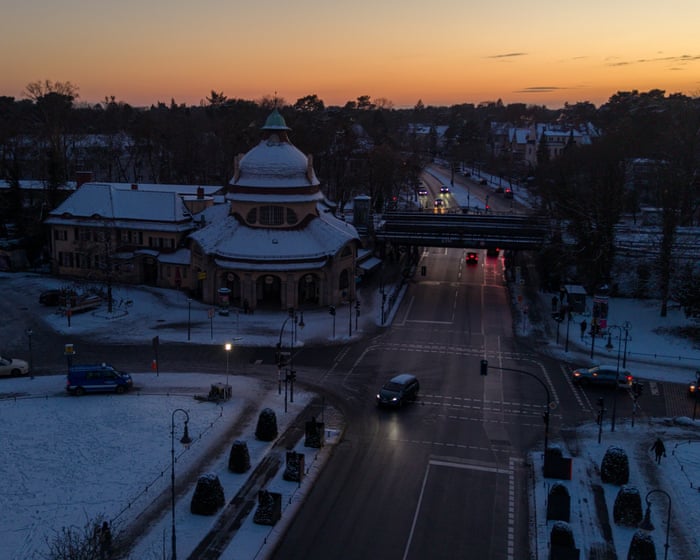
View image in fullscreen: Berlin-Nikolassee station during the power cut. Photograph: Action Press/Shutterstock
By this point, things had started to get really confusing. On January 7, a statement claiming to be from another Volcano Group appeared on Indymedia. This text, titled “Against appropriation and false continuities,” claimed to be from the group that carried out the original 2011 attacks and distanced itself from this year’s blackout. Their quarrel back then was with Germany’s involvement in foreign conflicts and the country’s arms industry, they said. They would never have tried to cause a blackout: “We wanted interruption, not escalation. Disruption of normality, not its destruction.”
The January 3 Volcano Group was annoyed by this and shot back, saying the above statement was obviously a fake, possibly planted by “intelligence agThe statement referred to “agencies and/or fascists.” It said, “This is about disorientation, sowing confusion and division.” Still, there was a strange tone of regret in the later statement too. The January 3 Volcano Group seemed sorry for causing such a major disruption to people’s lives. They claimed their target was the fossil fuel economy, not the people of Berlin, and their only goal was to cut a fossil fuel-burning plant off the grid. “The impact on around 40,000 private homes was neither intended nor expected,” they said. “Knowing what we know now about the consequences for some people, we would have carried out the action in a warmer season,” they wrote, somewhat apologetically. In other words, it seemed like this whole thing had been a big mistake.
Well, of course, thought Tadzio Müller, a veteran of Berlin’s leftist climate movement. “This act was indefensible,” he tells me. He found out about the blackout the day after it happened, while on a train back to Berlin. “I heard ‘power cut,’ I heard ‘arson attack,’ and I was thinking, ‘Please no, please no’ – and then I heard ‘Volcano Group.’ And I was like: ‘Fuck.'”
“I think it was a leftist action, and I think it went horribly wrong.”
Meeting him in his book-filled apartment over a herbal tea, I can see why Müller has become a well-known figure. He’s intense and talkative, a fit-looking 49-year-old with boundless energy. His conversation flows with stories from three decades of activism, mixed with references to a century of leftist and anarchist thinkers. And he has the scars to prove it: Müller has been beaten up by police in Prague, and sobbed with helpless anger at the fence of a British military airfield as planes took off to bomb Iraq in the early 2000s.
In 2015, Müller co-founded Ende Gelände, an environmental action group that is the most militant of Germany’s “above-ground” climate protest organizations. In 2024, he published a book about his journey from climate grief to renewed action, titled Between Peaceful Sabotage and Collapse: How I Learned to Love the Future Again.
When Müller read the Volcano Group’s initial confession, he also felt something was off about the language, but he doesn’t think this necessarily means the blackout was orchestrated by Russian agents. “I think it was a leftist action, and I think it went horribly wrong,” he says.
Müller is certain that the Volcano Group isn’t just made up of frustrated climate activists – people who were once in groups like Fridays for Future, Extinction Rebellion, Just Stop Oil, or the Last Generation and then decided to go militant; the kind of people imagined, for example, by Swedish academic Andreas Malm in his widely discussed 2021 book How to Blow Up a Pipeline. Instead, Müller places the Volcano Group within a specific branch of radical leftism called anarcho-primitivism, which has long pushed for destabilizing the economy through physical sabotage and has taken on a more eco-activist tone in recent years. Hansen seems to agree: they might be disgruntled climate activists, he tells me on the phone, “but I think it’s more likely that they’re people from the militant leftwing extremist scene.”
Müller has never considered going underground, but he does think there’s a useful space to explore between what is legal and what is legitimate. “I’ve said for years that we need to think about the possibility of some kind of publicly justifiable sabotage,” he says. “Like shutting down some tracks to block a train carrying nuclear waste. Sure, it’s illegal, but the country to some extent accepts that it is a legitimate protest.”The legal gray area of civil disobedience is exactly where Ende Gelände operates. Their name roughly means “end of the road,” and they combine environmentalism with anti-capitalism. Since 2024, Germany’s domestic intelligence agency, the Federal Office for the Protection of the Constitution, has labeled the group as engaging in “suspected” left-wing extremism—as opposed to actual left-wing extremism like the Volcano Group. In the late 2010s, Ende Gelände organized several large-scale protests where thousands of people occupied Germany’s coal mines. Unlike the Volcano Group, Ende Gelände’s actions are public and sometimes involve thousands of demonstrators, since they draw many activists from the broader climate movement.
Even though Ende Gelände also targets fossil fuel power plants, they noticeably didn’t express support for the Volcano Group. However, I did find one Ende Gelände activist willing to show at least some sympathy for the cause—if not approval of the methods. Scully, who doesn’t want to share her full name and has taken part in several Ende Gelände actions, has mixed feelings about sabotage. “I wouldn’t say I was happy,” she tells me over the phone when I ask what she thought of the blackout. “But I do support discussing whether we want to carry out sabotage and how we do it.”
Scully believes the chaos on January 3 wouldn’t have happened if the “above-ground” climate movement allowed space to debate such tactics within its ranks, so bad ideas could be rejected before anyone acted on them. She’s convinced that the threat of direct militant action has a role in the fight for climate justice. Like the anarchist group Kommando Angry Birds—thought to be behind at least seven attacks on Germany’s train system since 2023, and which cited inspiration from Nelson Mandela’s speech on acts of sabotage against critical infrastructure—Scully draws a comparison to the anti-racism movement. “It’s the classic argument: Martin Luther King wouldn’t have been as successful without Malcolm X.”
Frequently Asked Questions
Here is a list of FAQs about the mysterious Volcano Group and their Cut the power to the rulers blackout in Berlin
BeginnerLevel Questions
1 Who are the Volcano Group
They are a mysterious activist collective that claimed responsibility for a fiveday blackout in Berlin Very little is known about themthey have no public leaders or official headquarters
2 What does Cut the power to the rulers mean
Its their slogan It means they want to disrupt the systems that they believe support government and corporate control over society
3 Why did they cut the power in Berlin
They said it was a protest against political elites economic inequality and environmental destruction They want people to question who really holds power
4 How did they cause a fiveday blackout
They havent revealed their exact methods Experts suspect they physically sabotaged key power substations or used cyberattacks on the grids control systems
5 Was anyone hurt during the blackout
No reports of direct injuries from the blackout itself but hospitals and emergency services had to rely on backup generators The main problem was widespread chaos and economic disruption
Advanced Deeper Questions
6 Is the Volcano Group a real organization or just a name
Its likely a pseudonym used by a small decentralized network They have no official membership list so anyone could claim to be part of them
7 How could a group like this evade detection for so long
They probably use encrypted communication operate in small independent cells and avoid digital footprints The blackout itself was a onetime event making them hard to track
8 What was the biggest practical problem caused by the blackout
Transportation shut down businesses lost millions and food spoiled without refrigeration People couldnt charge phones or access ATMs creating panic
9 Has this ever happened before in a major city
Not on this scale There have been smaller blackouts from protests or cyberattacks but a fiveday citywide blackout claimed by an anonymous group is unprecedented
10 What can regular people do to prepare for something like this
Keep a small emergency kit with flashlights batteries a batterypowered radio cash and nonperishable food