Where in France can you get a nutritious, balanced three-course meal for just €1? If you’re one of the country’s roughly 3 million higher education students, the answer is: the university restaurant or café.
This month, after a survey showed that nearly half of all students were skipping meals because they couldn’t afford to eat, the French government announced that €1 meals—previously only available to scholarship students based on income—would now be offered to everyone.
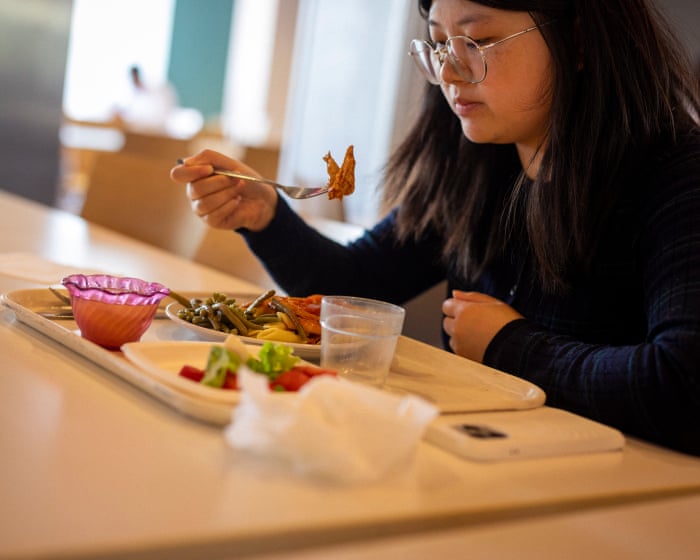
At the Université Paris Dauphine restaurant last week, students were loading their lunch trays with food from one of several counters. For €1 (about 86p), they can choose from a selection of starters, a vegetarian, meat, or fish main course with potatoes and vegetables, and fruit, yogurt, cheese, or a pastry for dessert. On most term days, they can also help themselves to a salad bar or grab a pizza—or both.
Extra dishes cost 55 cents, and coffee is 60 cents. It’s cafeteria food and unlikely to win any Michelin stars, but the dishes are varied, tasty, and generous.
Farid Rouba, the chef who runs the Dauphine university kitchen, said most dishes are made in-house and feature a healthy balance of locally sourced ingredients, many of which are organic. Students have given his menus a thumbs-up, he said.
“They rated us 9 out of 10 in a recent survey. Our customers are the students, and we listen to them when planning the menus. We’re feeding the future of France, and it’s important they eat well.”
Diane Chelkoff, the director of the Dauphine restaurant, said: “Students can have two balanced €1 meals a day here, either eating in or taking away. It helps those who don’t get financial aid but still struggle to make ends meet. Most of the dishes are prepared by us, so we know exactly what goes into them. The chef works hard to create a good, balanced menu and listens to student suggestions.”
During busy term days, the Dauphine restaurant seats 2,400 students across three sittings. Take-away meals are available at the university café next door. Chelkoff said the kitchen is ready for a surge in demand when the university year starts in September.
Théo Pupunat, 22; Jérémy Reyes, 20; Antoine Lebrun, 20; and Maxence Lapras, 21—all students in finance, marketing, or management—were enjoying their lunches and even going back for seconds.
“We eat here every day. There’s always a good variety,” said Reyes, digging into a roast chicken leg with pasta and green beans.
Yuqi Yang, 26, from China, is studying for a second master’s degree in marketing after completing a master’s in linguistics at the Sorbonne. She said: “I don’t have much money, so I always come here to eat. It’s very good.”
Across town at the Mabillon, the university restaurant used by Sorbonne students, Maxime Daniel, 26; Mehdi Aït Naceur, 22; and Julie Bénard, 22, were having lunch with their history professor, Laura Hobson Faure.
“I eat here almost every day, and there’s always a good choice. I’m on a scholarship, so it’s a big saving,” Bénard said.
Aït Naceur agreed: “It’s a financial help for those who aren’t on scholarships but still don’t have much money.”
Daniel, a PhD student, added: “It’s a bit basic. If I had to pay the full price, I’d probably just get a sandwich or something slightly better quality. But for €1, everyone can eat.”
Hobson Faure, who admitted she hadn’t eaten at the restaurant before, praised her meal—which included a main course of lentil and beef patty with potatoes, for which she paid the non-student price of €9.35.”Surprisingly good.”
From 2020 until this month, only students with low incomes or those receiving financial aid for housing and fees—about a quarter of all higher education students—could get the €1 meals. Everyone else paid €3.30, a price that hadn’t gone up in five years. Student unions pushed for the €1 meals to be available to all after a survey showed that nearly half of students were skipping meals to save money, and a quarter were doing so regularly.
View image in fullscreen: Student unions had campaigned to extend the €1 meals to all students, whereas before it was only available based on financial need. Photograph: Ed Alcock/The Guardian
“The country has decided to invest public money in its students,” said Bénédicte Durand, president of the National Centre for University and School Services (CNOUS), the government body responsible for student housing and welfare, in an interview with the Guardian. “Our students are very lucky when you look at what happens in other countries.”
“It’s not just about making life easier for those at university, but also about social and public health,” Durand added. “Obviously it costs the state money, but I strongly believe it’s important not only to feed our students but to ensure that everyone, whether they receive financial aid or not, can sit at the same table with the same meal, and that meal is balanced. And we all know about the public health problems among young people, like sedentary lifestyles and obesity, so this is also a health measure.”
Durand admitted that a universal measure like this is unusual in a system where most social benefits are based on financial need. But she said the €1 meals, served at the 950 restaurants and cafeterias run by CNOUS—including those at teaching hospitals—have full government support. The government has promised to set aside €120 million (£104 million) to fund them next year.
CNOUS is now hiring 200 extra staff and buying more equipment to handle the increased demand.
However, not everyone thinks the €1 meal for all is a good idea. Some future entrepreneurs at Dauphine University felt the subsidy could be better used elsewhere.
“Those who can afford to pay €3.30 should do so. I think it’s unfair that everyone pays the same price when it’s already cheap,” said Lebrun.
Reyes added: “Obviously everyone will say paying €1 for a full meal is great, but I’d rather the money go toward cheaper housing for students.”
Frequently Asked Questions
Here is a list of FAQs about Frances 1 meal program for students written in a natural clear tone
BeginnerLevel Questions
Q What is this 1 meal program in France
A Its a government initiative that allows university students to buy a full balanced meal at a campus restaurant for just 1 euro
Q Who is eligible for the 1 meal
A Its mainly for students who are struggling financially Initially it was for students on scholarships or grants It has since been expanded to include all students who are facing financial hardship
Q How do I prove Im eligible for the 1 meal
A You need to show your student ID and proof of your financial situation If youre on a scholarship your CROUS card usually works If not you may need to visit your CROUS office or apply through your universitys social service
Q Where can I get these 1 meals
A At any university restaurant or cafeteria run by CROUS across France
Q What kind of food is included in the 1 meal
A A standard meal includes a starter a main course a dessert and a baguette Drink is usually extra but cheap
Q Is this program permanent
A It was launched as an emergency measure during the pandemic and inflation but it has been extended multiple times As of now it is still in place but you should check your local CROUS for the latest updates
Advanced Practical Questions
Q Im an international student Can I get the 1 meal
A Yes as long as you are enrolled in a French university or higher education institution and meet the financial criteria Your nationality doesnt matter
Q I dont have a scholarship but Im really struggling How do I get the 1 meal