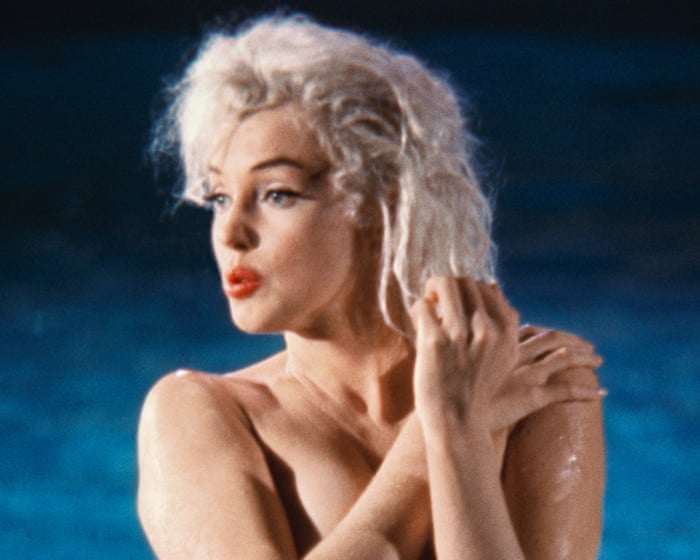
A few days after shooting a nude swimming pool scene for the 1962 comedy Something’s Got to Give, Marilyn Monroe got into her black T-Bird and drove her photographer, Lawrence Schiller, to Schwab’s Pharmacy on Sunset Boulevard. Schiller had brought his negatives, ready to be turned into prints. Monroe had her scissors in her purse. Under the streetlights of the famous Hollywood hangout, she started cutting the color film into pieces.
“Ziiiiiip — the ones she didn’t like,” Schiller says, making the sound. “Ziiiiiip.” She destroyed them? “Oh yeah, but that came with the territory,” laughs the now 89-year-old, the last living photographer of Monroe. He remembers his 25-year-old self bending down to pick up the scraps and thinking: “Well, I would’ve killed that one, too.” In fact, he speaks of her editing with nothing but admiration: “There wasn’t a picture she destroyed that I would’ve published.”
“That was our relationship: I could crack a joke — and she could crack one back that was more poignant and piercing.”
Two months later, Monroe died from a drug overdose. In the six decades since, this version of Monroe — the one who snipped negatives — has often been overlooked in favor of the myth: the so-called “messy” blond bombshell who struggled to control herself and was endlessly shaped by others.
But as Rosie Broadley, curator of the Monroe exhibition opening at the National Portrait Gallery in London, writes in the catalog: “Monroe not only performed, but also directed and claimed the right to veto any images she did not like.” Richard Avedon, Milton Greene, and Bert Stern may have held the camera, but Monroe helped guide it.
This idea is at the heart of the National Portrait Gallery show, timed for what would have been Monroe’s 100th birthday at the start of this month. It presents the star not as a passive bystander, but as an active creator of her own image. By all accounts, Monroe could be fragile, but she could also be tough and determined. She “so brilliantly conveyed” her energy, says Broadley, that it was “frequently at odds” with the reality of her life and struggles when the cameras were off.
Schiller remembers the pool shoot in May 1962, when Monroe jumped into the water and, ignoring director George Cukor’s instructions, swam to where the light was better. In one shot, she lifts her leg out of the water and hooks it on the edge of the pool, like a shimmering nymph. In another, she drops her towel just enough to show the small of her back — smooth like a cello, as if waiting to be played.
Before the shoot, Schiller recalls Monroe asking him: “What would happen if I jumped into the swimming pool with my bathing suit, like they say, but I come out with nothing on?” He replied: “You’re already a famous woman. But if I take those photos, you’re going to make me famous.” Monroe shot back: “Don’t be so cocky, Larry. I could fire you in two seconds.” He laughs. “That was the relationship I had with her: I could crack a joke — and she could crack a joke back that was more poignant and piercing, with a lot of subtext. And you had to understand Marilyn’s subtext.”
This idea was echoed by Eve Arnold, another of Monroe’s photographers. She compared the star to a woman searching for her lost self, with the photographer seeming to give her what she was missing. That observation feels especially true when you look at Schiller’s sparkling photos of her skinny-dipping in the moonlight, showing a joy that hides what was really going on in her life. Monroe was free.That fall, a year after her divorce from playwright Arthur Miller, she had been dealing with gynecological and gallbladder surgeries, a terrifying stay in a psychiatric clinic, and a growing dependence on alcohol and prescription drugs.
“She was showing up for work, but showing up late,” Schiller recalls. “The studio said it was costing them millions, while they were spending millions on Cleopatra.” This brings up another part of Monroe’s story at the time: Elizabeth Taylor, her headline-making affair with Richard Burton, and the $44 million “disaster” they starred in, which nearly bankrupted Twentieth Century Fox a year later. “What was on her mind,” Schiller says, “was: if I do this shoot a certain way, I’ll be on the cover of every magazine in the world—and Liz Taylor won’t be.”
Beyond the rivalry, her naked pool scenes might also have been part of what Arnold called the photograph “giving her back herself.” It wasn’t just about one-upping someone else; it was a complicated attempt to reclaim something—and at 36, that meant reclaiming the past as much as anything.
“I don’t see myself as a commodity, but I’m sure a lot of people have,” Monroe said in her final interview, just a few months after this pool shoot. That reminds me of a conversation I had with photographer Douglas Kirkland in 2015. He remembered an evening in 1961 when he photographed Monroe naked in bed. In some ways, he said, he thought she enjoyed making still images as much as making movies. “Why?” he asked. “Because she could write the script as she went along. She could make things happen. I didn’t tell her, ‘Turn this way, turn that way, do this, do that.’ She did it herself. That was Marilyn.”
This echoes what the National Portrait Gallery has called Monroe’s “creative agency” outside the studio machine, which told her what roles to play, how to look, and where to stand. Schiller agrees. “I don’t think any photographer captured Marilyn, because what they captured is what Marilyn wanted them to capture. She wanted to be the splash in the water with me. She wanted to be the dream in the middle of the night with Cecil Beaton. The short and long of it was: she controlled the still camera.”
Away from the still camera, though, it was a different story. In June, just a few days after Schiller photographed her smiling brightly with her 36th birthday cake, Monroe was found in a depressed state after taking many prescription pills. Five days later, Twentieth Century Fox fired her for repeated absences and sued her for $750,000 for “breach of contract.” The film Something’s Got to Give, about a woman who returns after being lost at sea, was never finished.
Talking to Schiller, I sense he’s careful not to overstate the time he spent with the star so close to her death. “In front of the lens,” he says, “she was someone for me to capture.” Yet he does say there was always something distant, fragile, and harder to grasp. “She was like a deer in the woods. You wanted to capture it before someone shot it. You wanted to get it alive before it no longer existed.” He felt this during their final shoot. “You wanted to photograph her before some tragedy entered her life again.”
The day before Monroe died, on August 4, 1962, Schiller visited her home in the Brentwood neighborhood of Los Angeles. She was “just out there with the flowers,” he recalls, and they talked about a possible Playboy cover. “Then at five…”In the morning, a friend called to tell me Marilyn was dead. I thought it was a joke. But it wasn’t. “I got in the car around 7 a.m. and drove back. By then, the media had surrounded the house, the glass from her bedroom window was broken, and they were taking her body out, covered on a stretcher.”
It was a tragic death, Schiller says—and one he felt he had to bear witness to. “Photography is part of the fabric of my life,” he reflects. And it seems this woman was too. She still is. “Marilyn Monroe came into my life in 1960,” he wrote in his 2021 memoir Marilyn & Me, “and she is still a living, breathing, extraordinary presence.” Her magic hasn’t faded. Marilyn Monroe: A Portrait is at the National Portrait Gallery in London from June 4 to September 6. Lawrence Schiller’s Marilyn & Me is published by Taschen.
Frequently Asked Questions
Here is a list of FAQs about Marilyn Monroes last photoshoot focusing on the boldness of the naked concept and its defiance of Hollywood norms
BeginnerLevel Questions
1 Wait did Marilyn Monroe really show up naked for her last photoshoot
No not completely She posed nude for photographer Bert Stern for Vogue in 1962 just weeks before she died The photos are famous for their intimate vulnerable and defiant tone
2 Why did she agree to do nude photos again She was already a huge star
She wanted to take control of her own image After years of being packaged by studios she wanted to prove she was a serious artist The shoot was meant to show her as raw powerful and unapologeticnot just a sex symbol but a woman in charge
3 Werent people shocked or angry about this
Some were but Marilyn cleverly used the media She posed for the shoot then later gave a famous interview where she said What if I show up wearing nothing at allturning the scandal into a statement of confidence The photos were published after her death but the idea of the shoot was her bold choice
4 What exactly was so defiant about it
At the time famous actresses were expected to be polished modest and ladylike in public By stripping down Marilyn was saying Im not hiding Im not ashamed of my body or my ambition It was a middle finger to the men who controlled her career
IntermediateLevel Questions
5 Did she actually surprise the photographer by showing up naked
No thats a myth The shoot was planned The showing up naked line was a calculated witty remark she made to a reporter to explain her boldness She knew exactly what she was doing
6 How did this shoot change the way people saw Marilyn Monroe
It shifted her legacy from dumb blonde to complex tragic artist The photos are rawyou can see her exhaustion intelligence and fragility They humanized her Today theyre studied as a feminist act of reclaiming her own body and narrative