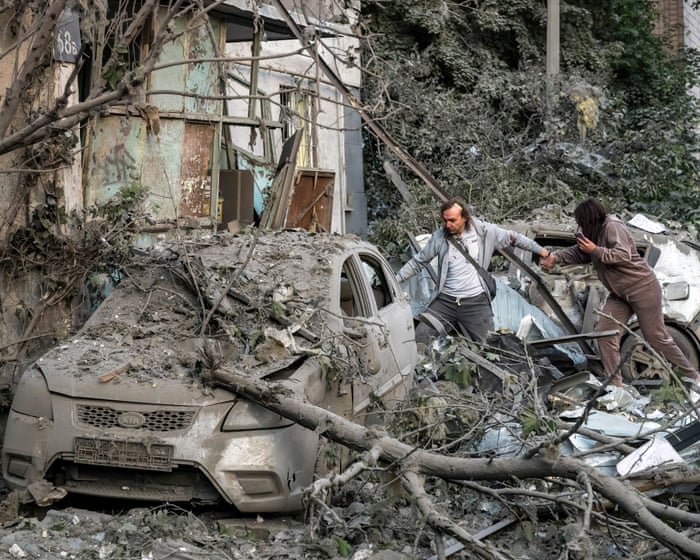
Russia’s war in Ukraine has entered its fifth year, and a ceasefire still seems out of reach. The United States is distracted, which limits outside pressure for a compromise, while both Moscow and Kyiv believe they can improve their bargaining positions by winning more ground on the battlefield.
But at some point, a deal will have to be reached. Negotiators on all sides already understand the basic terms. Russia will abandon its original war goals, and Ukraine will make de facto territorial concessions. The US will offer Kyiv security guarantees to prevent future Russian aggression, and the EU will provide Ukraine with a path to membership, along with help rebuilding the country after the war.
Under Ukraine’s constitution, any peace deal Zelenskyy makes must be approved by parliament and possibly by the public in a referendum. The key to Zelenskyy being able to strike a deal and sell it at home will be the EU’s commitment to Ukrainian membership.
Ukraine joining the EU matters for several reasons. Taking on membership obligations will push reforms in Ukraine that fight corruption and strengthen the rule of law. This, in turn, will attract investment and reduce the cost of postwar reconstruction for European taxpayers.
It would also give the EU more leverage with the US and ensure that European governments have a seat at the table when the final agreement is shaped.
The prospect of Ukraine joining the EU could also help deter a future Russian invasion. While Article 42.7 of the EU treaties—the bloc’s mutual defense clause—is no substitute for NATO’s Article 5 or a US backup for any European peacekeeping force in Ukraine, EU membership would still complicate planning for Russia’s military leaders. This is especially important as long as Donald Trump or his Maga movement hold power. That’s why Ursula von der Leyen, the European Commission president, and António Costa, the European Council president, are framing Ukraine’s accession as the most important security guarantee Ukraine could get.
The benefits aren’t all one-sided. Ukraine joining the EU would make Europe a military and agricultural superpower. Ukraine not only has a much larger army than the UK, France, or Poland—between 800,000 and 900,000 active personnel, depending on how you count—but it also has significant combat experience. Its defense industry has proven highly adaptable, leading in areas like drone innovation. As the US steps back from its promise to keep Europe safe, Ukraine can help the continent move toward greater military self-reliance.
For this to be a credible prospect, however, Ukraine’s EU membership would need to happen almost immediately—closer to 2030 than 2040. But EU leaders are divided on this. Despite warm public statements, many privately oppose Ukraine joining.
The list of concerns is long. Given immigration pressures, many countries oppose granting Ukraine immediate free movement of labor. Fears that Ukrainian agriculture could undercut EU farmers make others reluctant to allow free movement of goods. Strong opposition in France and Poland to the recent EU trade deal with South America’s Mercosur countries shows how tough this issue will be.
EU capitals also worry about corruption and the rule of law in Ukraine, especially given the EU’s past failure to address these problems in countries like Hungary once they’re in the club. Another challenge is how the EU would handle territories in eastern Ukraine’s Donbas region, whose sovereignty is likely to remain disputed. While Cyprus’s EU membership could serve as a model (EU law doesn’t apply to Turkish-controlled Northern Cyprus), the issue remains complex.In Northern Cyprus, dealing with a hostile Russia would be far more complicated. The budget impact would also be huge. Since Ukraine is agricultural and much poorer than the EU average, the money needed to support its farming and help it catch up economically would be enormous, leading to major transfers from southern, central, and eastern Europe to Ukraine. Another issue is that France and the Netherlands would likely need referendums to approve Ukraine joining the EU. The precedent this would set for other applicants in the western Balkans, as well as Moldova and Georgia, is also a big concern.
None of these challenges are easy. But EU leaders in national capitals and Brussels are nothing if not resourceful, and they can surely find solutions, as they have in past crises. During the Greek financial crisis, despite a no-bailout clause in the EU treaty, governments still managed to send over €200 billion to Athens between 2010 and 2018 to keep the country afloat and prevent a bigger crisis that could have threatened the entire eurozone.
Sticking to the old, painfully slow EU “enlargement” process would keep Kyiv waiting for most of a decade. But admitting Ukraine faster will require new thinking. One idea—currently rejected by the 27 governments—is “reversed membership,” where Ukraine would join the EU but not get all the benefits and rights right away. Instead, Kyiv would negotiate its way into the single market in stages over time, but from inside the club rather than outside.
Another idea is using “safeguards,” where Ukraine could lose funds, access to the single market, and certain voting rights if it fails to follow through on reforms. To manage the budget impact of fast membership, long-term opt-outs could be put in place, meaning Kyiv would only get full access to EU funds after 10, 15, or 20 years. German Chancellor Friedrich Merz’s recent proposal of “associate membership” hints in this direction, even if it wasn’t well received. Full membership would be a long-term goal. After all, many current EU members are still not part of the eurozone or the Schengen free-travel area.
None of this is easy. But the alternative—possibly jeopardizing a Ukraine-Russia peace deal—is surely even harder to accept. If the war continues, it can’t be because EU leaders failed to see how important this moment is for offering Ukraine a credible and fast path to EU membership that it needs—and deserves.
Mujtaba Rahman is the managing director for Europe at Eurasia Group, a political risk research and consulting firm.
Do you have an opinion on the issues raised in this article? If you would like to submit a response of up to 300 words by email to be considered for publication in our letters section, please click here.
Frequently Asked Questions
Here is a list of FAQs based on the article by Mujtaba Rahman covering the argument that the EU should speed up Ukraines membership
BeginnerLevel Questions
1 What does speeding up Ukraines membership actually mean
It means fasttracking the normal application process so Ukraine joins the European Union much faster than other countries have in the past possibly skipping some steps or setting shorter deadlines
2 Why does the author say the EU has the most to gain
The article argues that a stable prosperous and EUaligned Ukraine on Russias border is a huge strategic win for Europe It would secure trade routes strengthen the EUs military and energy security and prove that the EU can be a powerful geopolitical player
3 Isnt letting Ukraine join risky for the EU
Yes its a big risk Ukraine is at war has a weak economy and is a massive agricultural producer But the author argues that the longterm benefitslike a secure eastern border and a loyal allyoutweigh the shortterm costs and risks
4 What is the main problem with the normal EU membership process
The normal process usually takes 1015 years and requires huge reforms The author believes this is too slow given the current war and Russias aggression Waiting that long could destabilize Ukraine and the whole region
AdvancedLevel Questions
5 How does Mujtaba Rahman suggest the EU get around the usual membership rules
He implies the EU should use political will and creative legal mechanismslike phased integrationwhere Ukraine gets access to EU benefits before fully joining while still doing the required reforms
6 What specific economic or security benefits does Ukraine offer the EU
Ukraine has huge agricultural potential a large skilled workforce critical mineral deposits and a massive military that can defend Europes eastern flank It also offers a direct alternative to Russian energy supplies
7 What are the biggest internal obstacles within the EU to fasttracking Ukraine
The main obstacles are
Hungary and Slovakia Their leaders are friendly with Russia and could veto the process
France and other big farmers They worry about cheap Ukrainian grain flooding their markets