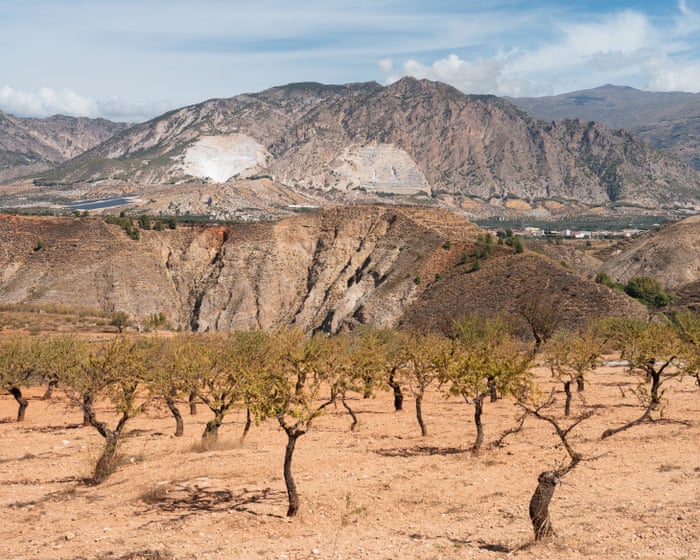
The European Commission is planning to revise the EU’s main water protection law to speed up the development of mines for critical minerals, even though many of these mines are located in regions that are drying up or facing water shortages, according to an analysis.
Mining uses a lot of water—for processing ore, controlling dust, managing waste, and draining mines. While modern projects recycle water, they still need large amounts, and in areas with water stress, this can put extra pressure on already strained rivers, groundwater, and water supplies.
An analysis and mapping project by Watershed Investigations, shared with the Guardian, found that more than half of the 33 planned new or expanded mines labeled as “strategic projects” under the EU’s Critical Raw Materials Act are in areas that have been getting drier over the past 20 years, based on NASA satellite data.
Nearly half of these mines are in zones that have experienced drought in the last three months, according to EU data, and a quarter are in regions considered water-stressed.
Six of the strategic mines are planned for highly water-stressed areas in Spain, with others in Portugal and Greece. All three countries are among the top 10 EU nations with the worst water scarcity, according to the European Environment Agency.
In 2024, the Spanish region of Catalonia declared a state of emergency due to its worst-ever drought, and water-use restrictions were imposed in Andalucía. In 2022, 96% of Portugal experienced “extreme” or “severe” drought conditions, according to the EU’s Earth observation program.
Some projects have already faced strong opposition. The environmental group Ecologistas en Acción is challenging the European Commission’s decision to grant strategic project status to all six Spanish mines, arguing that it didn’t properly consider risks to water resources, biodiversity, and protected areas.
Global demand for critical minerals has tripled since 2010 as countries rush to build AI infrastructure, electric vehicles, renewable energy technologies, and defense systems. It is expected to more than double again by 2030, with demand for graphite, lithium, and cobalt projected to rise nearly 500% by 2050 compared to 2020 levels.
Worried about its reliance on imports, the EU has designated 47 mining, processing, and recycling projects as “strategic projects,” including 33 mines. This status fast-tracks these projects through permitting processes and is meant to speed up development. Projects outside the EU will receive political support and potential access to EU funding.
In a move that has alarmed environmental groups, Brussels is also preparing to revise the Water Framework Directive (WFD), the EU’s key law protecting rivers, groundwater, and wetlands. The stated goal is to remove permitting bottlenecks and improve access to strategic minerals.
Euromines, the trade association for Europe’s mining and metals industry, has been pushing for these changes. It wants longer deadlines for countries to meet water quality targets, changes to how the WFD’s “no deterioration” rule is applied to water bodies, and greater legal certainty for mining and other industrial projects.
Environmental groups fear the proposed changes could weaken protections, but the industry body rejects this and insists it is “not a license to pollute.”
A Euromines spokesperson said: “Our main priority remains working constructively with policymakers to ensure strong environmental safeguards, along with legal clarity and predictability for permitting authorities.”
The European Commission defended its choice of mines, saying the strategic projects were assessed by independent experts and must comply with EU environmental law. A spokesperson said the WFD review would look at ways to improve access….to critical raw materials while protecting the environment and human health, with environmental and water impact assessments carried out by national authorities.
But Sara Johansson, a water policy manager at the European Environmental Bureau, called the plans reckless. She said the mining industry had “not presented a shred of evidence” that the Water Framework Directive (WFD) was creating bottlenecks for mining projects.
“Dismantling those protections undermines Europe’s water resilience and leaves taxpayers, farmers and communities to pay – both with their health and their wallets,” Johansson said.
Professor Kaveh Madani, director of the United Nations University Institute for Water, Environment and Health, also warned against removing protections. “The safeguards now being portrayed as obstacles are already fragile and full of gaps. Removing them may be celebrated as efficiency today, but history may judge it as recklessness tomorrow,” he said.
He added: “Fast-tracking mining in water-stressed regions by weakening safeguards is a form of Russian roulette. It may look like an economic booster in the short term, but one serious failure in the wrong location can neutralise many of the promised gains – especially when the damage to people, rivers, aquifers and ecosystems is long-lasting or irreversible.”
Several companies contacted disputed suggestions that their projects would place undue pressure on water resources. They pointed to environmental assessments, closed-loop water recycling systems, monitoring programmes, and regulatory oversight designed to minimise risks.
Frequently Asked Questions
Here is a list of FAQs based on the article title and topic written in a natural tone with clear answers
BeginnerLevel Questions
1 What does Its like playing Russian roulette mean in this context
It means the strategy of mining critical minerals in waterscarce areas is extremely risky Just like Russian roulette you might get lucky for a while but the potential for a disastrous outcome is very high
2 What are critical minerals
These are minerals like lithium cobalt and copper that are essential for making batteries electric vehicles solar panels and other green technologies Europe needs them to switch to clean energy
3 Why is Europe supporting mining in areas with water shortages
Europe wants to secure its own supply of these minerals so it doesnt have to rely on countries like China Many of the best deposits are in dry regions so Europe is backing projects there despite the water risks
4 How does mining cause water problems
Mining uses huge amounts of water to process minerals It can also pollute local water sources with chemicals In areas already short on water this can leave local communities and farms with nothing to drink or irrigate with
5 Is this happening right now
Yes Projects are being planned or expanded in places like the Atacama Desert in Chile and parts of Spain and Portugal where water is already very scarce
AdvancedLevel Questions
6 What are the specific tradeoffs between Europes green energy goals and local water security
The tradeoff is that Europe needs these minerals to build a lowcarbon future but mining them can destroy the water supply for local people and ecosystems Its a shortterm environmental cost for a longterm climate benefit
7 How does the water footprint of mining compare to other industries
Mining for metals like lithium can use 500000 gallons of water per metric ton of mineral Thats far more waterintensive than agriculture in many cases and much more than manufacturing or services In a droughtprone area this can be catastrophic
8 What are some realworld examples of this conflict