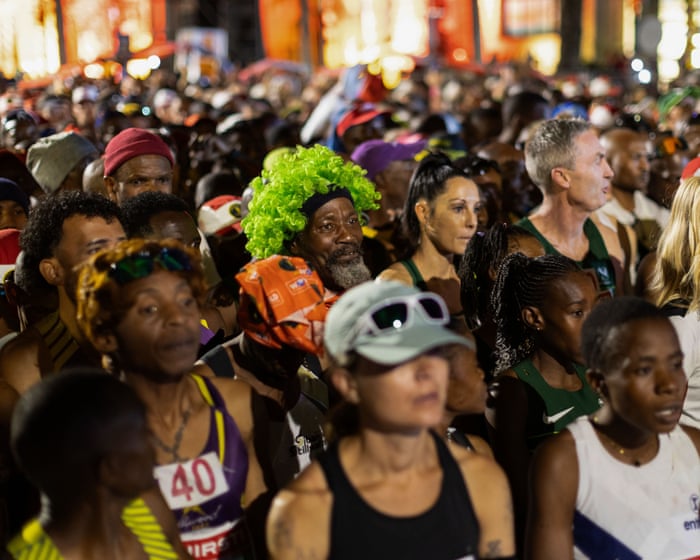
In the early morning darkness, thousands of runners waited, buzzing with excitement. South Africa’s national anthem played. Then came the haunting sound of Shosholoza, a song first sung by Zimbabwean migrant workers in South Africa’s gold mines. Finally, that unforgettable, spine-tingling piano melody: Chariots of Fire.
At 5am, a rooster crowed. A gun went off. The runners surged across the start line of the Comrades marathon.
The Comrades is the world’s oldest and largest ultramarathon. The first race in 1921 took runners 54.6 miles (88km) from Pietermaritzburg downhill to Durban on the coast. The next year, the race went in reverse, uphill back to Pietermaritzburg, and it has switched direction every year since, only stopping for World War II and the Covid-19 pandemic. Over its 99 editions, the route has averaged just under 55 miles.
That first year, 34 runners—all white men—lined up for the race. It was created by World War I veteran Vic Clapham to honor his fallen comrades. Sixteen of them finished. More than a century later, on June 14, over 20,000 people gathered outside Durban city hall, hoping to reach Pietermaritzburg before the 12-hour cutoff.
What started as an all-white, all-male test of endurance has become woven into South African life. It’s so common that you’d be hard-pressed to find someone here who doesn’t know a Comrades finisher.
Running clubs bus in from all over the country. Security guards and shop workers line up alongside bankers and celebrities. And for one day every June, South Africa’s deep racial inequality seems to fade away.
You hear it all around the race: every runner has their own reason. William Seleka started running in March 2025, while struggling with deep depression after his marriage ended. “I thought that to stay alive, I had to keep myself busy,” he said, stretching before a run outside the single room he rents in the Johannesburg township of Alexandra, two weeks before Comrades.
Seleka was convinced to join Run Alex, a local club. Six months later, having never run more than 10km, he finished a 50km ultramarathon from Johannesburg to Pretoria.
“I used to hear people say, ‘This is Comrades, you’re running from Durban to Pietermaritzburg.’ I said, ‘That’s crazy, you can’t do that.’ But now we’re facing reality—I’m doing it too,” he said.
To train, Seleka ran at least 10km every weekday evening after a day repairing appliances for fridge-maker Smeg. On Saturdays, the 38-year-old would run up to 50km with Run Alex. “Recovery,” he said, was a half marathon.
Seleka said he wanted to create a legacy for his 15-year-old son and three-year-old daughter. “I can’t wait to get my red cap and the medal to show my kids.”
On a Comrades “up run,” runners must climb about 1,800 metres (5,900ft) on their way to Pietermaritzburg, which is 650 metres higher than Durban. This year, runners started in three groups, at 5am, 5.15am, and 5.30am.
About 12 miles into the race, the sun began to rise over Pinetown, a suburb above Durban. “Let’s go! Let’s go!” spectators shouted. Seleka appeared up the hill. “Good to see you,” he beamed, leaning in for a quick hug.
In 1923, Frances Hayward became the first woman to start and finish the Comrades. In 1935, Robert Mtshali was the first black man to complete the race. Still, with ongoing…Only white men were officially allowed to compete, so the Comrades seemed destined to stay what most ultramarathons remain today – a niche, elite pursuit.
View image in fullscreen
View image in fullscreen
L-R: A runner gets a leg rub from a volunteer along the route in Camperdown; spectators cheer on the runners in Pinetown.
That changed in 1975, when the privately run race was desegregated and also opened to women. At the time, South Africa was banned from all major global sporting events because of apartheid, which drove the sport-obsessed country crazy.
“Some people in the sporting world in South Africa thought that if they started desegregating a few minor sports, it would show that South Africa isn’t as backward and racist as it’s made out to be,” said Ryan Lenora Brown, a journalist who has covered the Comrades since 2017.
Then TV arrived in 1976. The single, heavily censored state channel began showing Comrades highlights. In 1986, it broadcast the entire all-day race in full.
South Africans were captivated by the sight of delivery driver Hoseah Tjale going head-to-head with Bruce Fordyce, a professional athlete who won eight Comrades in a row starting in 1981.
View image in fullscreen
Runners fill the road from Durban to Pietermaritzburg.
“In the 1980s, you’d see a white runner sharing a bottle of water with a black runner. It was such a small gesture, but it meant so much in a society that was so divided,” said Brown.
Apartheid had pushed black South Africans to the lowest levels of society. But Tjale and Sam Tshabalala, the first black man to win the Comrades in 1989, proved they could achieve anything.
View image in fullscreen
View image in fullscreen
L-R: Supporters take photos with a runner in Pinetown; spectators line the route out of Camperdown.
As the runners left Durban, they wound their way uphill through lush trees, open fields, and small towns. Families barbecued by the roadside. Running clubs handed out supplies from gazebos blasting music. Everyone was cheering the runners, urging them on.
By the halfway point, most were walking up every hill. At the Run Alex aid station, Seleka changed into a spare pair of shoes. It was the wrong choice: by 34 miles, he was in agony. The only way he could distract himself from the pain was by counting or singing.
View image in fullscreen
William Seleka near Camperdown.
“I’m not someone who goes to church,” he said. “But that day, I started to sing. I don’t know where those songs came from.”
Around 46 miles, Seleka found another Run Alex aid station and put on a clubmate’s shoes. He pushed on.
The light turned golden. Some runners danced across the finish line with arms outstretched. Some crossed arm in arm, complete strangers who had become friends on the road. Many stumbled over the line, or collapsed and were carried away on waiting stretchers.
Darkness began to fall. Guns were fired for the first 12-hour cutoff, and then the second. About a third of Comrades runners finish in the final hour.
View image in fullscreen
An official prepares to fire the shot to mark the final 12-hour cutoff.
South Africa’s pacing “buses” are unique in long-distance running for their size and camaraderie. Runners sing and chant, led by a metronomic pacer known as a bus driver. Perhaps the biggest cheer of the day came when the final 12-hour bus driver, Shahieda Thungo, crossed the line at 11:56:34, carrying dozens of runners home with her. About 91% of runners finished this year, according to The Running Mann blog.
View image in fullscreen
View image in fullscreen
L-R: Jenny Da Silva misses the 12-hour cutoff time by seconds; an exhausted runner rests shortly after crossing the finish line in Pietermaritzburg.
Then there were those who just missed the cutoff. At exactly 5:30 p.m., a wall of people stepped across the finish line. Two women ran into them, just seconds too late. One, wearing the green bib of a 10-time finisher, doubled over in anguish.Her face was in her hands.
At the Comrades ultramarathon finish line, Seleka cried as he crossed at 10:30:49. He was thinking of his sister, whose kidneys failed in 2018. “At the start, everything changed,” he said. “I told myself, this pain today is for my younger sister.”
View image in fullscreen
A runner crosses the finish line of the 2026 Comrades Marathon in Pietermaritzburg.
Everyone needs a reason to finish the Comrades, said Seleka, who was already planning his race for next year. “If you’re going through a lot, once you say why, it becomes a mission,” he said. “After Comrades is done, it’s a new chapter again.”
Frequently Asked Questions
Here is a list of FAQs about the worlds largest ultramarathon based on the description provided
Beginner Questions
Q What exactly is an ultramarathon
A Its any footrace longer than the standard marathon distance of 262 miles This one was a massive event with 20000 runners
Q How far do runners go in the worlds largest ultramarathon
A While the exact distance isnt stated in your description most large ultramarathons are 50 km or 100 km Some are even 100 miles
Q Is it normal for people to cry during an ultramarathon
A Yes absolutely The sweat tears and friendship line is very real Runners often cry from exhaustion pain relief or joy from finishing Its a very emotional experience
Q Do you have to be a professional athlete to run one
A No While elite runners compete most participants are regular people with fulltime jobs who train hard for months The focus is often on finishing not winning
Q How long does an ultramarathon take to finish
A It varies wildly A 50 km race might take 512 hours A 100mile race can take anywhere from 15 hours to over 40 hours for the last finishers
Advanced Questions
Q How do runners deal with blisters and chafing during a 100mile race
A They use specialized antichafe balm wear moisturewicking socks and change shoes and socks at aid stations Many also pretape hot spots on their feet and use lubricant between their toes
Q What do runners eat and drink during an event this long
A Its not just water and gels They rely on real food like boiled potatoes salted watermelon pickles broth flat soda and even ramen noodles to get calories and salt They drink water sports drinks and sometimes cola for a caffeine boost
Q How do runners go to the bathroom during the race
A Most races have portable toilets at aid stations In remote sections runners may step off the trail into the woods following