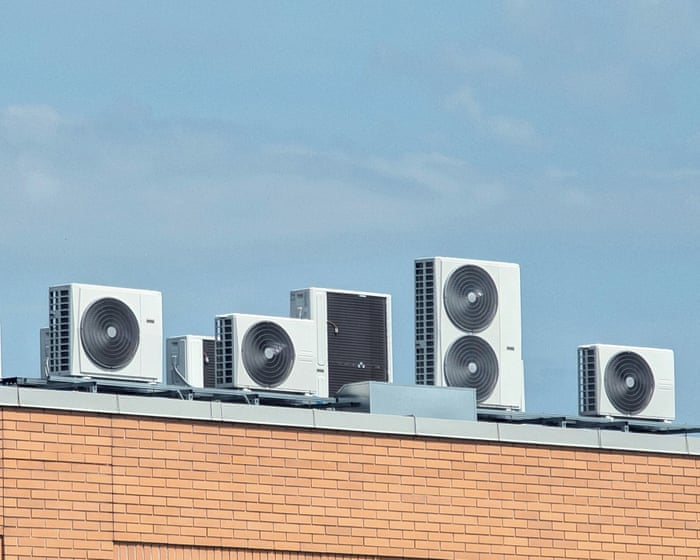
As Britain endures Europe’s worst heatwave on record, many households are, for the first time, seriously thinking about getting air conditioning. Left-leaning critics have often opposed AC, arguing there are cheaper and more eco-friendly ways to cope with extreme heat. But after decades of underinvestment have left the UK woefully unprepared for more heatwaves, maybe it’s time to reconsider the progressive stance on air conditioning.
Like many new technologies, air conditioning can bring major benefits but also real downsides, like raising outdoor temperatures and increasing global emissions. Stubbornly ignoring these harms, as AC supporters often do, isn’t helpful. But refusing to consider how mechanical cooling systems could play a more constructive role in progressive climate adaptation is just as narrow-minded.
Any left-leaning approach to air conditioning must start with efficiency. Right now, AC in Britain is installed in a terribly inefficient way—piecemeal, household by household, with no economies of scale or strategic planning. The technology itself is often clever. But when used on its own, it can become extremely wasteful. Cooling the air inside a building without also stopping that air from heating up again is like trying to fill a bathtub with the plug out.
Many British homes overheat simply because they lack good insulation and external shading. This week, my neighbour, struggling in the heat, hung a sheet outside his window to see if shading could stop his bedroom from overheating. He found a 17.8°C difference between the temperature inside his unshaded windows and the shaded ones—that’s like having multiple 400W radiators running at full power. Sure, he could install AC, but without cooling down his windows first, he’d be wasting money. And what happens when his AC unit breaks down, as many do during long heatwaves?
That said, there are specific situations where installing external awnings, shutters, or louvres—common in hotter parts of Europe like southern France and Spain—still might not be enough to keep temperatures down during the hottest times of the year. In those cases, using a moderate amount of air conditioning makes perfect sense, as long as it’s in addition to, not a replacement for, lower-emission cooling methods.
“Individual air-con units are the bottled water of urban cooling,” says Smith Mordak, former CEO of the UK Green Building Council. “What we need instead are the equivalent of mains water solutions: shared, available to everyone, and transformative for public health.” For Mordak, it’s not that air conditioning should never be used, but that its installation should focus on improving public health rather than private luxury.
Public transport is a great example of smart, strategic AC use. You can’t easily attach awnings or thick insulation to the outside of trains or buses, but without reliable, comfortable public transit, entire cities suffer. Everyone on the left of British politics should be calling for more air conditioning on public transport. The fact that most London buses still don’t have cooling systems, while almost all private taxis do, is a serious misallocation of resources.
Transport offers a useful comparison here. Air conditioning systems are, in many ways, like cars. Used well—with proper licensing, regulation, and alongside other forms of transport—cars are great. But if they’re unleashed without any strategic oversight as a one-size-fits-all solution, cars can quickly ruin cities and cause unchecked pollution. Similarly, air conditioning, used strategically, could be liberating. It’s only if we keep going with today’s purely market-driven AC boom, without a serious plan to expand less energy-intensive cooling methods or ensure cooling is shared fairly, that the technology will make inequality worse and speed up climate breakdown.
What’s more, dealing with extreme heatThis is a huge opportunity for creating skilled jobs and profitable state-owned enterprises—something the left should fully support. The French government already holds major stakes in key industries like energy, transport, and communications. As temperatures rise, cooling systems will become just as essential to a functioning society as other basic infrastructure. Leftists should seize this chance to push for public ownership of the cooling sector, ensuring democratic accountability and preventing corporations from profiting at the expense of desperate consumers.
Licensing also matters. Right now, there are no serious rules on where or how air conditioning can be installed—only who can afford it. Wealthy households can put in whatever system they want and run it as hard as they like, without caring about their neighbors or the climate. At the very least, simple rules should require buildings to adopt lower-emission cooling strategies before they can get an air conditioning permit.
The answer to overheating isn’t just air conditioning, because there’s no single solution to a problem as complex as climate adaptation. Instead, we need a mix of approaches: planting more trees to cool cities, using European-style external shading like awnings and shutters, upgrading insulation, setting up ambient loop heat networks, and improving cross-ventilation. Relying solely on air conditioning would be disastrous, making the very problem it’s supposed to solve even worse. But when used alongside other cooling measures, it has an important role to play, and it’s unhelpful to pretend otherwise. The progressive stance on air conditioning shouldn’t be about whether to use it at all, but about where, how, and alongside which other infrastructure upgrades it can have the most positive impact.
Phineas Harper is a writer and curator.
Frequently Asked Questions
Here is a list of FAQs based on the premise that air conditioning access is a progressive issue not a luxury
BeginnerLevel Questions
1 What do you mean Air conditioning isnt just for the wealthy
It means that access to cooling is becoming a matter of survival and health not just comfort As heatwaves get worse people without ACoften lowincome families the elderly and those in poorly insulated housingface serious risks like heatstroke and death Treating it as a luxury ignores this reality
2 Isnt AC bad for the environment How can that be progressive
It can be if we use old inefficient units and dirty energy The progressive argument is for sustainable efficient cooling using heat pumps solar power and better building design Its about making sure everyone has access to safe cooling without destroying the planetnot banning AC but greening it
3 Why should my taxes pay for someone elses air conditioning
Think of it like public libraries fire departments or winter heating assistance Extreme heat is a public health emergency Paying for cooling for vulnerable people prevents hospital visits saves lives and keeps people productive Its a shared investment in community resilience
4 Cant people just use fans or go to a public pool
Fans stop working when the air temperature is above your body temperaturethey just blow hot air Public pools and cooling centers are great but they arent available 247 for sleeping working from home or caring for a sick child Home AC is a consistent reliable solution
5 Who specifically needs AC the most
People with chronic health conditions the elderly infants pregnant women outdoor workers and those living in poorly insulated apartments or heat islands
Advanced Questions
6 How does the lack of AC worsen economic inequality
It creates a cooling poverty trap A lowincome family without AC may face 1 Lost wages from heatrelated illness 2 Lower property value 3 Higher electricity bills if they run a struggling window unit inefficiently Meanwhile wealthier families have central AC home offices and backup generators