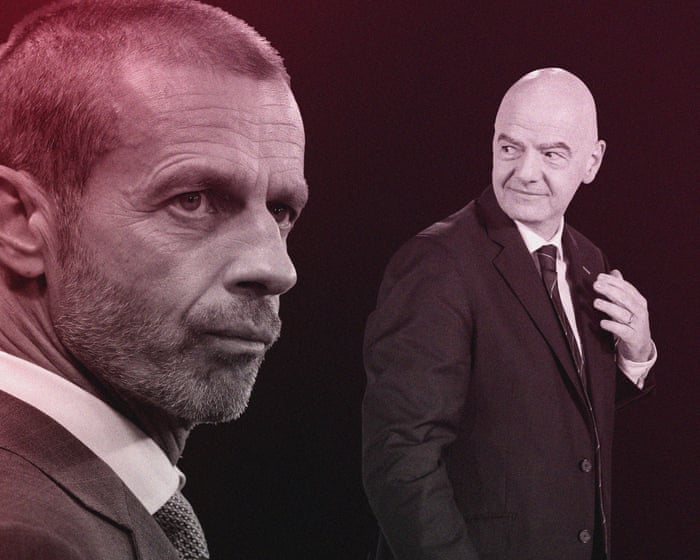
As the World Cup was winding down, a top figure in European football was thinking about how Gianni Infantino might try to clean up the mess left by the Folarin Balogun scandal. The answer came down to money. “He’ll just announce more funding for everyone,” was the general idea, though the tournament ended without any explanation of how FIFA would divide up its record $15 billion (£11.2 billion) earnings.
That was just the beginning. Infantino’s plan to sell parts of the World Cup to private investors, announced nine days after the final, has shocked the football world and left senior officials scrambling. There’s little time to organize a response, since FIFA—right in the middle of what passes for football’s holiday season—has given national associations until September 19 to decide whether to accept an initial $20 million (£15 million) payment that would essentially count as backing the new plan.
The FA joins criticism of FIFA’s plan to sell World Cup stakes to private investors. Read more.
The reaction needs to come quickly. Maybe, as UEFA considers its next move, it will look back to 2021 and remember the credit it earned by blocking the proposed European Super League. FIFA’s plan, which could give private investors a say in how and when its tournaments are run, is potentially more far-reaching and global in scale. If football’s future has been on a ticking clock under Infantino, the time is now one minute to midnight.
UEFA’s quick response to the plan fits with its renewed willingness, sharpened by several clashes over the past 15 months, to take aim at FIFA. “This crosses a line that football’s governing institutions should never cross,” it said. But anyone feeling a sense of déjà vu only needed to look back three weeks. On July 6, another UEFA statement said the suspension of Balogun’s case “crossed a red line.” These are strong, accurate words, but they can only be used so many times.
Infantino can push his proposals through by relying on votes from the overwhelming number of national associations—mostly outside Europe—that remain loyal to his leadership. But a show of strength from football’s most powerful continent, a sporting giant that has dominated both on the field and through the financial power of its institutions, would be a major blow to FIFA. It would only take concrete action from a handful of Europe’s major nations, with their governments working together, to make any plan to sell off football’s crown jewels unworkable.
View image in fullscreen: Fireworks go off at New York New Jersey Stadium as Spain’s Rodri lifts the World Cup. Photograph: Mike Segar/Reuters
Who will step up? This is a moment to remember that, as the Guardian revealed in mid-July, more than 200 of FIFA’s 211 members have already submitted letters supporting his candidacy for re-election early next year, which seems like a done deal. Most of those resisting significant pressure to offer support are from Europe, with Germany being the most high-profile holdout. But England’s FA, which is looking to confirm its hosting of the 2035 Women’s World Cup, was quick to offer its own endorsement well before this summer.
Then there are cases like Finland, whose FA president, Ari Lahti, said in June that his country aimed “not to be an eyesore” by refusing to back Infantino. This is a common stance, even among federations that are vocal in private about their disgust for FIFA’s disregard for norms and its closeness to the Trump administration. Countries of all sizes now have a duty to put the beauty contest on hold.
Any talk of boycotting future World Cups—which would surely have to include the women’s edition in Brazil next year—is complicated by a section of FIFA’s own rules that says its members are required to take part in its competitions. The only way to avoid financially punishing sanctions may be to threaten the most radical step of all: leaving FIFA….and the creation of a new governance model for football.
UEFA’s position may become more complicated because of its close ties with the European Football Clubs (EFC), which have been quiet so far. The EFC wants to set up a joint venture with FIFA to run the Club World Cup. UEFA and EFC already run a joint venture called UC3, which handles the commercial side of UEFA competitions. But a key difference from FIFA’s proposal is that UC3 doesn’t involve private capital.
Somehow, everyone needs to be brought together if Infantino is to be challenged. Another approach would be to slow him down by putting forward a serious opponent in the next election. After the Balogun affair, conversations with people at all levels of the sport wondered whether UEFA might back its own candidate for the FIFA presidency in March. The general feeling was that it’s too early for that, and this period will be about positioning for 2031, when, under FIFA’s current rules, Infantino must step down.
Is the World Cup for sale? Here’s what FIFA’s plans mean and what happens next | Paul MacInnes
Read more
But there’s no time to play a long game when Infantino plans to quickly carve up football’s future among private interests. There’s also no time to wait for a response from the European Commission to the complaint filed by FifPro (the global players’ union) and the European Leagues organisation in October 2024 about FIFA’s control over the international match calendar. A favorable outcome could put obstacles in the way of any plans by FIFA or its private investment partners to expand tournaments, but no resolution seems close.
UEFA and Europe must take the lead now and reject the current situation. Doing so might reveal unexpected allies. There are certainly countries in Asia and other confederations that would be open to clear suggestions for a better path. The fear is that a rush of vague statements, like the one from the Danish FA—which responded to Infantino’s plan by stressing the need to “gain a complete understanding of the proposal and the process behind it”—will lead to nothing but the usual delays and quiet acceptance. Bravery and strong resolve are needed now, more than ever, if football is to survive in anything close to its current form.
Frequently Asked Questions
Here is a list of FAQs based on the statement UEFA needs to show some backbone Taking real action could make FIFAs World Cup plans impossible to carry out
BeginnerLevel Questions
Q What does it mean for UEFA to show some backbone
A It means UEFA should stop giving in to FIFAs demands and instead stand up for its own interests even if it causes a big fight
Q What specific FIFA plans are we talking about
A The main plan is FIFAs idea to hold the mens World Cup every two years and to expand other tournaments
Q Why would UEFA care if the World Cup happens more often
A More World Cups would ruin the value of UEFAs own big moneymaker the European Championship It would also exhaust players and destroy the normal club season schedule
Q What kind of real action could UEFA take
A UEFA could threaten to boycott the World Cup ban its top players from participating or refuse to sell TV rights to FIFA tournaments
Q Could UEFA actually stop the World Cup
A Yes potentially The World Cup needs top European players and European TV money to be a success If UEFA pulls both the event becomes much less valuable and harder to organize
IntermediateLevel Questions
Q What is the core conflict between UEFA and FIFA right now
A FIFA wants to centralize power and increase revenue by adding more games UEFA wants to protect its own competitions and the health of its players and domestic leagues
Q How would a biennial World Cup hurt UEFA financially
A The European Championship is UEFAs flagship event worth billions A World Cup every two years would directly compete with it for broadcasters sponsors and fan attention slashing UEFAs revenue
Q Is there a legal way for UEFA to block FIFAs plans
A UEFA could argue in court that FIFAs plans violate European Union competition law by abusing its monopoly and damaging the market for football competitions
Q What does making the plans impossible to carry out look like in practice
A If UEFA told its 55 member nations not to participate in a new World Cup and the top leagues refused