Anita Thursby had been dreading the gas engineer coming to service her boiler. He would have needed to go into her kitchen, where the window looked out onto the tangled mess of 2-metre-high brambles that filled her back garden, and her shame had gotten out of control. “I would have been horrified,” she says. For the same reason, the 54-year-old had stopped inviting friends over and lived in constant fear of her housing association complaining.
Keeping the garden tidy had become too much for her, turning into a constant source of worry. But pride stopped her from asking for help, and money was too tight to pay for it. Family barbecues were a distant memory, even though she longed to have her 83-year-old mother over to sit in the sun. A few weeks ago, she bought a grill at Tesco, but never thought she’d actually get to use it.
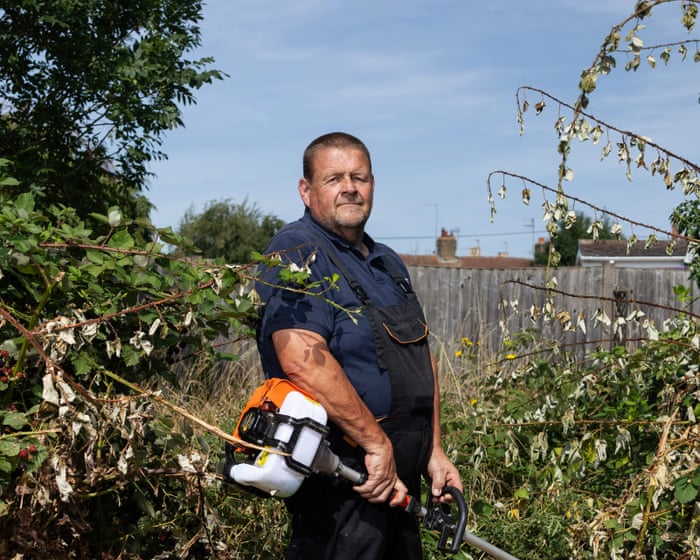
Stephen Jalland nods as she explains all this. Sweat is running down his face from the effort of cutting through the weeds that were taking over Thursby’s bungalow. His arms are covered in old scratches and fresh, ruby-red ones, mixed with sticky blackberry juice stains.
Thursby calls Jalland “family,” but really, they only met a few days ago. That’s when he showed up to clear her garden for free—something he’s done for about a dozen people with similarly overgrown yards since starting a “free mows” service on Facebook in June.
“I really don’t think you understand how much difference you make to people,” Thursby tells him, bringing out coffee amid the rotting plants and the thick smell of petrol fumes from his trimmer. “Demons have been going in my head over this,” she adds, looking at the partly cleared space. “Instantly, the weight is gone off my shoulders.”
Jalland nods again. “That’s what we’re aiming for,” he says, gruffly. And it’s that no-nonsense attitude she’s most grateful for. Jalland, 57, didn’t bat an eye when he arrived. “There was no judgment at all,” she says. “He said: ‘Come on, let’s have a look.'”
But it’s judgment that led Jalland to Thursby’s garden, not far from his own home in the Cambridgeshire town of March. More specifically, the realization that there’s too much of it in the world. “I was pissed off with people’s attitudes,” he says. It all started one afternoon in June when, finding himself with free time as his new handyman business struggled to find work, he scrolled through a community Facebook group and noticed a post about an overgrown lawn. “Here was an anonymous person having a go at somebody’s garden, saying people should take pride in where they live… You know, really laying into them, not knowing their situation.”
His reaction was instinctive: “Give me the address and I’m going to go down there and cut the grass.” Someone messaged him the address privately, he says, and he immediately “got off my ass.” When he arrived and offered his help, the man thanked him, then started explaining why his garden was in that state. “He was a single bloke living with his son and had various health problems. When his mower broke, he couldn’t afford to replace it.”
Jalland spent two hours cutting the overgrowth and clearing out rubbish. Meanwhile, the man made him a curry. Jalland came back the following week to do his back garden too. “We were able to sit down and have a chat. I got to know the bloke. Some people are on their own; they need someone to talk to. It’s all part of it.”
When he posted pictures of the garden’s transformation on Facebook, it blew up: “It got 40,000 likes and about 5,000 comments.” He also received 1,000 direct messages asking for help—not usually from the garden owners themselves, but from theirConcerned neighbours, friends, and family. “I thought: ‘What the hell have I done?'” Jalland recalls. “People need help. Reading them, the amount that it brought me to tears was unreal.” So he decided to offer one free garden clearance a week. He has been doing closer to three.
For every clearance, just as Jalland suspected, there has been a story of struggle hiding not far beneath the weeds. It’s rarely laziness or carelessness. Behind Thursby’s jungle is her father’s ill health, her adult daughter’s ill health, and finally, her own: a stage-four cervical cancer diagnosis in 2024, followed by gruelling treatment. “I’m sick a lot, I’m tired and I stagger,” she says.
A few days before this, Jalland cleared for a “bloke housebound on the sofa”, whose doors were so blocked by overgrowth that they had become a “firetrap”. Brambles reached his bungalow’s gutters. Jalland spent seven hours clearing. Then there was a mum with cancer who wanted a space for her young daughter to play. Often, mental health concerns accompany or take over from physical ailments. “I did a woman the other day and you could see she’s suffering – the anxiety, the stress,” Jalland says.
View image in fullscreen
Jalland finds a suitcase amid the rubbish. Photograph: Fabio De Paola/The Guardian
Next, there was the married couple, one of whom had become her partner’s carer and then broken her wrist. With garden maintenance becoming unmanageable, she became terrified of eviction. “She was in tears about it,” he says. And Jalland? “God, yeah.”
He admits he struggles to prioritise the jobs he takes on; he tends to go by instinct and location, offering a visit when he is nearby doing paid work. “I can’t decide whether multiple sclerosis is worse than mental health, or mental health worse than being in a wheelchair … I’m going to look at it as the bigger picture. Yes, somebody’s struggling. Someone needs help.”
In Thursby’s garden, he begins to cry again. He is deeply moved by her thanks. She adored her garden after moving here with her daughter in 2008. “I have been feeling very down, I think because of the state of it, but also realising what my limitations are,” she says. “The worse it got, the more I realised I was never physically going to be able to get on top of it.” She worried about what people would say. “Would there be a complaint? I didn’t want anybody to come round.” In the end, a friend messaged Jalland. “I would never have asked,” Thursby says.
Jalland’s understanding comes from his own experience. The father of three worked all his adult life as an engineer, but left his job about a year ago to work for himself. His wife works in care and he knows he may need to get a “proper job” again at some point, to help make ends meet. He has had depression in the past and still takes medication. “I’ve been at the bottom of that barrel looking up quite a few times,” he says. It happened initially after a motorcycle accident when his wife was expecting their first child. They had moved into their first home and his physical injuries, plus the stress of being unable to work or maintain the house, sent him to a dark place.
Then came an offer of assistance. “It was an occupational therapist,” he recalls. “She asked: ‘What could we do to help?’ I said the garden was a mess; they cleared and gravelled it, so it was maintenance-free. I felt on top of the world, a feeling of: thank God that’s done – that’s one thing that won’t play on my mind.”
“Me cutting the grass does not fix somebody’s mental health problems,” he continues. “But it can aid in making them feel a little bit better about themselves. It just takes away that little bit of stress.” He knows what a patch of usable garden can give. “I’ve said to people: ‘I’m goinI want to make you a space where you can come outside, sit down, have a cup of coffee, and enjoy the sunshine. It’s a safe space, a happy space, a clear space. He admits he’s not a gardener, but he’s still making a difference. He always says, “It’s not perfect, but it’s better.”
Jalland gets emotional on the job. As he tackles the last part of Thursby’s garden, he explains that when he first started offering free garden clearances, he didn’t know how to cut back overgrown plants. He says it’s all trial and error. His main tools are two trimmers (one was donated), a rake, a grass-covered broom, and a small mower that’s about 30 years old. He calls it “the little mower that can,” and you quickly see why.
His method is to use a bladed trimmer to cut through the tangled brambles at their thick bases, then pull the woody knots toward him with a rake to loosen them. After that, he works at the tangles with his trimmer, like an artist with a brush, watching the bits of stem fall to the ground before the mower chews it all into sawdust. “You’ve just got to go at it,” he says.
As the undergrowth thins out, objects start to appear, along with carrier bags and other rubbish. At Thursby’s, there’s a suitcase and an old Little Tikes easel. “Oh my God, that was here!” she says. She remembers her daughter using it as a child. “She had chalks, she would scribble all over it – she loved crafts.”
Jalland knows that many people won’t be able to keep up with the work he does, but he doesn’t mind. “I’d love them to keep on top of it, but they can’t always. I get that. The way I think about it is: I’ll be doing this all again next year if that’s the case.”
He’s trying to build momentum by posting on social media, hoping to generate funding. At the time of writing, he only has 140 YouTube subscribers. “The videos are terrible,” he says. Meanwhile, he’s crowdfunding for new tools, with £695 raised so far.
Even when his paid work picks up, he wants to keep his free garden clearances going on Saturdays. “I think I have found a purpose for my life, in a way,” he says. “There’s a need and I can fill it – and it’s filling big gaps in my heart, isn’t it?” Has he seen a change in his own mood? “I don’t know, because I’m exhausted,” he says. “But when I go home and take my boots off, I do feel I have done something good.”
In the UK, the mental health charity Mind is available on 0300 123 3393. In the US, call or text Mental Health America at 988 or chat at 988lifeline.org. In Australia, support is available at Beyond Blue on 1300 22 4636, Lifeline on 13 11 14, and MensLine on 1300 789 978.
Do you have an opinion on the issues raised in this article? If you would like to submit a response of up to 300 words by email to be considered for publication in our letters section, please click here.
Frequently Asked Questions
Here is a list of FAQs based on the story of the man who clears gardens for free
General Questions
Q Who is this man and why does he clear gardens for free
A Hes an everyday person who noticed that overgrown yards can make people feel isolated or overwhelmed He offers his labor for free because he believes that giving someone a tidy beautiful outdoor space can lift their spirits and reconnect them with their community
Q Is this a scam or is there a catch
A No catch The payment he receives is seeing the relief and joy on the homeowners face He is strictly focused on helping people not on making money or gaining fame
Q Who does he help
A He typically helps elderly people those with physical disabilities single parents or anyone going through a tough time who simply cannot manage the physical work of yard maintenance
Q What does he actually do in the garden
A He does a clearance This usually means mowing overgrown lawns trimming bushes pulling up weeds removing dead plants and hauling away rubbish so the space is safe and usable again
Q Where does he operate
A He generally works locally in his own neighborhood or town However his story has inspired similar good Samaritans to start doing the same thing in their own communities across the country
Benefits Impact
Q Why is clearing a garden so important for someones mental health
A An overgrown garden can feel like a walled prison When its cleared it lets in light and air For many it gives them a sense of control back and reduces anxiety because they no longer have to feel ashamed or stressed about the mess
Q How does this help the wider neighborhood
A A clean garden improves the look of the entire street which boosts property values and community pride It also removes hiding spots for pests and reduces fire hazards
Q What is the light he brings into their lives