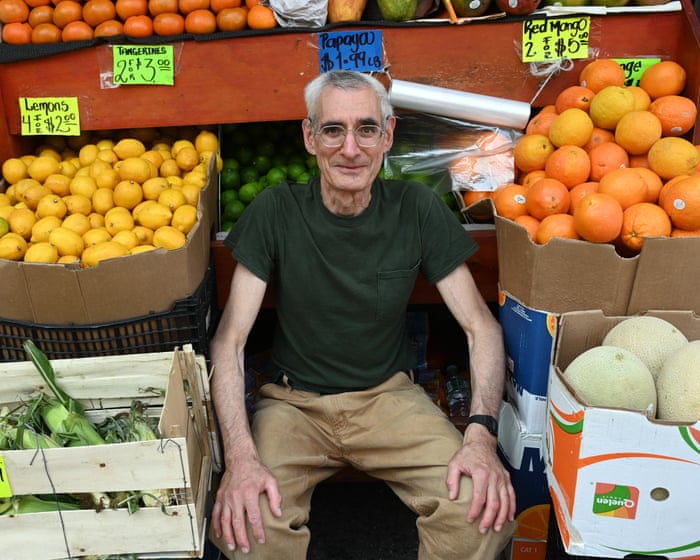
When Robert Solomon’s hours were cut during the pandemic—he did building management and tech support for a nonprofit—he took on an extra job at a food cooperative, helping to stock the store. He says it was the most ordinary job, but that’s exactly what made it special.
That job ended when the pandemic did, but in 2022 he left the nonprofit and looked for grocery work. Now, at 71, he’s an assistant buyer in produce (fruit and vegetables) at an independent market in New York. “I love the chance to do physical, creative work with my body, hands, and mind,” he says. “I’m working harder than I have since my 30s, and I love it.”
Solomon’s favorite time of day is the morning. He often starts at 5:30 or 6 a.m. “I put the rugs back on the floor and the carts out in the yard. Then I start stocking.” Certain products make him especially happy.
“I like fussing over the dandelion greens,” he says. (Though dandelions are often seen as weeds, both the leaves and roots are edible.) “I have a little bucket of water and I swish them around head first so they’re fresher again. We have to restock broccoli many times a day, and I like that.” When it’s all in order, “it makes a sea of broccoli.” We’re talking on a video call, and Solomon lifts his phone to the camera to show waves of blue-green broccoli heads.
“The work requires good attention,” he says.
By “attention,” he means his mind doesn’t wander too often. “One of the big draws is that it’s a low-fantasy job. I spend most of my time working, not daydreaming about what a wonderful job I’m doing and how I’ll become famous for it next year.”
“My political belief is that all work is important,” he says.
Solomon grew up in Brooklyn, five miles from the shop. His mother was a musician who later became a daycare center director, and his father was an art history professor. “They were first-generation immigrants from Russia, and to them, doing something technical or managerial was a step up.” His father “probably” wanted Solomon to be a scientist.
Solomon left school at 17. He tried night school but didn’t get his degree until he was 46, “with independent study and life credits.” For most of his working life, he was “a house painter, handyman, and cabinet maker.” After getting his degree, he worked for a neighbor’s company that sold energy-efficient lighting, and he had two stints at the nonprofit.
Through it all, he says, “I kept trying to change my job to a better one, and it just didn’t work for me.” At different times, he wanted to be a computer programmer, an interfaith minister, and a nurse practitioner. “In each case, things went terribly wrong.”
At an interview to become an emergency medical technician, after scoring an A on the course, Solomon was asked if he would cross a picket line. “No way,” he said. “My mother would roll over in her grave.” He watched his application get tossed into the bin.
Sometimes Solomon feels his late parents might disapprove of his grocery job. But recently, he remembered one of his mother’s sayings from when he’d throw a tantrum: “Stop running around like a chicken with your head cut off!”
Solomon thought that was impossible, but she explained that “when she was a girl, they had a little shop on the porch of their home. When my mother would get home, my grandfather would take a break, and if someone came in for a chicken, she would have to kill it.”
Solomon doesn’t handle poultry, but in his produce work, “all these things I learned from her that she didn’t mean to teach me are coming back. … She knew how to clean lettuce and she knew how to pick a good apple. I’m like: ‘That’s how I know all of this.’”
At first, shop work was challenging.On the subway ride home, it was tough to get back on my feet. “But now it feels okay,” he says. “I feel calmer in my mind. My knees don’t hurt as much. I feel stronger.” There’s no promise of how long I’ll be able to keep working, but I believe this is the best job I’ve ever had. It’s about valuing the good things in life.
Tell us: has your life taken a new turn after turning 60?
Frequently Asked Questions
Here is a list of FAQs based on the story A fresh start after 60 I became a grocer and now I feel physically stronger and mentally calmer
1 Is it really possible to start a new physically demanding career after 60
Yes While it requires a transition period many people find that regular movementlike lifting stocking and walkingactually improves their strength and stamina over time The key is to start slowly listen to your body and build up your endurance gradually
2 What are the main physical benefits of becoming a grocer later in life
The job provides natural functional exercise Youre constantly moving lifting moderate weights and staying on your feet This can lead to increased muscle tone better balance and improved cardiovascular health making you feel physically stronger than when you were more sedentary
3 How does this job help with mental calmness
The routine and repetitive nature of tasks can be meditative It takes you out of your head and focuses your mind on the present moment Plus the social interaction with customers and the simple satisfaction of a wellorganized shelf provide a sense of purpose that reduces anxiety
4 Im 60 and worried about the physical strain How do I avoid injury
Start by being honest with your employer about your fitness level Use proper lifting techniques wear supportive nonslip shoes and dont be afraid to ask for help with the heaviest items Also prioritize stretching before and after your shift
5 What if I have no experience in retail or grocery
Thats completely fine Grocery stores need people with life experience for their reliability work ethic and customer service skills Youll be trained on the specific systems but the core skillsbeing organized friendly and punctualare things you already have
6 Is the pay enough to support a retirement lifestyle
It varies by location and store but its generally a modest wage However many people take these jobs not just for the income but for the health benefits social connection and employee discounts Its often a supplement to retirement savings not a replacement