Before their new documentary screens, the members of Katseye appear in a video message to thank fans for their support. Their followers, known as Eyekons, have been crucial to their rise to fame, so it’s fitting that Katseye: Wild Hearts, which hit theaters worldwide this month, takes a moment to acknowledge them. Perhaps more than many other major music groups today, Katseye’s success has relied heavily on their bond with devoted fans who make sure Katseye mania reaches nearly every corner of the globe.
Katseye’s multinational members – Daniela, Lara, Manon, Megan, Sophia, and Yoonchae – were chosen through a mix of fan votes and judge scores on the 2023 YouTube reality competition The Debut: Dream Academy. This joint project between American label Geffen Records and Korean entertainment company Hybe aimed to create a global girl group, with contestants going through a tough bootcamp to test their singing and dancing abilities. The next year, Netflix’s docu-series Pop Star Academy: Katseye – which covered the group’s early days, including behind-the-scenes drama – pushed them to a whole new level of fame.
‘We’re at a crisis point’: Chappell Roan, Shirley Manson, and Eli on playing Olivia Rodrigo’s women-led festival Read more
Katseye blends Western pop’s focus on individuality with the intense training and choreography typical of the well-oiled K-pop machine. Even though they call themselves a “global girl group,” much of their dominance can be traced back to their K-pop roots. “Katseye started with that core K-pop training and high standards, which meant they were firing on all cylinders from day one,” said K-pop columnist Jeff Benjamin. “In pop music, there’s often a rewarding moment when an artist finally gets big-label backing for a song, video, or project, but K-pop ensures everything is supported from the start.”
As a $5 billion company with offices in Seoul, LA, Mexico City, Tokyo, Miami, and Mumbai, Hybe’s resources have certainly helped the group succeed, but Katseye doesn’t follow all of K-pop’s usual rules. “There’s no denying that many top-down decisions are made for them,” said Benjamin. “But Katseye stands out by openly talking about decisions they disagree with – the members seem to dislike Pop Star Academy and the competition format that created them – and by addressing topics most K-pop acts avoid, like their personal lives and sexualities.”
In 2026, Katseye is enjoying a wave of popularity that’s hard to ignore, including a sold-out tour, nearly 40 million monthly Spotify listeners, and two Grammy nominations. Katseye: Wild Hearts, which includes behind-the-scenes footage, interviews, and fan-submitted videos, brought in nearly $4 million in its opening weekend. The group has also landed major marketing deals: they’ve worked with State Farm, Pandora, Target, and the upscale LA grocery store Erewhon, where they have their own $22 smoothie. Their Gap Better in Denim campaign sparked a wildly viral TikTok trend and boosted the brand’s revenue growth.
Fans in their 20s, teens, and even younger are loving what Katseye offers, and it goes beyond just merchandise, thanks to their mix of Western pop and K-pop appeal, high-energy performances, and inclusive cultural and LGBTQ+ representation. (Two members identify as queer.) There’s also their smart use of digital media: Katseye quickly jumps on viral memes to promote their work and connect with fans. They reference Gen Z Disney Channel nostalgia, team up with other internet-savvy stars like Troye Sivan, and get fans involved with popular TikTok dances.
“Katseye emerged in a world where social media isn’t just a promotional tool, but part of how pop culture is created and shared,” said Dr Lucy Bennett, senior lecturer in Popular Music and Fandom at Cardiff University. “Fans caFans can take a song, performance, or interaction and repackage it for their own social media, helping to promote the group even further. In short, the Eyekons are better than any marketing team. “This is especially important for a new group because fandom can help create a sense that something is happening around them, like momentum and cultural relevance.”
When there were six: Katseye at the 2026 Grammy awards. Photograph: Mario Anzuoni/Reuters
Katseye’s core fanbase of Gen Z and Alpha isn’t accidental. Their easy-to-copy dance trends, partnerships with toy brands like Monster High and Gui Gui slime, and “brain rot” lyrics are aimed at younger audiences. “Boba tea (gnarly) / Tesla (gnarly) / Fried chicken (gnarly),” they sing on Gnarly, while their latest single includes lines like: “Carry my matcha / Mount Valley water / I like my mochi drenched in chocolata.”
The group’s rapid success hasn’t come without friction. Katseye says they’ve faced “heavy” racist and sexist harassment, dealt with extreme toxic fandom, and received death threats. Lara, a Connecticut-raised US citizen of Tamil Indian background, told the BBC she was falsely reported to ICE, while Sophia, who is Filipina-American, revealed that their family members had received hateful comments. Manon, who is of Swiss-Ghanaian heritage, called the experience “terrorizing on the mind.”
Miley Cyrus, Taylor Swift and more pay tribute to Dolly Parton: ‘Her legacy will be everlasting’ Read more
Like the Pussycat Dolls, Fifth Harmony, and other girl groups before them, Katseye has faced a flood of rumors about tensions within the group. Shadily edited clips of the girls have been shared on social media as proof of conflict between members. Some have even pitted the girls against each other. “People see us as women to rank. They’ll grade us on how pretty we are, our singing skill, dancing skill, and then add it up and give us a percentage. That’s so dystopian,” Lara said.
The familiar parasocial expectations fans have of artists weigh heavily on Katseye, but that’s nothing new in pop. “The more intimate the digital relationship becomes, the more complicated it can be to maintain boundaries,” said Bennett. “Because fans can invest so much time and emotional energy in an artist, this can create expectations around access and responsiveness.”
Other public scrutiny surrounding the band has been murkier. In February, the group announced that Manon was taking a temporary step back to “focus on her health and wellbeing,” leaving the band to perform at Coachella as a five-piece. Soon after, she removed references to Katseye from her Instagram bio.
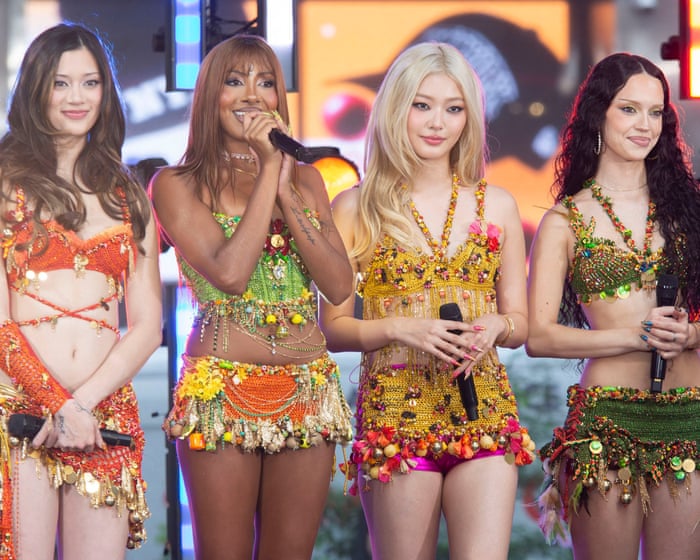
Katseye greeting fans gathered for their Today show performance. Photograph: Lev Radin/Shutterstock
In August, just months after Manon stepped back, Hybe announced that Sophia was similarly going on hiatus for her “mental health and wellness,” casting another shadow of uncertainty over the group’s seemingly shrinking lineup. It’s unclear if she’ll return in time to join her bandmates on their global Wildworld Tour this September. Meanwhile, the active members have voiced their support for both bandmates during recent promotional activities and appearances.
Bennett said “the participatory nature of Katseye’s formation” makes their relationship with fans complex. “If fans have voted, promoted, defended, and helped shape the formation of the group, they may feel they have a genuine stake in what happens to it. That can be a really positive thing, creating a strong sense of loyalty and investment in the group. At the same time, fans may feel that their investment gives them a particular interest in questioning or discussing decisions about [the band].”
‘I feel like I’m at war’: are we losing the battle against machine-made music? Read more
Katseye’s trajectory hasSo far, they’ve managed to overcome breaks, controversies, and dismissive rumors. Released on August 14, Wild is a huge success. The EP hit No. 1 on the Billboard 200, setting a new record for the biggest streaming week by a girl group. It’s also the biggest US debut for a girl group since Danity Kane’s 2008 album Welcome to the Dollhouse, and it’s the fourth No. 1 album by a girl group this decade, following K-pop releases like Blackpink’s Born Pink, NewJeans’ second EP Get Up, and Twice’s With You-th.
Despite the record-breaking sales, critics aren’t as impressed with the band’s recent work. Vulture described Wild as a “war between bittersweet pop … and deliberately juvenile singles,” while Pitchfork dismissed its songs as “hollow.” Maybe it’s a sign of their rebellious Gen Z pop attitude, but Katseye refuses to stick to any one style—for better or worse. When the EP hits, it really hits: “Pinky Up,” the follow-up to the initially polarizing “Gnarly,” is an exciting burst of thumping techno-pop. Co-written by Ed Sheeran, “Animal” is a radio-friendly throwback to early 2010s pop. Sadly, one of the EP’s best tracks, “Unloveu,” is only available on a Target physical CD. Written by Lara, the ballad showcases each member’s voice as they harmonize about moving on from a toxic relationship. It hints at what Katseye could achieve if their artistic input and vocals were prioritized over viral dance moves and brand deals.
Wild‘s lack of sonic cohesion and constant genre-switching make for an uneven listening experience. It’s also short on standout solo moments, with the girls’ voices often blending into a sleek but frustratingly uniform sound. “Bel Air,” an unreleased song from a 13-year-old Charli XCX, feels so laid-back it comes across more like a rough demo than the original. Then there’s “Hootie Frutti.” This Brazilian funk-flavored single is the EP’s most divisive track—some love its chaotic, campy fun, while others criticize its sexually charged music video packed with comedic product placements. (Manon and Sophia might be on hiatus, but orange-flavored Tic Tacs are definitely not.)
Amid a dizzying string of brand partnerships and promotions, fans are worried Katseye is being overworked. That might be the case. Representatives for the band didn’t respond to the Guardian’s requests for comment. K-pop has long faced criticism for its notoriously intense schedules, and the Western pop industry isn’t much better, especially given the pressures on female artists. Combined with various health-related breaks and public controversies, there’s a cloud of skepticism hanging over the group’s nonstop schedule. In just the past two weeks, they’ve performed at the Disney Legends awards, appeared on the Today Show and Tonight Show, played a Spotify event called Klub Katseye, signed CDs at Hot Topic and Barnes & Noble, and headlined a music festival.
Katseye’s potential for lasting mainstream pop success is undeniable. As today’s global pop group, fans praise them for their confidence, vibrant and distinct personalities—they embody an attitude that reflects modern sisterhood in all its messy, magical glory—and their celebration of diversity and digital culture. But something feels unsustainable. While the pop industry seems to demand keeping momentum at all costs, Katseye’s exhausting commitments, combined with relentless public scrutiny, could be harmful in the long run. Constant activity might also be preventing the group from more deliberately shaping their core image and artistic vision—both essential for building a musical legacy that goes beyond fleeting trends.
Time will tell whether the band’s current overexposure is a natural result of the well-earned hype around them, or a symptom of a larger, more troubling system that treats pop stars as products. Perhaps once the Wild promotion wraps up, the band would benefit from taking a step back.A collective reassessment is needed to determine what artistic goals Katseye has beyond just going viral. These talented performers deserve that much.
Frequently Asked Questions
Here is a list of FAQs about Katseyes meteoric rise and internal collapse written in a natural curious tone
General The Rise
Q Wait who is Katseye I feel like Ive heard the name but Im not sure
A Katseye is a global girl group formed through a Netflix reality show called Dream Academy in late 2024 They were created by HYBE and Geffen Records They were designed to be the worlds biggest girl group from day one
Q How did they get so big so fast
A It was a perfect storm They had the massive marketing power of HYBE behind them a gripping reality show that built a huge loyal fanbase before they even debuted and a viral hit song that blew up on TikTok They also had a diverse multinational lineup that appealed to a global audience
Q What was their debut song and why was it such a big deal
A Their debut single was Debut but the real gamechanger was their followup Touch It was a catchy emotional pop track that went viral hitting the Billboard Global charts and making them a household name in Kpop and Western pop circles almost instantly
Q What made them different from other girl groups
A They were a global group not just a Kpop group They had members from the US the Philippines South Korea Switzerland and Sweden They sang in English promoted heavily in the US and had a more Westernized popRB sound yet they had the intense training and performance polish of a Kpop group
The Falling Apart The Problems
Q Okay so they were huge What do you mean they were falling apart
A Behind the scenes there was a lot of internal conflict The members were overworked there were reported clashes between the Korean and American management styles and the intense pressure of their sudden fame created a toxic environment Rumors of a member being pushed out started swirling
Q Was it just about being tired or was there real drama