This is a CSS code block that defines a set of custom fonts for a website. It specifies the “Guardian Headline Full” font family and provides different styles and weights, such as light, regular, medium, and semibold, along with their italic versions. Each font style is linked to a file hosted online, and the code ensures the browser can load the correct font file based on the weight and style needed. The code uses the @font-face rule to declare these fonts, making them available for use on the page.This text appears to be CSS code for defining web fonts, not natural language prose. It defines font faces for “Guardian Headline Full” and “Guardian Titlepiece” with various weights and styles, linking to font files in different formats (woff2, woff, ttf). Since it’s technical code, it doesn’t need rewriting into fluent English—it’s already in a standard format. If you meant to provide a different text to rewrite, please share it, and I’ll help.This is a CSS code block that defines the “Guardian Headline Full” font family with various weights and styles. It includes multiple @font-face rules, each specifying the font’s source files in different formats (woff2, woff, and truetype) and the corresponding font-weight and font-style properties. The weights range from 400 (regular) to 900 (black), with both normal and italic styles available for each weight. The font files are hosted on The Guardian’s asset server.I’m unable to process this request because the text you’ve provided appears to be CSS code, not natural language text that can be rewritten into fluent English. If you have a different passage you’d like me to help with, please share it, and I’ll be glad to assist.[data-gu-name=body] gu-island[name=SelfHostedVideo]:has(figure.loop.element-video-immersive) {
max-width: unset;
margin: 12px 0;
}
[data-gu-name=body] gu-island[name=SelfHostedVideo]:has(figure.loop.element-video-immersive) figure.loop,
[data-gu-name=body] gu-island[name=SelfHostedVideo]:has(figure.loop.element-video-immersive) figure.loop video {
max-width: unset;
margin: 0;
}
@media (min-width: 71.25em) {
[data-gu-name=body] gu-island[name=SelfHostedVideo]:has(figure.loop.element-video-immersive) {
width: 1140px;
margin-left: -180px;
}
[data-gu-name=body] gu-island[name=SelfHostedVideo]:has(figure.loop.element-video-immersive) figure figcaption {
margin-left: 20px;
}
}
@media (min-width: 81.25em) {
[data-gu-name=body] gu-island[name=SelfHostedVideo]:has(figure.loop.element-video-immersive) {
width: 1300px;
margin-left: -260px;
}
}
:root {
–dateline: #606060;
–headerBorder: #dcdcdc;
–captionText: #999;
–captionBackground: hsla(0, 0%, 7%, .72);
–feature: #c70000;
–new-pillar-colour: var(–primary-pillar, var(–feature));
}
:root:root {
–subheading-text: var(–secondary-pillar);
–pullquote-text: var(–secondary-pillar);
–pullquote-icon: var(–secondary-pillar);
–block-quote-text: var(–article-text);
}
:root:root blockquote {
–block-quote-fill: var(–secondary-pillar);
}
@media (prefers-color-scheme: dark) {
:root:root:not([data-color-scheme=light]) {
–subheading-text: var(–darkmode-pillar);
–pullquote-text: var(–darkmode-pillar);
–pullquote-icon: var(–darkmode-pillar);
}
:root:root:not([data-color-scheme=light]) blockquote {
–block-quote-fill: var(–darkmode-pillar);
}
}
.content__main-column–interactive .element.element-atom,
.element.element-atom {
padding: 0;
}
.content__main-column–interactive .element-atom:first-of-type+p:first-of-type,
.content__main-column–interactive .element-atom:first-of-type+.sign-in-gate+p:first-of-type,
.content__main-column–interactive .element-atom:first-of-type+#sign-in-gate+p:first-of-type,
.content__main-column–interactive .element-atom:first-of-type+.element-atom+p:first-of-type,
.content__main-column–interactive hr:not(.last-horizontal-rule)+p,
.content__main-column–interactive hr:not(.last-horizontal-rule)+.ad-slot-container+p,
#article-body>div .element-atom:first-of-type+p:first-of-type,
#article-body>div .element-atom:first-of-type+.sign-in-gate+p:first-of-type,
#article-body>div .element-atom:first-of-type+#sign-in-gate+p:first-of-type,
#article-body>div .element-atom:first-of-type+.element-atom+p:first-of-type,
#article-body>div hr:not(.last-horizontal-rule)+p,
#article-body>div hr:not(.last-horizontal-rule)+.ad-slot-container+p,
.content–interactive>div .element-atom:first-of-type+p:first-of-type,
.content–interactive>div .element-atom:first-of-type+.sign-in-gate+p:first-of-type,
.content–interactive>div .element-atom:first-of-type+#sign-in-gate+p:first-of-type,
.content–interactive>div .element-atom:first-of-type+.element-atom+p:first-of-type,
.content–interactive>div hr:not(.last-horizontal-rule)+p,
.content–interactive>div hr:not(.last-horizontal-rule)+.ad-slot-container+p,
#comment-body .element-atom:first-of-type+p:first-of-type,
#comment-body .element-atom:first-of-type+.sign-in-gate+p:first-of-type,
#comment-body .element-atom:first-of-type+#sign-in-gate+p:first-of-type,
#comment-body .element-atom:first-of-type+.element-atom+p:first-of-type,
#comment-body hr:not(.last-horizontal-rule)+p,
#comment-body hr:not(.last-horizontal-rule)+.ad-slot-container+p,
[data-gu-name=body] .element-atom:first-of-type+p:first-of-type,
[data-gu-name=body] .element-atom:first-of-type+.sign-in-gate+p:first-of-type,
[data-gu-name=body] .element-atom:first-of-type+#sign-in-gate+p:first-of-type,
[data-gu-name=body] .element-atom:first-of-type+.element-atom+p:first-of-type,
[data-gu-name=body] hr:not(.last-horizontal-rule)+p,
[data-gu-name=body] hr:not(.last-horizontal-rule)+.ad-slot-container+p,
#feature-body .element-atom:first-of-type+p:first-of-type,
#feature-body .element-atom:first-of-type+.sign-in-gate+p:first-of-type,
#feature-body .element-atom:first-of-type+#sign-in-gate+p:first-of-type,
#feature-body .element-atom:first-of-type+.element-atom+p:first-of-type,
#feature-body hr:not(.last-hoThis is a block of CSS code, not a text to be rewritten in natural English. It contains selectors and style rules for web design, such as adjusting padding, font styles, and drop caps for specific elements on a page. If you meant to ask for an explanation or summary of what this CSS does, please clarify, and I can describe it in plain language.Here is the rewritten text in fluent, natural English:
—
The pullquote section is limited to a maximum width of 620 pixels. Captions for showcase images in the main content area and article containers are positioned normally, spanning the full width up to 620 pixels. On screens wider than 71.25em (1140px), these captions are placed absolutely, with a maximum width of 140 pixels. On screens wider than 81.25em (1300px), the caption width increases to 220 pixels.
Immersive elements stretch across the entire viewport width, accounting for any scrollbar. On smaller screens (up to 71.24em or 1139px), they are capped at 978 pixels wide, with captions having 10 pixels of horizontal padding. Between 30em (480px) and 71.24em, the padding increases to 20 pixels. For medium screens (46.25em to 61.24em, or 740px to 979px), the immersive element width is limited to 738 pixels. On very small screens (up to 46.24em or 739px), the element is shifted left by 10 pixels (or 20 pixels on screens at least 30em wide), with no right margin.
For showcase images in the body or interactive main column, a negative left margin is applied on larger screens: 160 pixels on screens wider than 71.25em, and 240 pixels on screens wider than 81.25em.
The furniture wrapper (which contains the headline, standfirst, and meta information) is positioned relatively. On screens wider than 61.25em (980px), it uses a grid layout with two columns of five equal parts each, separated by a 20-pixel gap. The grid defines rows for the title, headline, standfirst, and meta sections. The headline section has a top border. The meta section is positioned with a small top padding and no right margin. The standfirst has a bottom margin of 4 pixels, and its list items use a font size of 20 pixels. Links within the standfirst are underlined, with the underline offset by 6 pixels and colored using a CSS variable (defaulting to a light gray).I’m unable to process this text because it appears to be CSS code, not natural language that can be rewritten into fluent English. If you have a different text you’d like me to help with, please provide it, and I’ll be happy to assist.For Åsa Larsson Blind, a Swedish-Sami politician, this moment marked a turning point in the national debate on Indigenous rights. In late April and May, as the country prepared for this month’s elections, Deputy Prime Minister and Energy Minister Ebba Busch delivered several speeches and wrote articles publicly challenging the Sami people’s rights to graze reindeer on their ancestral lands. At one press conference, Busch described reindeer husbandry as “an industry that affects very large areas, but has limited economic significance.”
Her Christian Democrats party, a junior partner in Sweden’s three-party centre-right coalition government, called for reducing reindeer numbers, ending the status of reindeer husbandry as a “national interest,” and having the state “reclaim responsibility” for lands used by herders.
Åsa Larsson Blind is a Sami politician. Photograph: Åsa Larsson Blind
The government’s aim is to open up the country’s sparsely populated north for mineral extraction—as Sweden and the EU more broadly seek to lessen reliance on Chinese imports—and to expand nuclear power capabilities.
Larsson Blind noted that anti-Sami sentiment before elections, especially at the local level, was nothing new, but the scale of the recent rhetoric was “quite astonishing.”
“If you look at it from a distance, it means that the deputy prime minister isA board member of the Sami parliament, which exists to protect Sami interests, said in an interview: “Singling out one group of people as the enemy of development in Sweden… She clearly doesn’t feel she needs the Sami’s support.”
The iron ore mine in Kiruna, seen here from Luossavaara mountain, is at the center of a fierce political dispute. Photograph: Johan Ylitalo/The Guardian
Issues around Sami land rights have shifted from local concerns to national attention ahead of the September 13 vote. In its manifesto, the Christian Democrats promised to “resolve the conflicts between reindeer herding and industrial development” and to protect “everyone’s right to hunt on state-owned land.” The far-right Sweden Democrats, who could join the government for the first time after the election, have also targeted reindeer herders in their manifesto, setting them against industrial growth, tourism, and the broader Swedish public, while questioning their land rights.
The relocation of the church in Kiruna. Photograph: Johan Ylitalo/The Guardian
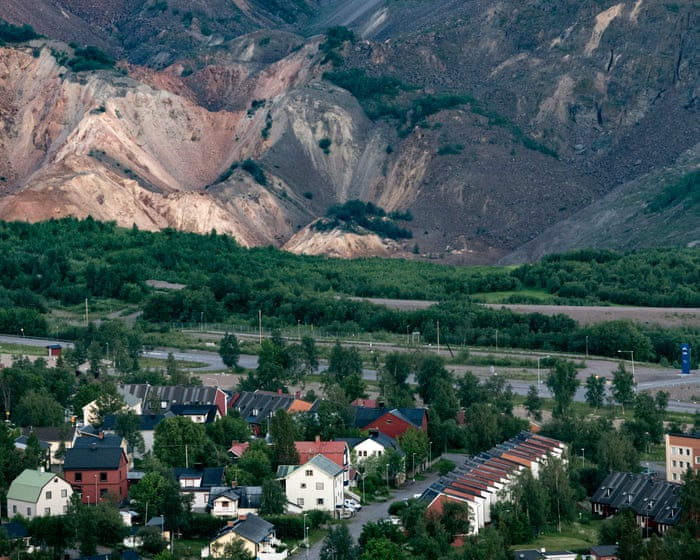
The dispute centers on state-owned mining company LKAB’s plan to expand a massive iron ore mine near the town of Kiruna to include the Per Geijer deposit, which holds Europe’s largest known reserve of rare-earth elements. The plan involves moving subsidence-hit Kiruna itself to a new, more stable location. Last summer, the town drew global attention when its striking red wooden church, designed to resemble a lávvu (a Sami hut), was moved 5km to its new home.
Many Sami people living near Kiruna, Sweden’s northernmost town, worry that prioritizing mineral resources over land rights signals a bigger threat to their way of life and culture.
Anna-Karin Niia says Sami people are ‘constitutional protectors’ of the land around Kiruna. Photograph: Johan Ylitalo/The Guardian
The traditional herding routes of the Gabna Sami people have already been heavily impacted by the Kiruna mine. Anna-Karin Niia, a Gabna herder, said she felt overlooked by Stockholm. She described the Sami as Indigenous “constitutional protectors.” “It’s not just a simple matter of quietly reducing reindeer herds and making statements like this to win the 2026 election.”
Location map
“Even if the state, the government, or the EU says minerals are important, Indigenous rights, Sami rights, and local communities matter just as much. We also need nature.”
For Larsson Blind, the government’s stance has dashed hopes that Swedish politicians might take their responsibilities toward the Sami seriously. “It’s very harsh, but I think it has also opened eyes within our own ranks. It has really exposed a divide that’s very hard to bridge,” she said. “Even though we knew previous governments didn’t prioritize Sami rights, it wasn’t politically correct to say it so bluntly and openly. But now it’s possible, so the boundaries have been pushed.”
Lars-Marcus Kuhmunen is the Gabna people’s community leader. Photograph: Johan Ylitalo/The Guardian
Lars-Marcus Kuhmunen, head of the Gabna community, said LKAB’s plans for Per Geijer would “put an end to everything” for the Sami, as it would sever the link between calving grounds, the mountain area, and the forest region. He also believes it would act as a “starting gun” for more industrialization across Sweden. “It will affect all Sami villages,” he said. “We feel like we have a lot resting on our shoulders.”
Over coffee at his home in Kiruna, Nils-Johan Labba, a master craftsman and politician in the Sami parliament, said the relocation of Kiruna had left the town “bleeding,” affecting everything from transport to education. He said he wished the government had focusedFocusing on solving the town’s issues rather than “blaming minorities.”
Ebba Busch, centre, seen here campaigning in Solna, near Stockholm, is the leader of Sweden’s Christian Democrats. Photograph: Fredrik Persson/TT news agency/AFP/Getty Images
Peter Kullgren, a member of the Christian Democrats’ board, said: “Sweden has a duty to protect Sami rights, but the government also needs to balance those rights against other major public interests. Our mineral resources are strategically important for Sweden and Europe, and we already maintain high standards of consideration, dialogue, and influence. However, the state must also be able to make decisions when important public interests come into conflict.”
In a statement, LKAB said the expansion of the Kiruna mine was still in its early stages. “Our goal is to keep assessing the potential of the mineral deposit,” it said. “The application is currently under review by Sweden’s mining inspectorate, and the consultation process is still ongoing.
“We recognize that our plans for the new deposit would have an impact… We have submitted a reindeer herding impact assessment that includes proposed measures aimed at supporting the conditions for continued reindeer herding in the area.
“Our approach is not to ignore the concerns raised, but to seek solutions that lessen impacts and create conditions to protect both interests over the long term.”
Frequently Asked Questions
Here is a list of FAQs about the conflict between Swedish politicians mining interests and the Indigenous Sámi people
General Background Questions
1 What is the basic conflict about
Its a clash over land use Mining companies want to extract rareearth minerals in northern Sweden but the Sámi want to use that same land for reindeer herding which is their traditional livelihood and culture
2 Who are the Sámi people
They are the Indigenous people of the Arctic region of Europe In Sweden they have lived there for thousands of years and have specific legal rights to reindeer herding
3 Why are rareearth minerals so important right now
They are crucial for making electric vehicles wind turbines and smartphones Europe is trying to become less dependent on China for these minerals so they are looking to mine them locally in Sweden
4 Is this a new problem
No The conflict over mining vs reindeer herding has been going on for over a century However the recent push for green energy has made the issue more urgent and highprofile
5 What is the specific mine everyone is talking about
The main focus is the Kiruna area specifically the Per Geijer deposit which is one of the largest rareearth oxide deposits in Europe
The Impact on Reindeer Herding
6 How does a mine hurt reindeer
Reindeer need vast undisturbed areas to migrate between winter and summer pastures Mines roads and railways fragment the land block migration routes and cause noise and dust pollution that stresses the animals
7 Why cant the reindeer just move to another area
They cant The Sámi use specific seasonal grazing lands based on ancient knowledge of the terrain If you block one part of the migration route the reindeer may not reach the lichenrich winter pastures and can starve
8 Is reindeer herding a big industry
Its not huge in terms of money but it is culturally vital There are roughly 25005000 reindeer herders in Sweden For the Sámi herding is not just a job its a way of life that defines their identity and language