It felt like the last day of summer. On a Sunday afternoon in late September, people in Kyiv strolled through the city’s botanical gardens, admiring the late-blooming dahlias. Later, the terraces in Podil—a neighbourhood full of bars, patisseries, and bookshops—filled with customers looking for a cocktail.
The idyll was an illusion. As the day darkened, air defences began their rumble and boom. When something fell with an explosive smack onto a bar table, the drinkers flinched, then laughed. It was only a conker from the chestnut tree overhead. Nursing a glass of rosé, writer Myroslav Laiuk talked about the picnic he and his wife had had the previous evening in a park in the Obolon district—prosecco in proper glasses, cheese, and charcuterie. Then a drone was shot down above their heads. Very pretty, he said with a smile. Shooting stars. Time to make a wish.
Kyiv is no longer the city it was in the summer. Since late August, the Russians have been attacking again and again during daylight hours, not just at night. The crump of air defence, the whine of drones, and the thunder of explosions are no longer the grim music of the night but a commonplace daytime symphony, disrupting schools and workplaces and threatening lives. Warehouses and city petrol stations have been targeted, and at times acrid smoke blurs the clear autumn mornings. Kyiv has become a frontline city. And winter is on the way.
Winter is something to dread in Kyiv. Last year the cold was terrible—temperatures dropped into the minus 20s—and cruelly long-lasting, persisting well into February. Illustrator Sergiy Maidukov was one of many who lost heating in his flat after the Russians attacked power infrastructure, the invaders’ aim seemingly to make the capital unliveable. The indoor temperature dropped to 3C. He kept warm by layering up, but also by going for runs.
Daily life in Lukyanivka district of Kyiv – the most damaged neigbourhood by the Russian attacks. Photograph: Julia Kochetova/The Guardian
“At least for 10 minutes afterwards you felt like a normal person, and you could just wear a T-shirt,” he said. He had a steady gas supply, so he could heat water in a saucepan for a basic wash afterwards. At intervals he’d get up from his work and dance or do push-ups—not an option for the infirm. As film-maker Iryna Tsilyk put it: “Young and strong people—they will survive every time. But how about all those invisible people that we usually don’t meet?”
Tsilyk’s biggest fear, she said, was losing internet connectivity. Lack of water supply would be another nightmare. Maria Shuvalova, an editor in academic publishing, described the period two winters ago when, for several days, the water supply failed both in her flat and in her coworking space. She was drinking tea to keep warm while working, then needing the loo. So she would walk the 20 minutes home, pee in a bottle, then return to the coworking space; then drink more tea, and repeat the whole cycle. For bowel movements, there was a plastic bag, knotted and disposed of in the trash. Such details of life were, she joked, “shit you definitely don’t want to know”.
Food supplies prepared for winter at Maria Shuvalova’s home. Photograph: Julia Kochetova/The Guardian
On a stroll in the botanical gardens, Iryna Gorlach, an international cooperation expert, laughed when asked how she was preparing for the coming cold. She pulled out her phone and showed an Instagram post from a popular Kyiv account. “This winter will be super difficult, we need to prepare properly,” it said. Then three bullet points: “Buy a house in a village; go abroad; stock up on grains and cereals.” Beneath were the words, “How I’m preparing” and a cartoon image of a panicked-looking dog holding a cross and a copy of the Bible.
Leaving the city is certainly on many people’s minds—if only for a few weeks at a time if things get bad. Nastya Dyakova, chief executive of an online safety charity, has rented a seA five-bedroom house in the Carpathian Mountains of far western Ukraine will offer staff and their families rent-free accommodation if life in Kyiv becomes practically or psychologically unbearable.
“It’s not just about winter in Kyiv, but about drones,” she said. Since August, the capital has been hit by new, faster, jet-powered drones that are harder to intercept. “It has become really emotionally difficult to stay in Kyiv, and we realized our team was struggling to work or focus because they were so worried about their safety. So this option in the Carpathians is available for the next six months, until the end of winter.”
Halyna is selling flowers next to the burnt market in Kyiv’s Lukyanivka district. The Lukyanivka neighborhood in central Kyiv has been especially hard hit this year, with its large shopping complex and market bombed and burned in early summer. Market traders have set up their stalls beside the ruins anyway: one woman, cheerfully presiding over slabs of salo — pork lard — declared that her personal coping strategy would be a plentiful supply of homemade moonshine, or horilka. Another stallholder, Halyna, cheerfully selling bouquets of lavender, dahlias, and chrysanthemums, was equally fatalistic. “It will be whatever God sends us,” she said.
Viktoriia Riabchenko, an accountant, was passing the market on her way to work. This year’s harvest in her dacha garden had been particularly good, she said, and she had a great stock of preserves: plums, sour cherries, raspberries, tomatoes, cucumbers, and sweet peppers. Not that she was especially worried about food shortages if warehouse bombings continued, she said; Russian propaganda exaggerated the potential problem, and specific shortages in shops tended to be fixed quickly.
Attitudes to winter, of course, depend on one’s perspective and experience. Viktor, a delivery driver, was pausing outside the McDonald’s in Lukyanivka. The plastic golden arches on the side of the building had recently been restored to their crisp shape after the heat from summer’s bombs and fires had melted them into a Dali-like droop. He was used to the cold, outdoors all day on his moped, and, having moved from Kramatorsk in the Donetsk region, had plenty of experience with bangs and explosions. Ivan Onyshchenko, who had stopped by for a hamburger and fries from his nearby workplace, had invested in a generator that he kept on his fifth-floor balcony — a lot of fuel to carry upstairs if the electricity stayed out. Generators usually chug away loudly; his, he promised, was “only as loud as a hairdryer.”
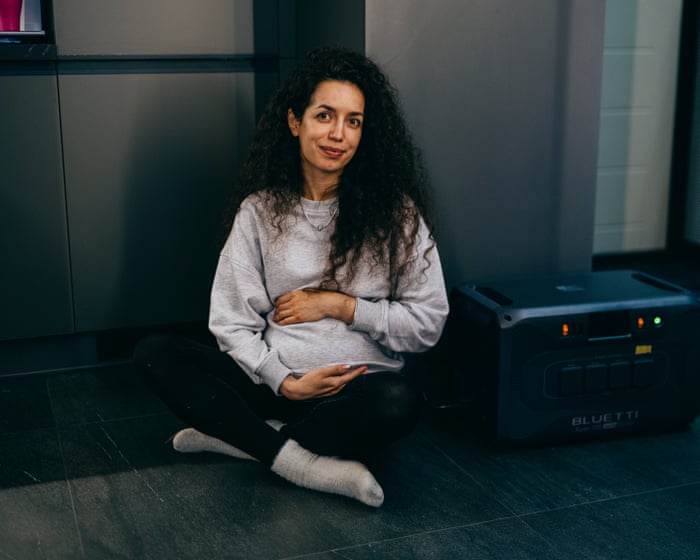
Shuvalova lives on the 14th floor of her apartment building and joked that last year she got great thighs walking up the stairs during power outages. This year will be different, though: she and her husband, who is serving in the army, are expecting a baby, and preparing for winter has been detailed and intense. The couple have plans A, B, and C — plan A is to stay in Kyiv, but leaving to stay with friends or family farther from Russian missiles is on the table. Realizing they could not expect the baby to live “like moles” as they did last year — reading by candlelight and working by laptop-screen glow during days-long outages — they have invested in an energy-storage system. The unit is essentially a giant battery, about the size of a small carry-on suitcase, that can keep appliances running for a day or so if needed. Last winter they sold for 160,000 UAH (about £2,700). Cannily, the couple bought one for about half that during the summer.Shuvalova also opened a drawer to reveal a collection of small power banks. Dry shower kits prepared for winter at Maria Shuvalova’s home. Photograph: Julia Kochetova/The Guardian. Residents of their apartment block are voting on whether to take over the management of their building. If they succeed, they will install a generator to power one of the lifts during outages, and a toilet for the bomb shelter—also known as the underground car park. Shuvalova opened cupboards to show stockpiles of water, dried grains, rice, and tinned meat. They have a camping stove and a box full of “dry shower” packs—wipes that can be used for washing with 50ml of water added. In her antenatal classes, she said, a lot of emphasis is placed on breastfeeding. Formula requires clean water and the ability to heat it—not something to be taken for granted this winter. “Breastfeeding takes care of all that,” she said. Air-defence guns roared as she spoke. People outside Ukraine may question the decision to have a baby in Kyiv under such circumstances. “We couldn’t postpone any longer, so we just have to adapt,” said Shuvalova. “It’s bringing a lot of meaning to our life, and joy. And pregnancy hormones are very nice. I’m so calm and not stressing at all.” The Lukyanivka neighbourhood has been particularly hard hit this year, with its huge shopping complex and market bombed and burned in the early summer. Photograph: Julia Kochetova/The Guardian. Whether fatalistic, downhearted, or meticulously prepared, the boundaries of what is “acceptable” or “ordinary” have been pushed outward for Kyivans in ways unimaginable to people in other European capitals. Only one thing is absolutely certain about this unpredictable, dreaded coming winter: that it will end. According to Maidukov, the illustrator, “In the evening when you are already blue and trembling, you’re thinking, ‘OK, one day is behind me, and I need to bear maybe two or three more weeks of this, which is not such a long time.'” Last winter’s freeze, he said, was a “weird period. Each day I was on the edge, about to collapse in morale, but I didn’t allow myself to. Because nothing will stop spring. Spring will definitely come.”
Frequently Asked Questions
Here is a list of FAQs about Kyivs situation as a frontline city with winter approaching written in a natural conversational tone
Beginner Questions
1 What does it mean that Kyiv is a frontline city now
It means the war has moved much closer Kyiv is no longer just a target for longrange missiles it is now near the active battle lines This puts it at greater risk of shelling drone attacks and ground combat than earlier in the war
2 Why is winter such a big deal for Kyiv
Winter makes everything harder It is very cold sometimes dropping well below freezing Without reliable heat electricity and water living conditions become dangerous Russia has also targeted power plants so people worry about staying warm
3 Is it safe to stay in Kyiv right now
It depends on your situation The city is not completely evacuated but it is dangerous Air raids happen often If you have a safe place to go outside the city many people are choosing to leave If you stay you need a plan for shelter heat and supplies
4 What should I do if I hear an air raid siren
Go to a shelter immediately This could be a basement a metro station or a designated bomb shelter Do not wait to see what happens Take your emergency bag with you
5 What basic supplies should I have for winter
You should have
Warm clothes and blankets
Nonperishable food and bottled water
Flashlights and batteries
A firstaid kit
Power banks for your phone
A batterypowered or handcrank radio
Intermediate Questions
6 How likely is it that Kyiv will lose heat and electricity this winter
It is very likely Russia has been attacking energy infrastructure across Ukraine Kyiv could face long blackouts and heating outages The government is trying to repair things quickly but no one can guarantee constant power
7 What is a heating point and where can I find one
A heating point is a public place where you can go to get warm charge your phone and sometimes get hot food or tea They are often set up in schools community centers and government buildings Local authorities publish lists of these points online and in community groups
8 Should I leave Kyiv for the winter
Many people