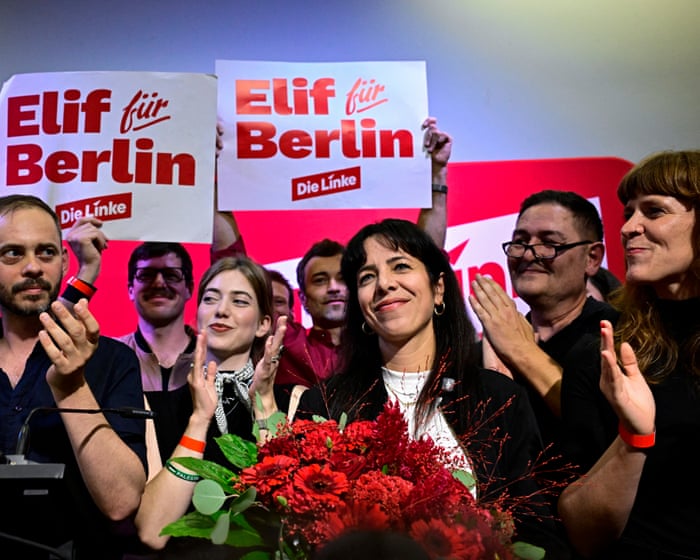
The German left-wing party Die Linke won the Berlin state elections on 20 September. It is unclear whether the party will be able to form a coalition, make its lead candidate Elif Eralp mayor, and carry out her main campaign promise: to socialise the housing stock of the city’s biggest real-estate companies. A flood of accusations began circulating as soon as the results came in. Even by today’s polarised standards, the attack was extreme. Based on one leaked chat and one rapper’s performance, the party was accused of cozying up to criminal clans and endangering the lives of Berlin Jews. Accusations of antisemitism led the Greens and the SPD – potential coalition partners – to question any cooperation, while “alt-right” commentators suggested that “Hamas and Hezbollah” had won the elections, or that the German Democratic Republic (the old East Germany) was about to return. Alice Weidel of the right-wing AfD claimed that Die Linke intended to “shoot the rich.”
Our liberal capitalist order is designed to protect property. Touch any part of it, and the whole thing apparently goes up in flames. Yet nerves are not always this raw. The current flare-ups reveal a deep crisis. Sober-sounding commentators have pointed out that the accusations against Die Linke are simply a strategy to stop the socialisation agenda. But that explanation of moral panic as deliberate strategy can hardly explain everything. Why do so many people want to believe the smear campaigns, especially while the AfD’s simultaneous wins are quickly normalised?
The frenzy becomes less surprising once we understand how liberalism is under pressure, and how that pressure makes the more reasonable political forces look like enemies of freedom. Freedom is the core of liberalism. It is freedom of a particular kind: individual freedom. It lets you do whatever you want as long as you don’t violate the freedom of others or, crucially, their property. The parallel between freedom and property runs deep: my right to do whatever I want comes from ownership of myself. I am my own quasi-property, and in that capacity I face other self-owners and rely on the state to settle disputes between us.
This balance between personal freedom and the freedom of all others is already precarious, but in the face of the global crises we now face, it is especially strained. Liberalism cannot manage economic inequality or ecological disaster, except by pitting the individual freedom of future or distant others against the freedom of the currently privileged. Without democratic pride in our collective ability to shape our shared fate, the resulting policies look like sacrifice with no benefit – I lose the (however hypothetical) freedom to own a row of houses, or I lose the freedom to drive a car, but even if I got public housing or public transport in return, that wouldn’t register as compensation. After all, I cannot do whatever I want with those.
Reason might be on the side of anti-discrimination, social distancing or electric vehicles, but freedom pushes the other way. It isn’t full liberal freedom any more, which would have to treat other people as a limit, but its unhinged, ultra-possessive part.
The right offers quasi-property (or “phantom possession,” as I like to call it) to satisfy its voters: it defends traditional gender roles, the family, freedom of speech and the nation as though they were things to own. “Take back your country” was a core campaign slogan of the AfD. It alludes to the “great replacement” myth, according to which white populations are being replaced by people who are not. This plot weaves together several possessive entitlements: white citizens should “own” their country; the country and its men should “own” women.The far right claims that women need to have more children to boost the domestic birthrate. Migrants are not even seen as capable of moving on their own initiative; instead, they are said to be imported by a woke or Jewish cabal and now need to be removed through “remigration.” While this kind of racist talk is more common in rural areas, “phantom possession” can suddenly override concern for fellow migrant citizens in Berlin as well. Any misstep by the Left is enough for the political center to give in to its own widespread property panic. Shaken by the AfD’s success, disoriented by a future that liberalism cannot effectively govern, challenged by the emancipatory demands of various groups, and struggling to defend Israel’s crimes, much of the so-called center also abandons the liberal pact founded on equality. In what some German Jews call “paternalistic philosemitism,” centrist pundits go beyond fighting antisemitism where it actually occurs. Instead, they promote an idea of absolute victimhood and defend it at all costs. They defend German “memory culture” as if it were their own private property. As a result, Die Linke—like human rights organizations, anti-Zionist Jews, pro-Palestinian demonstrators, and anyone perceived as vaguely “Arab”—is cast as a ruthless plunderer.
Berlin’s new political star offers something all of Europe needs—hope and housing | Fatma Aydemir
It is still unclear how Die Linke—and its promise to socialize some private housing—will weather this particular campaign. But whatever happens, it must continue to navigate a fractured political landscape. Like all emancipatory efforts today, its potential Berlin mayoralty faces unhinged claims and objective problems that require real change. That is why the left cannot win within the liberal script. It can only win with a compelling vision of freedom that points beyond the current impasse. Like Zohran Mamdani in New York, Die Linke has understood this. It has promised not just an abstract right but literally the freedom to stay in one’s city, one’s neighborhood, one’s apartment. And this freedom can scale up: against displacement, genocide, and the ecological doom that threatens our ability to remain on planet Earth. The German left urgently needs to find a way to translate such an agenda to the countryside, where parts of the white population have fallen for fascist myths. What non-toxic freedom could repair their lost sense of place? And above all, how can we guarantee the freedom to stay for migrant communities threatened with deportation by the AfD? Where this fails, even the most basic liberal achievement of human rights is lost. And definitely not because of socialized housing.
Eva von Redecker is a philosopher and nonfiction writer. She is the author of The Freedom to Stay.
Do you have an opinion on the issues raised in this article? If you would like to submit a response of up to 300 words by email to be considered for publication in our letters section, please click here.
Frequently Asked Questions
Here is a list of FAQs based on the article A leftwing win in Berlin shows that people want freedom and liberals cant provide it by Eva von Redecker
Beginner Questions
Q What election result is this article talking about
A It refers to the 2023 Berlin state election where the centerleft Social Democrats lost significant support and the conservative CDU won the most votes However the articles title focuses on the leftwing win which likely refers to the strong performance of the Left Party and the Greens or the rejection of the liberal Free Democrats who failed to enter the Berlin parliament
Q Who is Eva von Redecker
A She is a German philosopher and author known for her work on critical theory feminism and social justice She writes for publications like Die Zeit and is associated with leftwing political thought
Q What does liberals mean in this article
A In this context liberals refers to centerleft and centrist parties like the SPD FDP and sometimes the Greens They are seen as supporting capitalism individual rights and gradual reform but not radical economic or social change
Q What does the author mean by freedom
A She means positive freedomthe ability to live a good life have economic security and participate in decisions that affect you This is different from negative freedom which is just being left alone by the government
Q Why does the author say liberals cant provide freedom
A She argues that liberal parties focus on individual rights and market solutions but they dont challenge the root causes of inequality housing shortages or climate change So they cant give people the real everyday freedom they want
Advanced Questions
Q What is the core argument of the article
A The core argument is that the Berlin election shows voters are rejecting neoliberal and centrist politics because those politics fail to deliver real freedommeaning economic security affordable housing and a livable environment Leftwing parties by contrast offer a vision of freedom that is collective and material not just legal or individual
Q How does the author define leftwing versus liberal