“I don’t believe in comebacks.” Slaven Bilic sat in a hotel lobby in Canary Wharf, wearing a black Soundgarden T-shirt and dark denim, confidently discussing everything from Sir Alex Ferguson’s autobiography to classic Yugoslav films and Nikola Tesla’s celibacy. He was enjoying life in London, just before his third Premier League season as West Ham’s manager, and a rare interview with Croatian media gave him a chance to catch up on domestic gossip.
“I’m now distanced by default, geographically,” he said with a sigh of relief, before jumping from topic to topic—a bit about a Metallica concert, then steaks at an Argentinian restaurant, followed by some off-record stories. He was clearly enjoying himself and didn’t hide it; his time as Croatia’s manager seemed long gone, though talking about it always left a bittersweet taste.
Nations League: Ronaldo-less Portugal prosper while Klopp gets first win as Germany coach
“I have nice memories and wouldn’t want to spoil them,” he said. “I don’t like coming back. It’s not fear of failure, just the feeling that something has run its course.”
And yet, here we are. Nine years after that interview—and 14 since his first spell as Croatia’s manager ended—Bilic is back in charge and preparing to face England in Rijeka in the Nations League on Saturday. In between, there were stints in the Saudi Pro League and Chinese Super League, as well as West Brom and Watford, and no work for 23 months from August 2024.
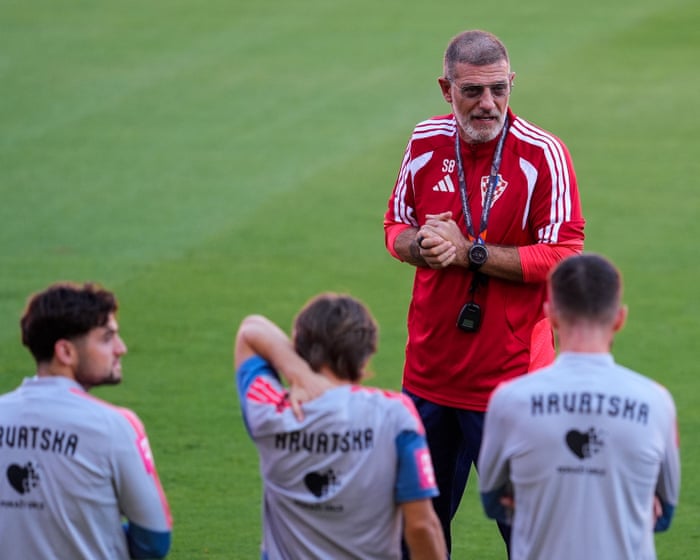
Age has added some sophistication to Bilic’s look, his style resembling a patchwork of tributes to great football managers of our time (the Klopp/Guardiola salt-and-pepper beard, the Bielsa glasses on a string, the Simeone all-black wardrobe), but he is still unmistakably himself: direct, eloquent, and above all passionate—so different from his predecessor Zlatko Dalic’s restrained, humble, almost priest-like persona.
In July, on Bilic’s first public appearance back in the job, it felt as if someone had opened the windows and let in fresh air. The 58-year-old remains the man; he knows how to charm and capture attention.
No coach would find it easy to succeed Dalic, who made history with Croatia by leading them to second and third at World Cups, but Bilic was always the best choice: not only because he knows full well what he is dealing with, but also because there is a lingering sense that he laid the foundation for that success.
The feeling is that he planted what blossomed into Luka Modric’s and Dalic’s team; that he made Croatia dream big for the first time since his generation of 1998 as a player, a cornerstone being the famous 3-2 victory at Wembley in 2007, when Croatia won not because they needed to but because they could and felt fully confident in their strength.
Bilic is also probably the only one who could have convinced Modric to stick around for a while. Fittingly, the 41-year-old Modric scored the first goal of the second Bilic era, in a 2-1 win in Prague against Czechia last Saturday, and rushed to embrace his manager. “Luka is everything to us, he’s just incredible,” Bilic said.
Skip past newsletter promotion
Free newsletter | Every weekday
Sign up to Football Daily
Kick off your evenings with the Guardian’s take on the world of football
Enter your email
Sign up
after newsletter promotion
View image in fullscreen
Luka Modric scored Croatia’s first goal since Slaven Bilic returned to the dugout. Photograph: Martin Divíšek/EPA
When it comes to his managerial work, Bilic needs to prove himself again. He is inevitably no longer the coach he was during his first reign, and it remains to be seen how he can apply his experience. It is too early to tell after two games—the second a 4-1 away defeat by a vastly superior Spain, for which he rotated heavily—but there are clues.
Under Dalic, the team often waited and relished their underdog role, then were deadly on the counter, despDespite not having many quick players and with a creative midfield as their main strength, Bilic wants to dominate. He wants his players to press high, take more risks, and get more players into the opposition area. He wants his centre-backs to step up with the ball instead of waiting for Modric or Mateo Kovacic to drop back to the edge of the box to receive it. He wants his team to be brave, attacking, and as passionate as he is. Can he do this with a squad that, despite a significant influx of fresh blood over the years, is still led by veterans like Modric, Kovacic, and Ivan Perisic? He believes he can. Bilic has always believed. In 2012, he believed his Croatia could win the Euros (they went out in the group stage), and now he says he can match Dalic’s success. Maybe he didn’t really believe in comebacks nine years ago, but that didn’t stop him from having faith in bigger things.
Frequently Asked Questions
Here is a list of frequently asked questions about Slaven Bilis return as Croatia manager
Beginner Questions
Q Who is Slaven Bili
A He is a former Croatian football player and now a manager He famously coached Croatia from 2006 to 2012
Q What is a second stint
A It means he is managing the team for a second time His first time was years ago and now he is back
Q When did he return as Croatia manager
A He was appointed again in July 2024
Q Why did Croatia hire him again
A After a disappointing Euro 2024 the team needed a leader they trusted Bili is a popular figure who knows Croatian football well
Q What does courage and faith mean in this context
A It means Bili is showing bravery by taking on a tough job and he has belief in himself and his players to succeed
Intermediate Questions
Q What did Bili achieve in his first stint
A He led Croatia to the quarterfinals of Euro 2008 and the 2010 World Cup but they did not advance past the group stage in Euro 2012
Q What problems does Croatia face now
A An aging squad key players retiring and a need to rebuild team spirit after a poor tournament
Q How is Bili different from the previous manager
A Bili is known for his motivational skills and close relationship with players The previous manager Zlatko Dali was more tactical but faced criticism for being too cautious
Q What is Bilis coaching style
A He prefers attacking football high energy and strong team unity He also gives young players a chance
Q What are the benefits of bringing him back
A Instant respect from players renewed fan enthusiasm and experience in big tournaments
Advanced Questions
Q What are the biggest risks of this second stint
A If results dont improve quickly fans may turn on him Also his previous success was over a decade ago so football has changed
Q How does Bili plan to handle the transition from old to new players
A He has said he will mix