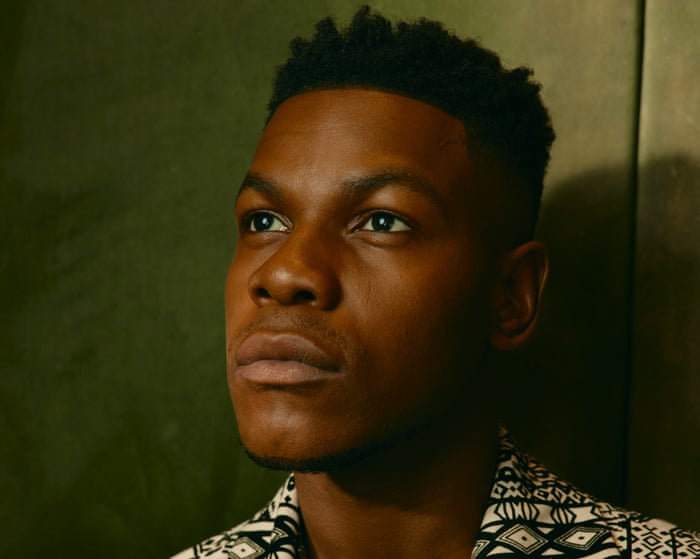
“I feel a bit nervous,” John Boyega admits as he sits down in front of the camera. “Talking about it might help. I haven’t revisited this in a long time. Yeah, my heart is racing.” The Attack the Block and Star Wars actor is speaking in the opening scene of a new BBC Two documentary about the killing of 10-year-old schoolboy Damilola Taylor.
On 27 November 2000, Damilola was stabbed in the leg with a broken bottle and left to die in a concrete stairwell. He was attacked as he walked home from an after-school club at Peckham library in south London. It took six years and three separate trials at the Old Bailey, costing £16m in total, to secure a manslaughter conviction. His death shocked the nation not only because he was so young, but because all the suspects were also children. Boyega was one of the last people to see Damilola alive. The two had been close friends since Damilola moved to the UK from Nigeria in August that year.
Watching the film at a Bafta screening a few weeks before its premiere, it’s striking how young and vulnerable the 34-year-old actor looks as he talks about his friend’s death. Boyega is more often seen looking assured and confident, whether he’s giving an impassioned, impromptu speech to thousands at a Black Lives Matter protest in Hyde Park, posing for the Pirelli calendar, or playing an African king in a Hollywood movie. Usually he stands tall, broad-shouldered and proud. But as he revisits the memories of that day, it feels as if he has almost reverted to the eight-year-old child he was nearly 26 years ago when he learned his friend had died.
A couple of hours later, I meet him again at BBC New Broadcasting House to discuss the show. In person, Boyega is unassuming, with a calm manner and a welcoming smile. He has just returned from a trip to New York fashion week and looks surprisingly fresh-faced for someone who has not long stepped off a transatlantic flight.
Boyega is sitting comfortably with his father Samson, his mother Abigail and an older cousin. It’s a lively space – Boyega lives in Los Angeles now, and I get the impression everyone is excited to grab a bit of time with him while he’s in London. We immediately fall into a five-way conversation about the criminal proceedings around Damilola’s death. Everybody is talking at once.
The first trial collapsed after the judge ruled that the prosecution’s key witness was unreliable, and there was controversy about crucial evidence that was excluded from the proceedings. The family closely followed all three trials – in the second, the jury failed to reach a verdict for two of the three defendants on a murder charge – and there is a sense of frustration at the missed opportunities to bring the killers to justice.
“You would have thought the influence of the Stephen Lawrence case would have been much stronger, if they had actually learned something. It didn’t come across like that,” Boyega sighs. The police investigation was heavily criticised after it was found to have made a number of significant mistakes.
The whole Boyega family knew Damilola, but the actor has previously said very little about him in public. Boyega has worked steadily since his 2011 debut in the sci-fi cult classic Attack the Block, including a game-changing lead role in Disney’s Star Wars franchise. His most recent projects, The Woman King (2022) and They Cloned Tyrone (2023), were both critically acclaimed. He has said that his professional success is due in no small part to being inspired by the way Damilola lived his short life.
He has been deeply involved in the documentary. “The first time I watched a rough cut I was in my living room and it was bright out. Since then, we’I’ve been watching daily edits on my phone, laptop, and a small TV. But seeing it in a cinema hits differently – it was an emotional hurdle to get through, watching the film that way. It really affected me.” During the 75-minute screening, you could hear crying and sniffling around the room. “It’s one of those films I wouldn’t watch multiple times because of my personal connection to it, but it’s definitely a film I’ll return to – when my child is old enough, I’ll show him this film. You need to know the realities of your lineage.”
On Damilola Taylor’s first day at Oliver Goldsmith primary school in Peckham, soon after he arrived in the UK, a teacher assigned Boyega’s sister Grace to be his guide. She says in the documentary: “My teacher was like, ‘Grace, there’s a new boy and he’s from Nigeria, and obviously you’re Nigerian so you understand the language – you can show him around.'” They became a trio, because Boyega and his sister were inseparable at the time.
“The only reason I was around him so much was because I was always with my sister – I inherited Damilola,” Boyega tells me, laughing. “I stayed because I found him hilarious.”
The psychological impact is something that definitely stayed with me.
Boyega in a still from the documentary about Damilola. Photograph: BBC/Optomen TV
His father adds a poignant memory: “John doesn’t have many friends – at least not boys. John had girls around him. And I remember asking, ‘John, why are you hanging around girls?’ and he said, ‘Dad, boys are dangerous – they’ll beat me up.'” At lunchtime, the three of them would run around the playground together.
Boyega describes the day Damilola died as a turning point for him. “The psychological impact is something that definitely stayed with me, but now it comes out as appreciation. Every time I wake up and I’m here, I appreciate it.” He smiles as he talks about telling his friends: “I’ll tell my boys, ‘Hey, a bullet doesn’t look at you and say, “You’ve done movies before,” and swerve you!'” As a child, though, his thoughts were less positive. “When I’d hear that somebody had been stabbed or whatever, it just felt like it was getting closer and closer, and that awareness became part of everyday life. I was very scared of that.”
Boyega was eight when Damilola was killed; he had previously thought death “only happened to old people.” He was bewildered by it – “like when babies fall and everyone goes, ‘Oh my gosh!’ and then the baby, seeing the response, decides to cry? It was like that.” As the news sank in, he found it hard to understand that bad things could happen to good people. “I was trying to work out what that meant. I thought about the practicality of it. The last breath. Does it hurt? I remember having conversations with Grace where I’d be like, ‘Do you think death is sleep?’ or, ‘Maybe they go for 20 years and then they come back?’ It kept me up at night because I had just been with the guy, you know?”
After Damilola’s death, Boyega spent a lot of time at home in his bedroom. Sometimes friends would knock for him and he would tell his mother to pass on the message that he didn’t want to go out. “The hand of death is influencing kids to kill kids. I’m like, ‘Damn, I’m a kid, let me stay where I feel safest.’ I had a home that gave me extreme safety, and my parents didn’t shy away from showing concern.”
This played out in many ways, including their choice of secondary school for him. Instead of the options in their home borough, he was sent to Westminster City School – almost an hour away by bus. Was getting out ofWas the area a response to Damilola’s death? Boyega’s father answers: “Before John says anything, I went to his teacher when he was going to secondary school and he said to me, ‘Mr Boyega, why do you have to choose Westminster?’ And I never said to him what I saw: that the environment here will corrupt this guy,” he says, pointing at his son. “I saw what was coming, that in the future this environment is going to be very, very dangerous.” This was in 2003. By the end of the decade, 188 teenagers had been murdered on the streets of London. I direct the conversation back to Boyega. Did he have therapy back then? He lowers his chin and looks at me with a furrowed brow. What he appears to be conveying is there’s no such thing as therapy in an African household – especially not a 1990s African household. We both laugh. At this point I am conscious that my question could easily be construed as a criticism of his parents, who are sitting on the sofa opposite us in the suddenly quite claustrophobic room. We quickly move on. Over the years there have been numerous documentaries focusing on various aspects of Damilola’s killing, from a 2002 BBC Panorama special to most recently one fronted by broadcaster Yinka Bokinni to mark the 20th anniversary of Damilola’s death. This latest project focuses much of the narrative on the 24 hours leading up to his killing. We hear from a number of people who were critical to the investigation in its early stages, including the estate maintenance worker who first found Damilola as he lay bleeding in the stairwell. There were several months of discussions between Boyega and the director, Alex Thomas – who also directed the award-winning Sky Original documentary Bibaa and Nicole: Murder in the Park, about the 2020 killings of Bibaa Henry and Nicole Smallman. “It fell to me to decide who was coming from my world to sit down and talk,” says Boyega. “That’s when I decided that Grace would be more appropriate to discuss Damilola than me because that was her direct friend – they were around the same age. And I think her perspective on it was quite important.” skip past newsletter promotion Sign up to Inside Saturday The only way to get a look behind the scenes of the Saturday magazine. Sign up to get the inside story from our top writers as well as all the must-read articles and columns, delivered to your inbox every weekend. Enter your email Sign up after newsletter promotion That was the easy part. More difficult was deciding how to address the ecosystem of bullying and fear on the streets of Peckham that led up to and ultimately underpinned Damilola’s killing. In the final edit, much of this element of the storytelling is omitted. It doesn’t go unnoticed. During a Q&A after the screening, a Bafta member in the audience queries the lack of backstory included about the lives of the two boys convicted of Damilola’s manslaughter. In August 2006, brothers Danny and Ricky Preddie were each sentenced to eight years in youth custody after the third trial. The questioner pointed out that the brothers appeared at the Old Bailey unattended by any family. “I’d love to know why you left that out,” they said, referring to the brothers’ troubled childhoods. It was well known that their single mother struggled immensely while raising them. The pair were eventually placed in a local authority children’s care home. “We did look at the option of interviewing the two brothers,” said Boyega, who explained a general concern within the team that it might be viewed as being too empathetic to the perpetrators. In the end, the decision was made not to approach them. But Boyega agrees that some elements of their backstory do have a place in the narrative, in particular when it comes to the debate about how to end youth violence. “Family. Discipline,” he says decisively. “The fact that you don’t have an adult at home that holds you accountable is a ve”Really important, especially for boys.” He repeats the last sentence a little slower to emphasize its importance. “But you know, you could have two parents at home and the child still goes out and does what they need to do, so there’s obviously a more nuanced conversation. Even in the sense that someone showed you that they loved you, that they cared about what you did or whether or not you made a mistake. What that person said at the screening Q&A made me think about what it meant—that they didn’t have that. Not even a social worker.”
“I didn’t know I was poor until I was in year 7. When you’re very young, you’re not really thinking about that. When you get to school, you start to see where you are in the food chain of life.” There’s a long silence when I ask Boyega what was difficult about making the documentary. “Poverty,” he replies eventually. He means it brought back memories of the poverty he experienced as a child. Growing up, he lived in a small flat on the Sceaux Gardens estate just off Peckham Road with both his parents and his older sisters—Grace, who appears in the documentary, and Blessing, who generally keeps a much lower profile. His mother was a care worker and his father a Pentecostal minister. “I didn’t know I was poor until I was in year 7. When you’re very young, you’re not really thinking about that. And then when you get to school, you start to see where you are in the food chain of life, and that’s when you start to compare yourself with other children and other kids.” The process of filming the documentary brought that world back into focus.
Boyega recalls being keen not to stand out for the wrong reasons in his first year at Westminster City School, and begging his mother to buy him a pair of Kickers. She took him to Barrie Howard, a shoe shop on East Street in Walworth—a strategic rite of passage for any south Londoner who hoped to survive the brutal transition from primary to secondary school. But once he had the shoes he felt bad, because he could tell how much it cost her. “I never asked for Kickers from my mum again—I wore Clarks for the rest of school.” Recounting these memories, plus seeing the archive footage of Peckham and the burgundy Oliver Goldsmith school sweater, brought back the distinct feeling that he had so much less than many of his peers. “I did work hard to get out of that. In making this film I had to revisit who I used to be, and that bothered me.” The interviews took place while he was on location on the Isle of Skye making a supernatural horror movie, The Punishing, in which he stars alongside Cara Delevingne (it is currently in post-production). The surroundings served as a physical reminder of how far he’s come in life.
Boyega with Oscar Isaac in Star Wars: The Force Awakens, 2015. Photograph: Disney/Lucasfilm/Allstar
… and with his family at the London premiere of Star Wars: The Last Jedi, 2017. Photograph: PA Images/Alamy Stock Photo/Alamy Live News.
Boyega had some reservations about being involved in the project. His main concern was that he wanted to make sure that Damilola’s brother—Tunde Taylor, chair of the Damilola Taylor Trust—was happy with the way Damilola’s life is portrayed. “I’ve been in the public eye for a minute now and from my experience, you have to be very careful, because you don’t know which journalist is being stressed by an editor. You don’t know which person wants to grab a story and not use it with the right intentions. You don’t know if they’re gonna be respectful to the people who are really involved.” But he was reassured by meeting producer Nelson Adeosun, a childhood family friend, and fellow contributor Leroy Logan. Logan is the founder and former chairman of the Black Police Association, whom Boyega portrayed in the film Red, White and Blue, from StevSteve McQueen’s 2020 anthology series, Small Axe, earned him a Golden Globe award. Moving thousands of miles away from Peckham has inevitably changed Boyega’s connection to the place that shaped him. “The south is still familiar, but if I go now, people have to guide me … it’s so, so different,” he says, referring to the area’s gentrification. For him, though, the heart of the place lies in the people who remember what it was like when he was growing up. We reminisce a little about which legendary hangouts have survived. He’s pleased to note that Bagel King is still around.
Someone pokes their head around the door to tell us we need to wrap up. Boyega’s on a tight schedule. I ask a final question. Tell me about your jewellery, I say, gesturing towards his left hand. “Oh yeah, this is my wedding ring,” he says casually. “I’ve been married for nearly two years now.” He doesn’t share any details about his wife, but mentions they had a small ceremony, joking that he got married the way Braveheart did, while miming planting a sword in the ground. He then drops his voice to its deepest register and bellows, “Will you come with me?”
His eldest sister has now joined us, and the room erupts into a chorus of unrestrained laughter. I notice the ring he’s wearing is different from the one in the documentary. “Yeah, this is our very sentimental ring,” he says of the two-toned band. “This is the one we decided to pick up spontaneously because I just wanted the ring on my finger, so we went to Walmart to get this. It was a lovely trip to Walmart. Shout out, Walmart Canoga Park!” he laughs. I’m surprised to learn he didn’t have a traditional Nigerian ceremony. “I would love to have a wedding celebration. We both like the idea of celebrating something established, rather than celebrating the entry. And by then, we’ll have to shut Nigeria down!”
It occurs to me that the child he mentioned earlier may not be hypothetical. Are you about to hard launch a baby, I ask tentatively. “My baby’s on the way. We got a baby cooking.” And you said “my son” earlier – is that because you’re having a boy? He confirms this and that he also has a young stepson. “So, you know, my life is completely, completely fulfilled in terms of family. It’s been so nice with the timing.”
Adjusting to this new dynamic away from the public eye has clearly served him well – and perhaps this is why he’s now ready to speak publicly about his friendship with Damilola. “I do think it’s important to reach back and tell people the grounded realities of your origins, because it wasn’t until I knew the grounded realities of other people’s origins that I decided to pursue something more.” When he thinks about the kind of father he wants to be, it’s all still sinking in. “Us being parents is funny! I just want to make sure I’m present, I’m consistent and full of love.”
These personal milestones explain why he’s been less visible in recent years. “I’ve tried as much as possible – especially after periods when I’ve worked a lot – to de-centre my career. There have been certain moments when I’ve known that this is a time for family. Y’know, there’s stuff to do.” In this moment, he’s clear that his purpose is to love his wife and sons and invest in the support system he knows he’s lucky to have had. Damilola: The Untold Story is on BBC Two and iPlayer from 5 October.
Frequently Asked Questions
FAQs John Boyega Recalls the Day His Friend Damilola Taylor Was Killed
1 Who is John Boyega
A British actor best known for playing Finn in the Star Wars sequel trilogy He also starred in Attack the Block Pacific Rim Uprising and Detroit
2 Who was Damilola Taylor
A 10yearold Nigerian boy living in London He was attacked and killed on November 27 2000 in Peckham south London
3 How did John Boyega know Damilola Taylor
They were school friends Both attended Oliver Goldsmith Primary School in Peckham and grew up in the same area
4 What exactly did Boyega say about Damilolas death
He said it kept me up at night because I had just been with him He has spoken about the shock of losing a friend he had seen shortly before the attack
5 How old was Boyega when Damilola died
He was around 8 years old at the time making the loss one of his earliest experiences with tragedy
6 What happened to Damilola Taylor
He was stabbed in the leg with a broken bottle while walking home from a library He bled to death Two brothers were later convicted of manslaughter in 2006
7 Why does Boyega still talk about Damilola
He has said the memory stayed with him and shaped his view on youth violence He uses his platform to keep Damilolas story alive and to push for change
8 Why did this story affect Boyega so deeply
Because he had just been with Damilola before the attack That close timing made the loss feel personal and immediate not distant
9 What is the Damilola Taylor Trust
A charity set up by Damilolas father Richard Taylor to help young people and fight youth violence in the UK
10 Did Boyega work with the Damilola Taylor Trust
Yes He has supported the trust and spoken at events honoring Damilolas memory
11 What is the main lesson from Boyegas story
That youth violence has a lasting impact on friends families and whole communities and that survivors carry the memory for life