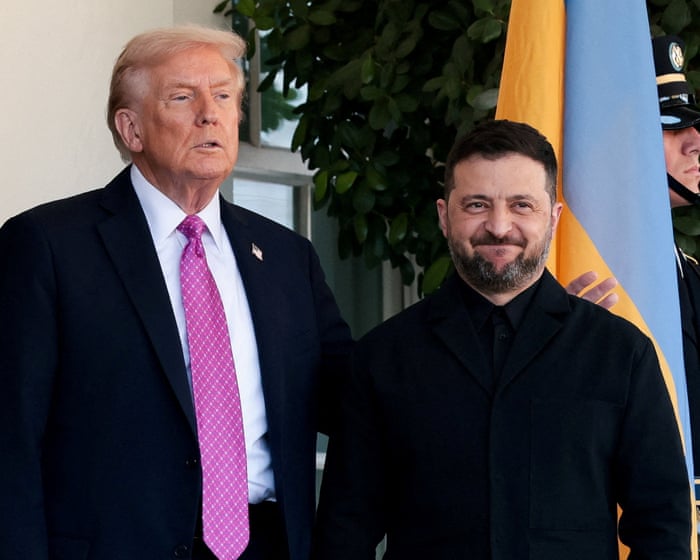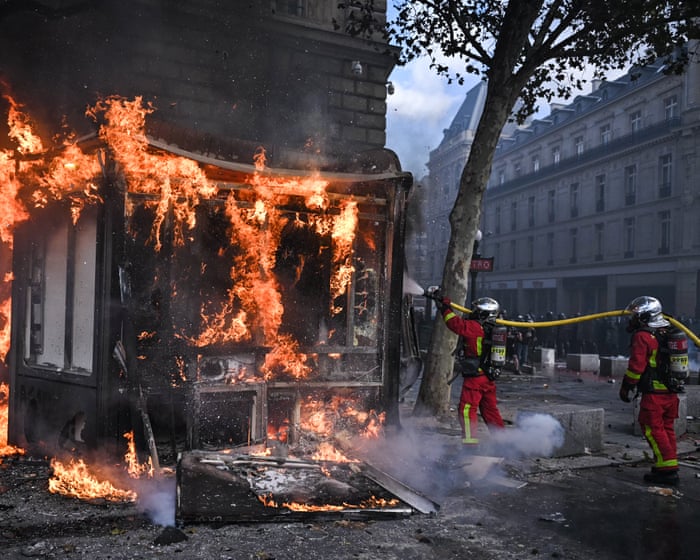
The only clear winner so far from France’s chaos is Marine Le Pen. The violence and rioting that swept through towns and cities across the country over the weekend, six months before a crucial presidential election, is a gift for the hard-right, Eurosceptic, anti-immigration candidate. As buildings burned, shops were looted and police were attacked, the rioting largely overshadowed peaceful mass protests over the poor state of schools, fuel prices and the cost of living. Across France and the rest of Europe, people are shocked by scenes of arson and looting in city centres, the destruction of symbols of the republic such as the 19th-century town hall in the peaceful provincial city of Limoges and the bust of Marianne in Marseille’s city hall, and the looting of more than 2,000 shops. Though France has a long revolutionary tradition, this was not the work of egalitarian insurgents or working-class fighters, but nihilist, anarchist “black bloc” gangs, joined by opportunistic looters and rioters. Emmanuel Macron is a lame-duck president with no practical answers to a crisis that is ruining his legacy. Macron expressed his “anger and shame” at the violence and the damage to France’s global image in a Sunday-night broadcast to the nation, but he is so widely disliked, including by many who voted for him in two presidential elections, that his calls for order and dialogue were largely ignored. Le Pen, by contrast, issued a solemn video message, looking presidential as she sat at a desk with the national tricolor (but no EU flag) and bookshelves behind her. Millions of suffering French people were angry about “anarchic immigration” and the cost of living without smashing or burning anything, she said. They would have a chance in six months to vote for a different path of “restored authority and security.” Macron’s minority government is trapped in a vicious circle. France’s debt and deficit squeeze leaves him no spare cash to buy off protesters. A decade of his centre-right presidency has failed to reform a bloated public sector or improve public services. The country has a youth crisis, marked by anxiety over an economically uncertain future and amplified by social media, as well as a geopolitical crisis with Russia’s war on Ukraine spreading into a covert war against Europe. Foreign critics of progressive European social policies are fanning the flames with inflammatory commentary. Donald Trump gloated on social media that “France is burning!” Blaming the situation on immigration, he urged the French to “close your borders and take control before it is too late.” Vladimir Putin’s close aide Kirill Dmitriev described events in France as “the suicidal fall of Europe” and also attributed it in part to chaotic migration. The convergence of crises leaves little room for manoeuvre for a French government struggling to push even a mildly cost-cutting budget through a hung parliament. For now, it is trying to extinguish the violence with selective curfews. One presidential hopeful, Dominique de Villepin, who was a Gaullist prime minister 20 years ago, has even compared the situation to the eve of the fall of the ancien regime in 1788, a year before the outbreak of the Revolution, when France was stricken by drought, failed harvests and empty state coffers. That may be a far-fetched parallel. But the sense of a fraying state, a discredited political class and an ossified bureaucracy unable to stem a slow-motion financial crisis that might suddenly accelerate makes the stakes in next year’s presidential race ever higher. Until last weekend’s explosion, the school and student protests, unrest over the cost of living and outrage at instances of police brutality against young demonstrators all seemed to be boosting the campaign of radical-left firebrand Jean-Luc Mélenchon, who in some opinion polls had overtaken the centrist Edouard Philippe for second place. However, Mélenchon’sHis apparent refusal to clearly condemn the looting or attacks on police, and his dismissal of the violence as “disorder that is part of the events in the life of a society,” may cost him support among more moderate leftwing voters who have boosted Socialist candidate Raphaël Glucksmann in recent opinion polls. Investors are alarmed by the violence and political instability, selling French stocks and bonds. A deepening market run on France could still change the dynamics of the presidential campaign, rallying a frightened middle class behind a seasoned centrist candidate seen as a safe pair of hands in a crisis. A month after the May 1968 student-worker uprising that shook Charles de Gaulle’s staid regime, voters scared by the spectre of civil unrest delivered a landslide victory to his party, which promised to restore order and authority. A year later, De Gaulle was disavowed in a referendum on regional devolution and resigned. Historical comparisons are risky. Last weekend’s violence has increased the likelihood of a law-and-order backlash among voters that could propel Le Pen into the Élysée Palace. But if the financial situation worsens and the campaign turns on who can save the economy, she may yet lose out to a candidate who is firm on security and more orthodox on fiscal policy. Economics is Le Pen’s weak spot. So far, neither Philippe nor other centrist and centre-right rivals have set the campaign alight. But six months is a long time in French politics.
Paul Taylor is a senior visiting fellow at the European Policy Centre
Frequently Asked Questions
FAQs After the violence and chaos in France only one person benefits Marine Le Pen
Q What is this article about
A Its an opinion piece by Paul Taylor arguing that the riots and unrest in France politically benefit Marine Le Pen the farright leader more than anyone else
Q Who is Marine Le Pen
A A French politician who leads the National Rally a farright party She has run for president multiple times and promotes antiimmigration and lawandorder policies
Q What violence and chaos is the article referring to
A Waves of urban unrest in Francesuch as the 2023 riots after a teenager was killed by policeinvolving burning cars looting and clashes with police mainly in disadvantaged suburbs
Q Why would Le Pen benefit from chaos
A Unrest plays into her core message that the government cant maintain order and that immigration and crime are out of control It can push voters toward parties promising tough solutions
Q What does Paul Taylor mean by only one person benefits
A Its a rhetorical claim not a literal one Hes arguing that while the unrest hurts the government and the country broadly Le Pen gains the most politically
Q Is this a news report or an opinion piece
A Its commentaryanalysis Paul Taylor is a columnist so the piece expresses an argument rather than just reporting facts
Q What is the National Rally
A Frances main farright party formerly called the National Front It has softened its image in recent years to appeal to more voters while keeping hardline stances on immigration and security
Q How does unrest actually translate into votes
A It can raise the salience of security issues erode trust in the ruling government and mobilize voters who feel order is collapsinggroups Le Pen courts But the effect isnt automatic
Q What are common criticisms of this argument
A Critics say its too simplistic unrest can also galvanize turnout against the far right damage public sympathy for rioters or fade from memory before elections Correlation isnt causation
Q Whats a practical takeaway for readers
A Treat the claim as an argument to evaluate not a fact