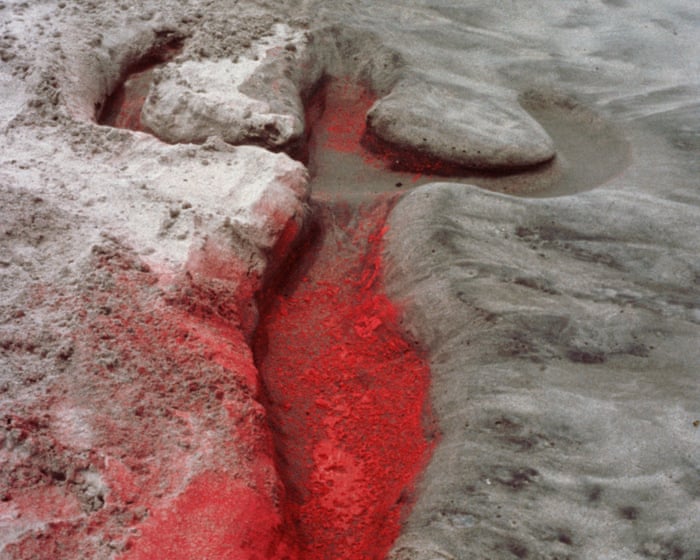
A huge color photo of a ruined ancient site greets you at the entrance to Ana Mendieta’s captivating exhibition, and it immediately signals that this will be something different. It looks like it belongs more in a British Museum show about a lost pre-Columbian civilization than in the concrete fortress of Tate Modern’s Blavatnik wing. Yet in her imagination, that’s exactly where Mendieta felt she belonged. Born in Havana, Cuba, in 1948, she was sent to the US at age 12 to escape the revolution. She felt like an outsider among white Americans. For her, home was the past, and she would dig into the very origins of art and mythology.
Mendieta created art from blood, feathers, flowers, and sand, and she did it in such fresh ways that these primal materials seem like new inventions. She literally played with fire, drawing a human figure with gunpowder on the ground or on a tree trunk, then setting it ablaze. The flames leave behind a scorched shadow of a person, like victims of a nuclear bomb or the dead of Pompeii preserved in ash. Facing a row of these burnt ghosts emerging from real tree trunks, you almost expect them to speak to you like the spirits of the dead.
View image in fullscreen
Playing with fire … Ana Mendieta, Untitled, 1977. Photograph: The Estate of Ana Mendieta Collection, LLC/DACS 2026
More often than not, the human shape that blends with nature is Mendieta’s own. In one photograph, she stands covered in brown mud against a tree, so her body seems to sink into the bark, nearly vanishing into it. In another, a female figure—who is the artist yet also a universal, totemic being made of mud—slowly decays in a pool of water.
But Mendieta wasn’t above joking. She poured animal blood on a sidewalk so it looked like a human bloodstain and secretly photographed passersby as they tried to figure out this disturbing trace of some terrible violence. In another early work, she tries on a flamboyant mustache, playfully addressing her uncertainty about who she was and where she came from.
View image in fullscreen
Holy portals … Ana Mendieta, Untitled (Guanaroca [First Woman]) 1981, 1994. Photograph: The Estate of Ana Mendieta Collection, LLC/DACS 2026
She returned to Cuba for the first time in 1980. Then, in 1981, just two years after her father was released from a political prison there, she carved stunning limestone sculptures in quiet corners of a nature reserve. Her black-and-white photographs make these Rupestrian Sculptures—as she named them, meaning simply “composed of rock,” a tautological joke—look like mysterious traces of a lost civilization: the ancient Rupestrians, perhaps. Curvy fertility goddesses resembling the Venus of Willendorf and other abstract female forms, bat-like or maybe alien, with vaginas like holy portals, rise from rock formations as eroded yet lasting masterpieces of human culture. Mendieta created them hoping walkers would come across her works and think about them.
She wasn’t the only modern artist to dream of, or even fake, an ancient, prehistoric past for the Americas. Robert Smithson’s 1970 earthwork Spiral Jetty aims to be a US answer to Stonehenge, sinking and resurfacing in the Great Salt Lake; James Turrell’s Roden Crater and Walter de Maria’s Lightning Field have similarly primal ambitions.
But Mendieta is different. She avoided massive monuments in favor of more personal gestures, like a human silhouette made of flowers. And instead of the abstract language of modern American art, she depicts actual divine figures, a personal mythology as strangely coherent as William Blake’s. Scattered among the photographs, films, and objects are drawings, including lovely sketches on leaves, where Mendieta develops this surreal imagery. She brings her graphic imagination directly into nature, leaving her imprint in a muddy wasteland, or a figure made of white flowers in a coffin-like grassy rectangle, or another deep imprint of herself in mud that is filled withA red pigment, like blood. This artist is impossible to ignore. She doesn’t just make bold interventions—she presents a fully developed theory of the universe. She works to reconnect art and nature through a feminist mythology of ancient goddesses, half-forgotten, whom she literally digs out of the soil or reveals hidden in trees through fire sacrifice.
“I thought of her as a volcano”: the triumphant art and very troubling death of Ana Mendieta. Read more.
This is art rooted in organic matter—in leaves and ashes—with an unrestrained ability to create unforgettable images. It’s also art for our time. Mendieta died in 1985 at age 36, under highly controversial circumstances. This exhibition doesn’t dwell on that, and neither will I, except to say that her art holds infinitely more life than the bricks her husband Carl Andre sold to the Tate years before he was accused—and then acquitted—of her murder.
A Mendieta who never fell from her apartment would be at the absolute forefront of art in this century. But then again, she would have been equally at home in the Stone Age. Some archaeologists now claim that the stenciled handprints found in Paleolithic caves are female. Years ahead of this theory, Mendieta made a mold of her hand and turned it into a branding iron, using it to burn her handprint into the earth—and into history.
Ana Mendieta is at Tate Modern, London, from July 15 to January 17.
Frequently Asked Questions
Here is a list of FAQs based on the review title Ana Mendieta review if she were still alive she would be at the forefront of art in this century
BeginnerLevel Questions
Q Who is Ana Mendieta
A She was a CubanAmerican artist known for powerful performance art earthbody sculptures and works exploring identity displacement and violence against women
Q What kind of art did she make
A She often used her own body in naturelike pressing her silhouette into mud setting herself on fire or creating outlines with flowers and blood Her work is raw emotional and deeply connected to the earth
Q Why is this review saying she would be at the forefront of art today
A Because her themesmigration feminism ecological crisis and bodily autonomyare more relevant now than ever Many contemporary artists cite her as a major influence
Q Is her work hard to understand
A Not really Its very direct and visual You feel the emotion even if you dont know the backstory Her pieces are about being human being a woman and belonging somewhere
IntermediateLevel Questions
Q What does earthbody mean in her work
A Its her own term for blending her body with natural elementslike lying in a grave of flowers or becoming a silhouette in sand She wanted to show that we are part of nature not separate from it
Q How did her early life influence her art
A She was exiled from Cuba as a child and moved to the US That loss of home and identity runs through all her work Her art often deals with searching for roots and reclaiming a sense of place
Q What is the most famous piece in this review
A The review likely highlights her Silueta series where she created outlines of her body in earth fire water and mud Its her most iconic and haunting work
Q Why do people compare her to contemporary artists like Marina Abramovi
A Both used their bodies as medium and explored endurance and ritual But Mendietas focus was more on nature spirituality and the politics of exile while Abramovi focuses on