I recently spoke to a group of more than 100 European ambassadors about the major challenges the continent will face this year and next. My main message to these senior diplomats was that, perhaps surprisingly, Europe’s biggest external challenges over the next 12 months will come from Russia and China, not the US.
Europe’s relationship with Trump’s America remains difficult. The US president has weakened confidence in Nato, stirred up new transatlantic trade tensions, and created uncertainty around everything from US support for Ukraine to his territorial ambitions regarding Greenland. Yet paradoxically, despite Trump’s latest tariff threats over the EU’s outreach to Canada, the transatlantic relationship is becoming the more stable part of Europe’s external environment. Not stable, but more stable.
Compared with Russia and China, Europe’s disputes with Washington remain somewhat limited – and largely negotiable. Ukraine’s rapidly expanding drone capabilities, its military innovation, and its battlefield experience have made Kyiv a more valuable partner for Washington. US defence companies are also benefiting from Europe’s military support for Ukraine and its rearmament against Russia. The US, Denmark, and Greenland now say they have reached a deal allowing the US to develop a significant military presence on Greenland. The details will matter, but they have much stronger incentives to reach an agreement than to let the issue become a lasting source of confrontation.
Trade tensions more broadly will persist, particularly over European regulation of American tech companies. The same is true of Nato, which has lost credibility because of Trump’s frequent criticism. Nonetheless, these disputes are between countries with deeply interconnected security and economic interests. The risks Russia and China pose to Europe are more structural – and increasingly point toward escalation.
Russia is becoming more dangerous because it is becoming weaker. The Kremlin is running out of cheap and politically painless ways to finance its war in Ukraine. Its original budget assumptions for 2026 have been overtaken by events. Military spending continues to rise, driven not only by the need for equipment but by the growing cost of recruiting soldiers for the frontline and paying compensation to casualties.
How Vladimir Putin funds his war is now the battlefield behind the battlefield. Further tax increases would damage an economy that, outside the military sector, is approaching recession. Borrowing has become more expensive, while public spending – on everything from schools and hospitals to infrastructure – is being squeezed to preserve the war effort.
Rather than push Putin toward compromise, Russia’s economic challenges are likely, at least initially, to produce the opposite effect. If he expects his economic position to worsen next year, the Kremlin has a powerful incentive to improve its military position now. That means escalation in Ukraine and against Nato. This explains the recent impromptu visit to Moscow by CIA director John Ratcliffe.
In Ukraine, Russia is likely to accelerate its mobilisation efforts and carry out heavier attacks on Ukrainian cities and infrastructure, intensifying its efforts to undermine Ukraine’s economy and civilian morale this winter. The coming months will also see an escalation of Russia’s hybrid warfare activity against Nato countries.
China presents a different but equally serious challenge. For years, Europe has debated whether China competes fairly. That argument is essentially over. A broad consensus now exists that China’s subsidies, industrial overcapacity, undervalued exchange rate, and export-led economic model require a political response. The question is no longer whether Europe should defend itself against unfair Chinese competition, but how far it is prepared to go.
Beijing, meanwhile, has reached a very different conclusion. It inEurope increasingly views Europe’s trade-defence measures, industrial policy and economic security agenda as an attempt to constrain China’s growth. The European commissioner for trade and economic security, Maroš Šefčovič, and his Chinese counterpart, Wang Wentao, met in late June and committed to resolving a number of outstanding issues by October. That may delay confrontation. It is unlikely to avert it. China is not going to abandon its use of industrial subsidies, the exchange rate or its export-led growth model. These are central features of China’s economic strategy, and not subject to negotiation. Equally, the EU is not going to retreat from its economic security agenda. The union is developing investment controls, procurement restrictions and new industrial and trade-defence instruments. Although formally country-agnostic, many are clearly directed towards China. Every European measure to reduce dependence on China is therefore likely to prompt a Chinese response, while every Chinese retaliation will strengthen the political case in Brussels to go further. That makes compromise harder, and escalation between the two sides more likely over the medium term.
The most likely outcome is managed confrontation, rather than a full-scale trade war. The EU will expand targeted restrictions limiting China’s access in additional sectors. China will respond with selective tariffs, procurement barriers, regulatory pressure on European companies and tighter controls on critical minerals. Both sides will try to increase pressure without losing control. Europe has leverage, too. China remains extraordinarily dependent on access to the EU single market, one of the world’s last large and wealthy export destinations. Europe can withstand coercion – if its governments remain united.
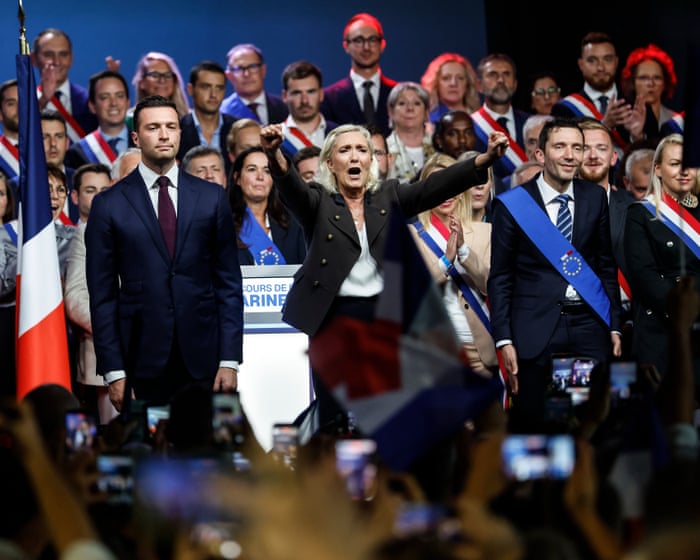
That is why France’s presidential election next year could prove more consequential for Europe than any decision taken in Washington, Moscow or Beijing. Far-right leader Marine Le Pen has a credible path to victory. She is scoring 35% to 38% in first-round polling at present, and is a more formidable candidate than her younger lieutenant, Jordan Bardella, who many assumed would be the Rassemblement National’s candidate in next year’s race. Her prospects will depend heavily on whether France’s fragmented centre can unite behind a single candidate. If it cannot, Le Pen could face the hard-left renegade Jean-Luc Mélenchon in the second round – and would probably win. A Le Pen presidency would be profoundly disruptive for Europe. She would probably oppose further support for Ukraine, obstruct sanctions against Russia, undermine the bloc’s approach to China and initiate battles with Brussels over Schengen, fiscal rules, electricity pricing and the single market. Her threat to withhold France’s contribution to the EU budget could plunge the union into an unprecedented financial and constitutional crisis.
Europe’s external challenges, while substantial, are manageable. But the decisive variable is Europe itself: whether it can maintain the political coherence required to deal with the US, Russia and China. A Le Pen victory would call that coherence into question, precisely when Europe needs it most.
Mujtaba Rahman is the managing director for Europe at Eurasia Group, a political risk research and consulting firm.
Frequently Asked Questions
Here is a list of FAQs based on Mujtaba Rahmans article regarding Europes concerns about a potential second Trump presidency and the deeper structural issues facing the continent
1 What is the main point of Mujtaba Rahmans article
The article argues that while Europe is currently terrified of Donald Trump returning to the White House they are obsessing over the wrong thing Even if Trump loses Europe faces massive internal economic and security problems that could be worse for them in the long run
2 Why is Europe so worried about Donald Trump specifically
European leaders fear Trump because he is unpredictable They worry he might stop supporting Ukraine pull the US out of NATO or start a trade war by putting tariffs on European goods They feel they cannot rely on the US for protection if he is elected
3 What does the article mean by he could be the least of our problems
It means that Europes own internal issueslike a weak economy aging population and lack of military readinessare bigger threats than Trump If Europe doesnt fix its own house it will struggle to survive regardless of who is in the White House
4 What is the biggest internal problem facing Europe right now
The biggest problem is economic stagnation Europe is falling behind the US and China in technology and growth They have slow productivity high energy costs and strict regulations that make it hard for new companies to grow
5 What is strategic autonomy and why does it matter
Strategic autonomy is the idea that Europe should be able to defend itself and make its own decisions without relying on the US It matters because if the US stops helping Europe needs to have its own military and economic power to protect its interests
6 How does the war in Ukraine fit into this
The war in Ukraine exposed how dependent Europe is on the US for weapons and money If Trump cuts off aid to Ukraine Europe would have to fill that gap alone which would be extremely expensive and difficult for them
7 What is a trade war and how would it hurt Europe
A trade war is when countries put taxes on each others goods to hurt the others economy If Trump taxes European cars and steel it would hurt European factories and could cause a recession in countries like Germany
8 Why is Europes economy falling behind the US
Europe has