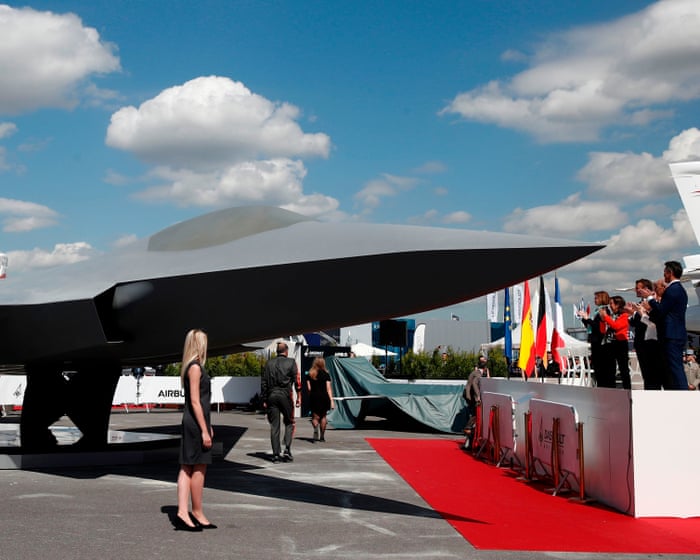
France and Germany’s plan to develop a next-generation fighter jet, designed to operate alongside drone swarms and a “combat communications cloud,” is falling apart. German Chancellor Friedrich Merz said this week that the €100 billion program no longer suits Germany’s needs. He described the issue as technical rather than political, pointing out that France requires a jet capable of carrying nuclear weapons and launching from aircraft carriers, while Germany does not. However, the problems run much deeper.
Announced with great enthusiasm in 2017 by French President Emmanuel Macron and then-German Chancellor Angela Merkel, the Future Combat Air System (FCAS) was later joined by Spain in 2019. The jet was intended to replace France and Germany’s existing fighters by 2040, featuring stealth technology and supported by drones for reconnaissance or as decoys, all connected through real-time data sharing.
Europe already operates three competing fighter jets: the Eurofighter Typhoon, France’s Rafale, and Sweden’s Gripen. Successive Airbus CEOs have warned that Europe must consolidate such projects. Yet the collapse of FCAS would have the opposite effect, with the British-Italian-Japanese Tempest project and a potential Gripen successor already in development.
For a bloc that spent €381 billion on defense last year but struggles to convert that spending into military capability, the stakes are high. Threats from Russia are growing, and Donald Trump has urged Europe to take more responsibility for its own security.
For years, the companies involved in the Franco-German jet have been unable to agree on leadership. France’s renowned jet maker, Dassault Aviation, insists on leading the fighter portion of the project. The family-controlled company and its CEO, Éric Trappier, have fought to maintain control despite opposition from Airbus’s German-based defense division, the other lead partner.
A former senior French official, speaking anonymously, noted that the project seemed to have been conceived “at a very high political level,” without broader discussions within the defense ministry about whether the two countries shared the same military needs. “We do not have the same way of waging war, Germany and France,” they said. “I was quite troubled by this.”
Trappier made Dassault’s position clear at a factory inauguration last year. “If they [the Germans] want to do it on their own, let them do it on their own,” he told reporters. “We know how to do everything from A to Z.”
The Rafale remains highly successful on the export market, with orders extending into the mid-2030s, highlighting Dassault’s leverage over other stakeholders—including the French government. “Dassault is not easy,” said the former official. “They have amazing engineers… but politically, they do as they please. And now they don’t even need this program, with many export sales coming from the Rafale. So they are very comfortable, and their collaborative spirit is not good. They piss me off.”
This dynamic was evident this week as Macron traveled to Delhi to promote the sale of over 114 Rafales to India—essentially acting as Dassault’s salesman—while back home, the company refuses to cooperate on developing its replacement.
Dassault has a history of this behavior. The company withdrew from the Eurofighter program in the 1980s because it wanted to lead the project. That jet was eventually built by the UK, Italy, Germany, and Spain—without France.
The problem is that Trappier might…Of the three countries involved, only France has the proven ability to design a fighter jet entirely on its own, according to defence analyst Francis Tusa. “Dassault is absolutely correct,” he said. “But if you’re going to cooperate and collaborate, you shouldn’t rub other people’s noses in the dirt.”
The issues are not one-sided. Bertrand de Cordoue, Airbus’s former head of EU and NATO public affairs, noted that tensions between the two companies existed from the beginning, with Airbus engineering teams viewing Dassault as a competitor. “For the German part of Airbus, it was not natural to accept moving away from the existing Eurofighter program,” said de Cordoue, now an adviser at the Jacques Delors Institute. “The teams working on Eurofighter did not readily accept the idea of completely changing their mindset to work with a French company that, on the export market, was a competitor, not a partner.”
In turn, Dassault has resisted sharing its fighter-building expertise with Airbus, fearing a competitor would gain French knowledge. De Cordoue argued that since the technology is funded by French taxpayers, it should be “more the ownership of the French authorities”—and that Dassault should cooperate.
Even if the French and German governments could control their respective companies, the political will to do so seems to be fading—a sign of a growing divide between the two countries on defence. Earlier in February, German Foreign Minister Johann Wadephul suggested France needs to spend more on its military. NATO member states committed last year to spending 5% of GDP on defence and security by 2035, but Wadephul said French efforts have been “insufficient to achieve this so far… France, too, needs to do what we are doing here with difficult discussions.”
Germany’s more assertive stance is partly due to shifting dynamics. When the FCAS program began in 2018, Germany’s defence spending was modest. Now, following the decision to rearm after Russia’s invasion of Ukraine, Berlin plans to spend €150 billion by 2029—nearly twice France’s budget—after a historic deal last year to relax its “debt brake.” “France has 60 years of being the accepted leader,” said Tusa. “Suddenly Germany is saying: ‘We don’t have to be deferential.'”
In reality, going it alone on a fighter jet would be challenging for Germany, Tusa added. Despite Airbus’s expertise in commercial jets, building a fighter from scratch would be “their equivalent of the Manhattan Project” due to their lack of experience. Even the Eurofighter was a joint project with Britain’s BAE Systems and Leonardo. Germany would be “really starting from ground zero and mobilising every single resource,” he said.
What happens next remains unclear. Germany could try to join the rival British-Italian-Japanese Global Combat Air Programme (GCAP), known as Tempest, which is set to enter service by 2035—five years earlier than FCAS is nominally due. However, Germany would likely only be accepted as an observer rather than a full partner.Airbus remains undeterred. On Thursday, CEO Guillaume Faury outlined a potential path forward, suggesting France and Germany could each develop their own fighter jets while connecting them through a shared combat network and drone systems.
Speaking alongside the company’s annual results, he stated that the current impasse “should not jeopardize the entire future of this high-tech European capability, which will bolster our collective defence.”
“If mandated by our customers, we would support a two-fighter solution and are committed to playing a leading role in such a reorganised FCAS delivered through European cooperation,” Faury added.
While acknowledging FCAS is at a “difficult juncture,” he maintained that “we continue to believe that the programme as a whole makes sense.”
Failure would fragment Europe’s defence efforts. Instead of a single next-generation fighter, the continent could end up with three or four separate programs—including FCAS if it survives, the UK-Italy-Japan GCAP project, potential independent French and German national efforts, and a possible successor to Sweden’s Gripen fighter.
“I think they should have kept going with a single aircraft,” said analyst Francis Tusa. “They [Airbus and Dassault] need to go to counselling and basically be told: ‘Come on guys, play nice.'”
Dassault declined to comment.
Meanwhile, French President Emmanuel Macron continues to publicly insist the project can be salvaged. At the Munich Security Conference this month, he stated: “It’s hard for me to understand how we will build new common solutions if we destroy the few ones that we have.”
A former French official offered a more pessimistic view, noting Macron’s presidency ends in May 2027. His potential successor, Marine Le Pen’s far-right National Rally party, takes a softer stance toward Russia and might abandon the project entirely.
“My feeling is that this project was born with Macron,” the official said, “and could die with Macron.”
Frequently Asked Questions
Of course Here is a list of FAQs about the FranceGermany nextgeneration fighter jet project designed to answer questions from basic to more advanced
Beginner General Questions
1 What is this fighter jet project called
Its called the Future Combat Air System or sometimes SCAF Its not just a single jet but a complex system including a new fighter drones and advanced networks
2 Who is involved in building it
The core partners are France Germany and Spain The main industrial companies are Dassault Aviation and Airbus
3 Why are France and Germany building it together
To share the enormous costs and technical expertise strengthen European defense independence from the US and create a cuttingedge system to replace their current fleets
4 Whats the main argument about
The core dispute is over leadership and workshare Frances Dassault insists on being the clear leader in designing the fighter jet itself based on their expertise Germanys Airbus demands a more equal partnership reflecting its financial contribution and industrial base
5 Why cant they just split it 5050
Its extremely complex Leadership determines who has the final say on design choices controls the most valuable technology and gets the most highskilled jobs and export rights for the future
Advanced Detailed Questions
6 What are the specific technical issues they disagree on
Key sticking points include
Intellectual Property Who owns the cuttingedge technology developed
Data Access Should all partners have full access to all the jets software and data
The Loyal Wingman Drones How will the autonomous drones that fly alongside the jet be developed and controlled
The Next Engine A separate but related dispute between Safran and MTU over leading the engine development
7 How does Spain fit into this disagreement
Spain is a junior partner but sides with Germanys Airbus in pushing for a more balanced workshare This adds diplomatic pressure