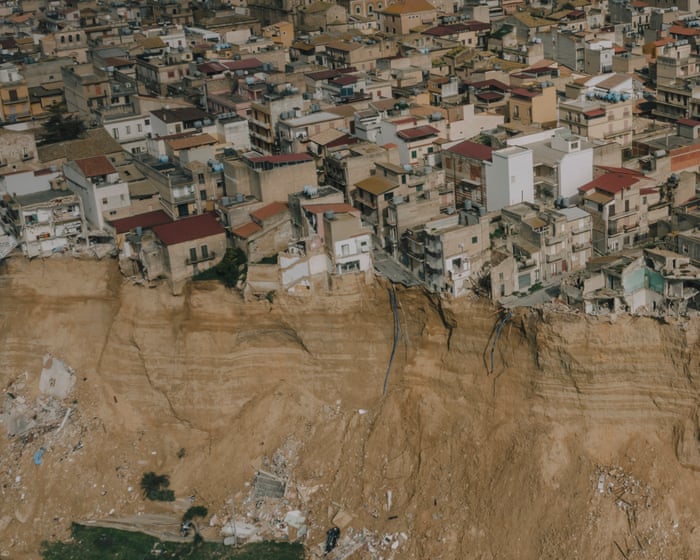
For days, the 25,000 residents of Niscemi in Sicily have been living on the edge of a 25-meter-deep chasm. On January 25th, after torrential rains from Cyclone Harry, a devastating landslide tore away an entire slope of the town, creating a 4-kilometer-long gash. Roads collapsed, cars were swallowed, and entire neighborhoods plunged into the valley below.
Dozens of houses now hang precariously over the edge, while vehicles and pieces of roadway continue to crumble hour by hour under the strain of the unstable ground.
Authorities have evacuated more than 1,600 people so far. Entire sections of the historic center are at risk, including 17th-century churches that could slide downhill at any moment.
Geologists and environmental experts say the landslide in Niscemi is the latest sign of how the climate crisis is reshaping the Mediterranean, an area marked by decades of indifference to flawed building policies and uncontrolled urban sprawl.
“It all happened in a matter of moments,” said 70-year-old Salvatrice Disca. She had been living in a home now inside the “red zone,” an area authorities have designated as at risk of collapse. “The power went out, and a few minutes later the police knocked on our door. They told us to leave immediately, to abandon everything and take only the essentials—a few blankets and our medicines. For a week we couldn’t even wash or change our clothes.”
Most of those evacuated are staying with relatives, while the elderly have been moved to care homes. Others are temporarily housed in bed-and-breakfasts. Outside the red zone, firefighters have set up a tent where residents wait to be escorted by rescue teams to retrieve valuables, photographs, and paintings they left behind in their rush to flee.
Authorized by rescue teams, the Guardian joined a mission inside the red zone, accompanying firefighters. Among the buildings destined to be abandoned permanently is a well-known pizzeria, A Barunissa. Its owner, 41-year-old Benedetta Ragusa, had only minutes to salvage equipment and furnishings.
The landslide is still advancing. Last week, a three-story residential building broke away from the edge of the precipice and smashed into the slope below after teetering on the brink for six days.
“We’re emptying the place,” Ragusa said. “It’s over. We’ve lost everything.”
A heavy silence has fallen over the town, the kind that comes just before catastrophe: the streets are empty, the urban landscape reduced to a ghost town in the landslide’s wake.
Perched on the edge of the mudflow, the Biblioteca Marsiano, a public library, hangs over the void. Its basement holds more than 4,000 rare and historically valuable books. Writers have urged authorities to recover the collection, which includes rare pre-1830 editions on Sicilian history, but the library lies in the “black zone”—off-limits even to firefighters—leaving the books’ fate, like that of hundreds of residents, uncertain.
“People are traumatized,” said Davide Cascio, 38, a volunteer with the group Outside, which is supporting evacuees. “For many, this wasn’t just a house: within those walls was their entire life, their memories. There’s a mix of anger and despair, because they know this disaster could have been prevented.”
The same area of town had already collapsed in 1790, when a landslide forced people to flee the Sante Croci neighborhood. More than two centuries later, in October 1997, the ground gave way again.The danger returned, forcing mass evacuations. Despite this history, many buildings in the area were constructed decades later, from the 1950s and 60s onward, alongside 17th-century homes.
Firefighters help evacuees collect belongings from their houses in the red zone.
“My family lived in that house for three generations,” said Sofia Salvo, 61, a primary school teacher unable to return home since the landslide. “We renovated it for my retirement, after my grandfather and father built it legally. Now it’s gone, and I keep asking why the authorities allowed it in a risk area. Someone has to take responsibility.”
The public prosecutor’s office in Gela, a few kilometres from Niscemi, has opened an investigation into negligent disaster.
“We are examining a substantial body of material, including images provided by the Italian Space Agency,” said Salvatore Vella, the chief prosecutor in Gela. “Witness hearings will follow. One thing is certain: no one will be spared scrutiny.”
What happened in Niscemi is far from an isolated case. According to geologists and environmental experts, it is the outcome of decades of reckless housing and planning policies, which, since the second world war, have largely ignored the country’s acute vulnerability to landslides and floods.
Vehicles and fragments of roadway continue to give way.
Italy has built hundreds of new neighbourhoods and thousands of homes in fragile areas: along riverbeds, on unstable slopes, near cliffs, and in zones exposed to landslides, floods and earthquakes. In short, places where people should never have been encouraged to live.
According to a report by the national statistics agency Istat, released last November, for every 100 new homes built in Italy, 15 lack the necessary authorisations. This is in a country that, according to the Italian environmental association Legambiente, has recorded about 17,000 major landslides in more than 14,000 locations in just over a century, resulting in nearly 6,000 deaths.
In 1998, one of Italy’s deadliest landslides hit the city of Sarno in the southern Campania region. After days of heavy rain, entire hillsides collapsed, killing 160 people. Investigations later showed that many homes had been built illegally on unstable slopes.
“Over the past 70 years, a series of poor choices has compounded the damage,” said Christian Mulder, a professor of ecology and climate emergency at the University of Catania in Sicily. “Money from the European recovery programme, received after world war two, was badly spent in Italy, fuelling a reckless model of urbanisation that ignored environmental risk.”
A kiosk bar along the Catania seafront demolished by heavy storms caused by Cyclone Harry.
Between 1948 and 1952, Italy received about $1.5bn in aid under the programme, known as the Marshall Plan. Those funds fed rapid urbanisation in a country with weak planning and widespread favouritism, especially in the south. The result was a disaster, now made irreversible by the accelerating climate crisis.
“These are not gentle rains but violent downpours, dumping a year’s worth of water in a few hours and triggering landslides,” Mulder warned. “With the Mediterranean experiencing some of its hottest years on record, warmer seas are supercharging the atmosphere and fuelling extreme events like Cyclone Harry, which struck Niscemi and the rest of the island.”
The destructive force of Harry, with winds exceeding 60mph and seas whipped into waves reaching up to 15 metres, left a long trail of devastation in Sicily, destroying ports, damaging homes, tearing up roads and causing an estimated €2bn in losses.
Beach resorts in Catania wrecked by Cyclone Harry.
Legambiente said that in 2025 alone, the island was hit by 45 extreme weather events.Extreme weather events continue to inflict severe damage on both public and private infrastructure. In Niscemi, another section of the town collapsed. Built on unstable clay, the ground gave way once more, sliding downhill. An elderly couple, who had waited ten days for permission to collect some belongings, were turned back by firefighters. The alleys were already marked for collapse, they were told, and it was too dangerous to enter.
With heads bowed, they walked out of the restricted area. One of them shook her head, as if still struggling to accept the situation. Quiet tears fell.
They knew they would have to wait even longer before going back home. And they knew, more painfully, that they might never return at all.
Frequently Asked Questions
Of course Here is a list of FAQs about the landslide disaster in a Sicilian town framed in a natural tone with direct answers
Basic Understanding The Event
1 What happened in the Sicilian town
A massive landslide destroyed a significant part of a small town burying homes businesses and roads The ground literally gave way causing buildings to collapse or become dangerously unstable
2 Which town was affected
While the specific town may vary by report this scenario is tragically common in Italy Recent major events have happened in towns like Casamicciola Terme on the island of Ischia or historically in places like Giampilieri in Sicily The phrase crumbling following a landslide often refers to towns built on unstable slopes
3 Why are people saying weve lost everything
Residents have lost their homes possessions family heirlooms and livelihoods in an instant For many their entire lifes work and their sense of security and community were physically destroyed
4 Was anyone hurt or killed
In major landslides like this fatalities and injuries are tragically very common People can be trapped in collapsed buildings or caught in the path of the mud and debris
Causes and Context
5 What causes a landslide like this
Its usually a combination of factors heavy prolonged rainfall saturating the ground unstable geology steep slopes and sometimes inadequate land management or drainage
6 Is this related to climate change
Scientists say yes indirectly Climate change intensifies rainfall patterns leading to more frequent and severe extreme weather events especially in vulnerable regions
7 Could this have been prevented
This is a source of great anger Residents often accuse authorities of ignoring warnings failing to maintain land and allowing unsafe construction Prevention requires extensive and expensive geotechnical work and landuse planning
8 Is this a common problem in Italy
Yes Italy is geographically prone to hydrogeological risk Thousands of towns are considered at risk due to its mountainous terrain seismic activity and weather patterns
Aftermath and Response
9 What is the immediate response after the landslide
Search and rescue for survivors evacuating the entire area due to continued risk