A woman from Liverpool was determined to get a good spot on Whitehall, so she woke her nieces at 3 a.m. to travel to London. Her effort paid off. By the time the march reached her on Saturday afternoon, she was sitting on a wall outside Downing Street, with the little girls in camping chairs at her feet, absorbed in their iPads.
She had two banners with her. One said, “Keir Starmer is a wanker,” and the other read: “We’re not far right, we are England’s mothers and we will not stay silent. Stop the rape of our children, mothers across Britain are taking a stand.”
When I asked why she was there, she looked surprised. Wasn’t it obvious? “Because Keir Starmer’s a wanker.” Why? “He’s taking our speech away.” Even though you’re allowed to sit outside his house and call him a wanker? “Well, he is.”
About the other sign, she said she made it “because I’m not far right and I’m sick of being called it. I’m tired of coming to places like this and being labeled far right. I’m here for the right reasons today—for the future of these children. People are coming in illegally and raping our kids, and it has to stop.”
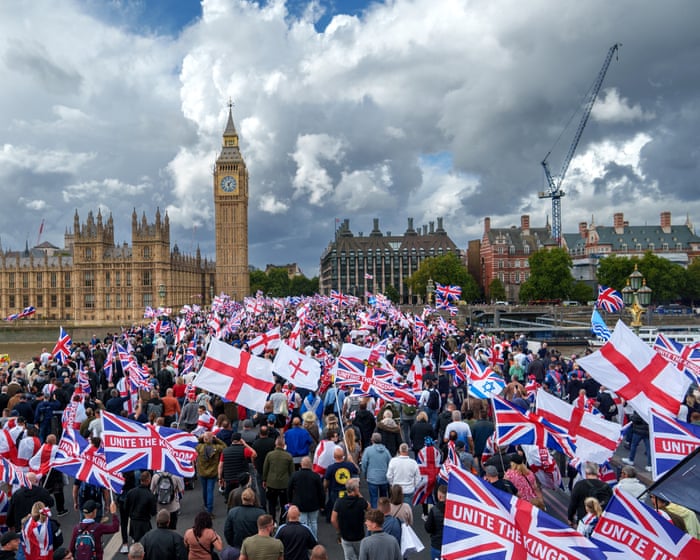
I went to Tommy Robinson’s “Unite the Kingdom” rally on Saturday to record an episode for the Guardian’s daily podcast, Today in Focus. Robinson called it “the biggest freedom of speech rally in British history.” Others, like Hope Not Hate, described it as “Britain’s largest ever far-right protest.” Unsurprisingly, aside from one cheerful Welshman who said, “Well, my views are far right,” no one I met saw themselves that way. “We’re just right,” I heard repeatedly—meaning correct.
Many of the speakers at the rally were undeniably racist, often repeating versions of the “great replacement” conspiracy theory. Robinson told the crowd: “It’s not just Britain that is being invaded, it’s not just Britain that is being raped. Every single western nation faces the same problem: an orchestrated, organized invasion and replacement of European citizens is happening.”
But most of the 110,000 marchers couldn’t hear the speeches. Many couldn’t even fit onto Whitehall to see the big screens. I didn’t get the sense they were there for the speakers anyway; it was about making their own voices heard.
A few wore their racism proudly, like the man with a misspelled sign that said: “Why are white people dispised when our tax money pays for everything.” But mostly, these were “ordinary people” with “ordinary jobs” who “care about our kids,” and who said over and over that they’d “had enough.” Usually, it was about immigration, but often it was more than that. They’d had enough of a Britain they felt was no longer working.
Instead of blaming years of Tory austerity or a capitalist system stacked against ordinary people, they pointed to “illegal immigrants.” And Starmer was the villain. “Look what he’s done to the farmers, inheritance tax, you know, the NHS is on its knees,” said a man from Norfolk. “We have potholes in the roads, we can’t get GP appointments, people are left in hospital hallways for hours in critical condition. This country is becoming a joke.”
For him, it was personal: “I’m starting to lose my teeth because I’m a type 1 diabetic. It’s a struggle to get them replaced because of my diabetes. They don’t help people like me. But they’d help someone who steps foot here from a dinghy and gets everything.”
No one used the words “asylum seeker” or “refugee.” It was “illegals” and “fighting age men.” All were judged by the actions of a very few, like the man convicted of touching a teenage girl at the Bell Hotel in Epping.
Everyone claimed they had no issue with legal immigration—the millions who come to the UK with visas to study or work. They weren’t the ones being blamed.The claim that small boat arrivals are putting pressure on public services doesn’t hold up—they made up only 4% of total arrivals in 2024.
I left the rally when the crowd on Whitehall grew tense and I realized the police had blocked all the side streets, making a quick exit impossible. Since then, I’ve been trying to make sense of what I witnessed. It was undeniably a far-right gathering, yet many attendees seemed unbothered by that label, even though outlets like the Guardian had clearly identified it as such. They weren’t put off by what used to be considered an extreme, fringe description.
During his speech, Tommy Robinson made a point that worries me: “For 20 years, they tried to silence us with labels—‘racist,’ ‘Islamophobe,’ ‘far right.’ Those don’t work anymore!”
If the far right is becoming the mainstream right, how do we even talk about what’s happening? Why are so many people feeling ignored, frustrated, and angry? Until we address the fundamental issues in Britain—like the state of the NHS, schools, potholes, and fuel prices—I don’t see this movement fading. It will only keep growing.
Helen Pidd is a presenter of Today in Focus, the Guardian’s award-winning daily podcast.
Frequently Asked Questions
Of course Here is a list of FAQs about the topic based on the articles themes
General Beginner Questions
Q Who is Tommy Robinson
A Tommy Robinson is the alias of Stephen YaxleyLennon a British political activist known for his strong antiIslam and farright views He is a controversial figure who has led various protests and movements
Q What is this article I left the Tommy Robinson rally with a troubling thought about
A Its a firstperson account by a journalist Helen Pidd who attended a rally She describes the energy and size of the crowd and expresses her concern that the movement behind Robinson is not a small fringe group but is growing in influence
Q What is the main troubling thought from the article
A The troubling thought is the authors realization that the farright movement symbolized by Tommy Robinson is more mainstream organized and popular than many people assume and she fears it will continue to expand
Q Why would someone support a movement like this
A Supporters often cite concerns about immigration a loss of national identity and a feeling that mainstream politicians are not addressing these issues They are often drawn to figures who voice these frustrations loudly
Advanced Analytical Questions
Q How does the article differentiate between legitimate concerns and farright rhetoric
A The article suggests that while people may have legitimate worries about immigration or culture the movement coopts these concerns and channels them into divisive often Islamophobic and sometimes violent rhetoric and actions
Q What does the growth of this movement indicate about the current political climate
A It indicates a rise in populism and a significant portion of the population feeling disillusioned with the political establishment It shows that movements that offer simple answers to complex problems can gain traction during times of social and economic uncertainty
Q Isnt this just free speech and peaceful assembly Where is the line
A While free speech and assembly are fundamental rights the line is often crossed when speech incites hatred or violence against a specific group of people based on their religion or ethnicity The article worries that the rallys energy could easily tip into this territory
Q What are the common tactics used by such movements to gain support