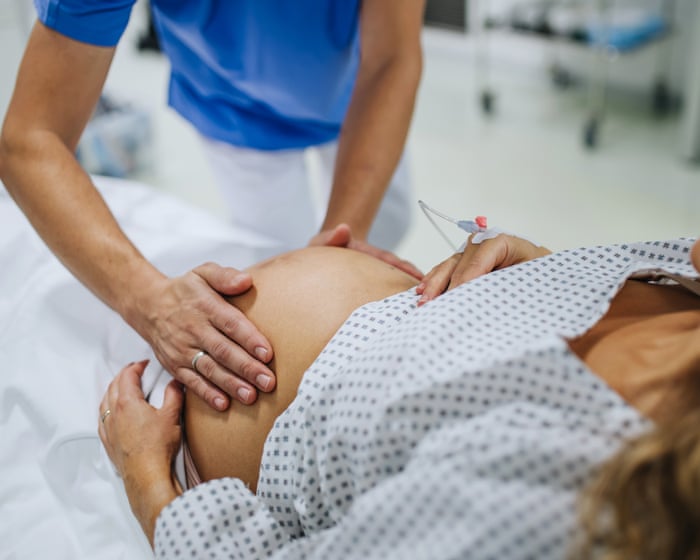
In the public ward where I spent my first days as a mother, there were no chandeliers. It was at the oldest continuously running maternity hospital in the world. The room was filled with the sound of crying, the worn floor creaking under footsteps, and windows that looked out over Dublin’s city center.
Now, the Rotunda hospital, where I’m due to give birth again soon, is getting ready to welcome its 1 millionth baby. It’s also at the heart of a heated argument about plans to change Ireland’s two-tier state healthcare system, so that people who pay to “go private” in public hospitals no longer get an unfair advantage over those who don’t.
The Rotunda Private’s website, with its soft lighting and a chandelier in the background, lists fees of up to €4,500 for private treatment in this public hospital. In Ireland, maternal healthcare is free from the state, and there are no standalone private maternity hospitals. But within the public system, those who can afford it can pay for continuity of care with a private consultant, private scans, and the option to request a private room after giving birth.
Ireland stands out in Europe for not offering free universal primary healthcare. But at least in public hospitals, the two-tier system might finally be coming to an end. A major overhaul of the state healthcare system aims to ensure equal access for everyone. The “Sláintecare” plan, launched nearly 10 years ago with support from all political parties, seeks to provide equal access to health services based on what each patient needs, not on what they can pay. However, it still hasn’t been fully put into action.
Under the reform, hospital consultants on new public-only contracts are not allowed to do private work in public hospitals. More than 60% of consultants have signed up to these new contracts in exchange for pay that can go over €300,000 (including on-call duties and overtime). With no private maternity hospitals, giving birth is finally set to become entirely public.
But there’s been a backlash, revealing both a worryingly low number of obstetricians compared to patients, and resistance from these highly paid senior doctors to a fairer, single-tier health system. Ireland has fewer hospital consultants than most EU countries, with many medical graduates leaving the country. The lowest uptake for the new public-only contracts is in obstetrics and gynecology, at just over half.
The amount of private activity in Ireland’s public healthcare system and the push for a single-tier system put us at the center of a Europe-wide debate about separating the two.
The government recently won a long-running standoff with the Rotunda’s management by threatening to cut funding. This came after it was revealed that, despite the ban, consultants on public-only contracts were still treating private patients in this public hospital, using public resources, and billing insurers for hundreds of thousands of euros of care, with the Rotunda’s board’s permission.
Allegations that private consultants gave financial gifts of up to €1,500 to public-only colleagues to deliver their private patients’ babies on weekends added fuel to the controversy.
Senior figures at the Rotunda have argued that women should be able to choose between public and private care. But if there’s a shortage of consultants, surely all their time needs to go to higher-risk pregnancies, whether the mothers can pay or not?
A Rotunda staff member who sees both public and private patients assured me that births happen in the same delivery rooms, and that patients are meant to be seen based on need. “The sickest women often get the best care,” she said. She suggested the dispute was less about maternal “choice” and more about a revenue stream that hospitals don’t want to give up. A fully public system was “the only way to have truly equitable care,” she said.
Beyond maternity, there are wider concerns about the unfair use of public hospital resources for private healthcare. Despite Ireland being a wealthy country with high spending on health…In Ireland, public hospital corridors are often lined with patients on trolleys, sometimes waiting days for a bed, while children endure years of pain on waiting lists for spinal consultations.
Nearly half of the Irish population relies on private health insurance, because in many cases it allows them to skip the long waiting lists in public hospitals. I have basic health insurance, but I went fully public for maternity care during my first pregnancy, paying for prenatal testing myself, which I believe should be free.
As a public patient with no complications, I was cared for by midwives at the Rotunda. Ireland has low maternal mortality rates, but one of Europe’s highest C-section rates. Midwife-led care can mean fewer interventions and should be expanded, as the WHO recommends.
Midwives gave me freedom during labour, helped my baby latch, and taught me to use a blanket with my scent to help him sleep, while I dealt with shared toilets and fed myself one-handed. Now, just a few years later, some of the free midwife-led antenatal classes I found so important have been cut back. And not everyone in Ireland can access midwife-led care. Our government, which seems to champion public care, is also overseeing a crisis in midwifery staffing, caused by state cuts.
Around a quarter of pregnant women in Ireland go private or “semi-private,” an option that the state health service still officially says is available in all maternity units across the country. In practice, however, private maternity care is slowly being phased out. At the National Maternity Hospital, an unprecedented 150 women were turned away for private care in just six weeks in June and July, sparking a campaign against women losing this “choice.”
But any patient who needs it should be able to see a dedicated consultant obstetrician on a public-only contract. And while many women have traumatic birth experiences in Ireland, surely we should be fighting for every pregnant person to have access to the care they need – not just those who can afford it.
A health worker I know chose private care for her second baby after experiencing missed complications and absent consultants during her first public maternity experience. But in her work, she sees consultants “using the public system to their advantage and funding a lot of their private practice through it.”
Weeks ago, a still-developing body inside my belly flickered on an ultrasound. I was told to come back in a month because of a borderline concern. As a public patient, I worried about falling through the cracks.
Since then, a brilliant midwife and public sonographers referred me to consultants, including top foetal medicine specialists listed on the Rotunda Private site. I see them for free as a public patient. This is how the system is supposed to work – escalating care based on need.
Yet it’s disheartening to know there’s a perception that I could be risking my baby’s health by not “going private,” for the continuity of care that paying patients receive and which midwives have been demanding be made standard for everyone.
I trust the people working hard to provide strong public care, and we shouldn’t have to “go private” to feel safe. If everyone relies equally on one system, there’s real pressure for change.
There’s a history in Ireland of bishops, doctors, and conservative politicians opposing free healthcare for mothers and children, desperate to maintain control and profit.
I want a fully public, equitable health system. For that to work, those in power must ensure resources and accountability.
My Rotunda maternity ward looked out onto a statue of Charles Stewart Parnell, the first president of the Irish National Land League – a mass movement againstagainst private monopolies. Ireland’s revolutionary proclamation promised to “cherish all the children of the nation equally.” What better way to honor that promise, from a child’s very first breath, than a fully public maternity system?
Caelainn Hogan is a journalist and the author of Republic of Shame: How Ireland Punished ‘Fallen Women’ and Their Children.
Frequently Asked Questions
Here is a list of FAQs addressing the concerns of expectant parents during the ongoing maternity care dispute in Ireland
General Background
1 What is the major dispute in Irish maternity care all about
Its a disagreement between the Government and maternity doctors about pay and working conditions The doctors argue that years of underfunding and staff shortages have made the system unsafe and they are demanding better pay to attract and retain staff They have threatened strike action if a deal isnt reached
2 Im due to give birth soon Will my hospital shut down
No Even if strike action happens emergency and essential care will still be provided However planned procedures like Csections and inductions that are not emergencies may be postponed You will still be looked after but the situation may be chaotic
3 What does pay just to feel safe mean in this context
It refers to the fear that the only way to guarantee a safe attended birth is to pay for private health insurance and private obstetric care Many people feel that public patients are being left with unsafe staffing ratios and they shouldnt have to spend thousands of euros just to get a basic standard of care
4 Is it true that private patients are treated better than public patients
In many hospitals private patients are guaranteed a consultantled birth and more oneonone midwife care Public patients are often cared for by midwives and junior doctors with consultants only called for complications This disparity is a core part of the dispute
Impact on Your Birth Plan
5 My baby is breech and I need a Csection Will my surgery go ahead
If your Csection is considered an emergency it will happen If it is a planned date it is at high risk of being postponed if a strike occurs Your hospital will contact you if your date is changed
6 Im being induced next week Should I expect a call to cancel
Possibly Inductions are often scheduled and can be delayed during a strike to free up staff for emergency births If you have a medical reason for induction you will be prioritized but you should prepare for possible delays