The US and Israel may have started the war in Iran, but aside from the countries directly involved, it’s China and Europe that stand to lose the most. Yet while European leaders seem frozen like deer in headlights as energy prices skyrocket, China has responded to the crisis with remarkable calm. It’s striking how confident Beijing appears ahead of this week’s Trump-Xi summit.
That’s because China is better prepared for what I call an age of “un-order.” This isn’t the same as disorder, where rules exist but are broken. Un-order is a world where the rules themselves no longer matter. While European governments have been obsessed with preserving order, China has been figuring out how to survive chaos.
China saw this coming fifteen years ago, as Europeans outsourced their security to NATO, their trade rules to the World Trade Organization, and their energy supplies to Russia and the Gulf. Meanwhile, Beijing quietly stockpiled oil, food, and semiconductors on a massive scale, cornering the global market in rare earths, critical minerals, and future technologies.
Everyone is now captivated by the drama of Trump’s America, but an even bigger long-term risk is that China manages to eat Europe’s lunch, weaken its defenses, deindustrialize its cities, and open it up to coercion and blackmail. Europe’s exposure to Chinese dominance is staggering—and China’s industrial overcapacity and predatory exchange rates make Europe’s open markets the main target for Chinese exports.
Take the industries of the future. The fossil fuel shortages caused by the war in Iran are prompting many Europeans to look again at their clean energy transition. Yet all the key parts of that transition—from batteries, electric vehicles, and solar panels to, if action isn’t taken soon, wind energy supply chains—are dominated by Chinese firms.
What’s more, as Europe begins a massive rearmament drive in the face of growing Russian threats, it finds itself dependent on Moscow’s biggest trading partner for the technologies it needs. A startling 80% of the global drone supply chain is Chinese, while 97% of the EU’s magnesium—a key component in fighter jets, tanks, and certain munitions—comes from China. Beijing has shown it is both willing and able to use these choke points when it sees a political advantage, as Trump learned the hard way when he was forced to back down on his tariffs in October 2025.
The scale of Europe’s exposure to China’s dominance is staggering. Some European leaders fear that taking a harder line against Beijing would mean missing out on a flood of Chinese investments. But the massive technology transfers and investments that Beijing has dangled in front of outgoing Hungarian Prime Minister Viktor Orbán and Spain’s Pedro Sánchez have yet to materialize. They likely never will, unless the EU introduces tariffs that encourage Chinese companies to build in Europe rather than export from China.
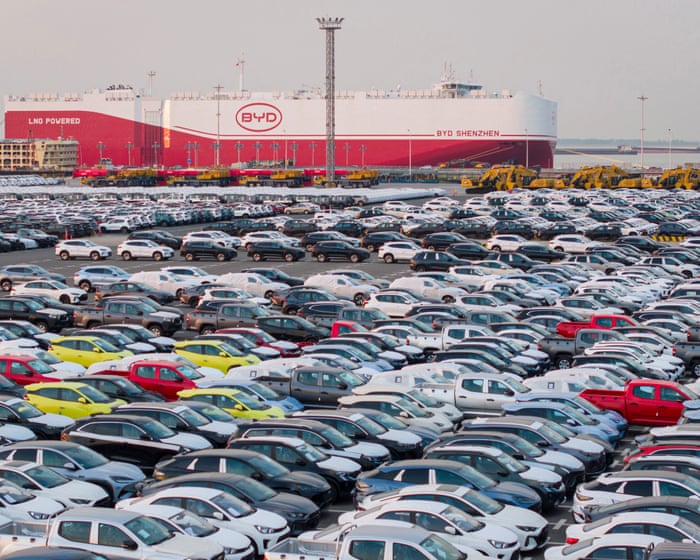
The half-hearted tariffs the EU introduced on the auto sector have led to a few BYD plants, but these measures are too low to really change the calculations of Chinese firms. Instead of Chinese-built factories in Eastern Europe providing thousands of jobs, Europe is more likely to see rapid deindustrialization as cheaper—and often better—Chinese products flood European markets. Fears that Baden-Württemberg, home to Mercedes and Porsche, could become a German Detroit might be overblown, but only slightly.
To avoid a future where it is poorer and less able to defend itself, Europe needs to develop its own power in a world without order. This means behaving more like China—and maybe giving Beijing a taste of its own medicine. Instead of relying on external rules to protect it or thinking it could shape the world, China selectively closed off its vast internal market to foreign companies. At the same time, it aggressively pushed its own exports.It saw where the world was heading and positioned itself to take advantage. Europe now needs to do the same—the window before its manufacturers lose out to China for good is closing fast. Europeans must stop their capital from flowing overseas to the US and instead use it for a massive push into green technology, AI, and defense. They need to build strategic stockpiles of critical minerals to make Europe’s defense industry more resilient in a crisis. Countries should make clear political commitments to buy European-made batteries and keep Chinese wind turbines out of their infrastructure.
But de-risking alone isn’t enough. Europeans need to realize they have their own tools to use. For one, there’s the EU’s famous “trade bazooka”—the anti-coercion instrument—which governments have been reluctant to use until recently. Momentum might finally be shifting in the right direction. Clément Beaune, France’s high commissioner for strategy and planning, recently argued that a 30% across-the-board tariff on Chinese goods should be on the table (this is well above the French government’s official stance). The EU’s Digital Markets Act and Digital Services Act, mostly known for annoying Mark Zuckerberg and Elon Musk, could also be used to limit the operations of TikTok’s parent company ByteDance, Tencent, and Alibaba in Europe. And there are even more aggressive options: few realize that Europe could ground more than half of all Chinese commercial planes by withholding software updates for China’s Airbus fleet.
This toolkit could put Europe and China on a more equal footing, but its benefits go beyond the EU-China relationship. It would also help Europe stand up to Trump if he makes another move on Greenland, pressures Ukraine, or threatens to cut off European access to US technology. Once European governments start trying to survive chaos instead of preserving order, they’ll be better equipped to handle the full range of threats that emerge in our age of disorder.
Mark Leonard is director of the European Council on Foreign Relations and author of Surviving Chaos: Geopolitics When the Rules Fail.
Frequently Asked Questions
Here is a list of FAQs based on the premise that Europe should act more like China to survive the current chaotic era
BeginnerLevel Questions
1 What does it mean for Europe to act more like China
It means adopting some of Chinas key strategies longterm national planning strong state guidance of the economy rapid decisionmaking and prioritizing strategic selfsufficiency
2 Why is Europe in a chaotic era right now
Europe faces multiple crises at once war in Ukraine high energy costs inflation competition from the US and China and political divisions among its own member states
3 How does China make decisions faster than Europe
China has a centralized government that can make and enforce big decisions quickly Europe on the other hand requires consensus among 27 different countries which takes much longer
4 If Europe copies China does that mean it will become a dictatorship
No The idea isnt to copy Chinas political system Its to borrow specific economic and strategic habitslike setting 10year industrial plans or investing heavily in key technologieswhile keeping democratic freedoms
5 Can you give a simple example of what this would look like
Instead of each EU country having its own energy policy Europe could create a single statebacked energy company to buy gas and build renewable projects just like Chinas stateowned giants do This would get lower prices and faster results
AdvancedLevel Questions
6 What specific Chinese economic policies could Europe adopt
Europe could adopt industrial policy strategic stockpiling and wholeofnation RD
7 Would acting like China violate EU competition laws
Yes this is a major conflict China uses state aid to create national champions which is illegal under current EU rules Europe would have to relax its strict antisubsidy laws to compete
8 How would this affect Europes relationship with the United States
It would likely cause friction The US wants Europe to follow its lead on sanctions and tech bans against China If Europe starts acting like China it would be seen as a strategic rival to both the US and China