In the 1960s, France became the third country, after the US and Soviet Union, to independently launch a satellite (Astérix) into orbit. It was also the only nation to send an animal into space and—most importantly for Félicette the cat—bring it back alive. A decade later, the Franco-British Concorde began whisking passengers across the Atlantic in just three and a half hours, while the TGV started propelling travelers through the countryside at speeds of 250 km/h (155 mph), later increasing to 320 km/h. Then, in the late 1980s, the French space agency designed a crewed spaceplane called Hermès. Unlike NASA’s Space Shuttle, which was perched on top of its launch vehicle, Hermès was integrated into it—a design intended to reduce vulnerability.
France also pursued a major expansion of nuclear power, giving it one of the least carbon-intensive economies in the world. And, of course, there was the Minitel. More than a decade before people began typing “www” into web browsers, French users could buy train tickets, check movie times, do their banking, play games, find recipes, read horoscopes, or even log into erotic chat rooms—known as la messagerie rose.
Driven by a postwar obsession with independence and sovereignty, the French state excelled at advancing technologies that served collective needs. This offers a lesson for the European Union today as it seeks “tech sovereignty” from the US and grapples with broader questions about what kind of technology is needed and by whom.
Why revisit this history now? Because as Europe crafts a new “made in Europe” industrial policy in response to competition from the US and China, the EU has an opportunity not only to resist pressure—such as from the Trump administration—to roll back laws restricting hate speech and illegal online content, but also to break free from US tech dominance entirely and rethink what kind of technology best serves European citizens.
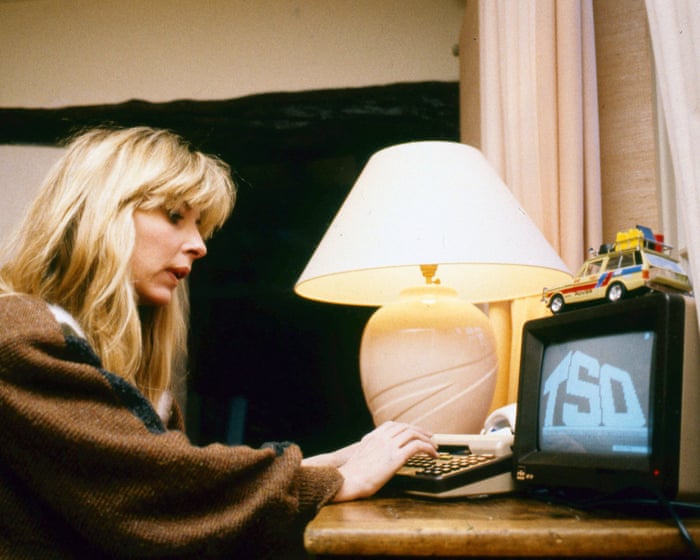
The Minitel began as an electronic phone directory with a screen and a fold-down keyboard. It could find people even if their names were misspelled, as long as the spelling was phonetic, and it displayed business information, including locations on a map. As a 1982 news report noted, early users saw it more as a gadget than a life-changing tool. By the late 1980s, 20% of French homes had a Minitel terminal. Between games and chats, many saw their usage bills skyrocket, leading to the introduction of devices like Mistral, which allowed users to download up to 60 Minitel pages at once for offline viewing—where time no longer meant money.
Most people think of the internet as an American, or perhaps Anglo-American, phenomenon. In reality, it has deep Franco-American-British roots, with a uniquely French detour—a ghost of what might have been. While the US was developing Arpanet, the precursor to the internet, French researchers were also exploring networked systems. They split into two competing camps: Cyclades, which favored decentralized networks (where data packets, or “datagrams,” took any available route and were reassembled at their destination), and Transpac, which advocated for centralized networks (where data followed a fixed path, like train cars on a track).
France Télécom backed Transpac’s closed, centralized system and offered free Minitel terminals to spur adoption, monetizing the service through usage fees. The number of services offered by France Télécom skyrocketed from 145 to 2,074 in just one year, between 1984 and 1985.
This success also contributed to its downfall. Minitel’s orderly, predetermined data flow made it difficult to scale the network. Some might look at this and think, “The government backed the wrong technology and lost to the market.” But there’s another way to see it: Minitel was overtaken by the internet not because the government failed, but because the internet’s open, decentralized model proved more adaptable and scalable in the long run.The Minitel came to life through government initiative, but France Télécom’s insistence on end-to-end control as a monetization strategy mirrored the same approach that, as Cory Doctorow writes, has “enshittified” the modern internet via tech monopolies.
Centralization worked for the Minitel, but only up to a limit—a limit France and the Minitel reached around the same time. The U.S. tech monopolies that later rose to dominance were fueled by venture capital with a prime directive: amass a vast, self-perpetuating user base. From there, the sheer scale of English speakers and the U.S. stock market took over. Technology shifted from a broadly socially positive collective endeavor to a deeply individualized, socially negative focus on capturing attention and extracting user data.
With Germany urging budget-constrained France to increase defence spending, all of Europe should recognize that much of the continent’s existing technology—from nuclear energy and space exploration to telecommunications (like Eutelsat, an alternative to Starlink), chip manufacturing, frontier AI (such as the French company Mistral AI, whose name nods to the Minitel era), and quantum computing (Pasqal)—stems from the French government’s stubborn refusal to cede entirely to market logic and abandon capacity in these strategic areas.
Yet even political will can hit a wall of sheer scale. For all its foresight, France cannot scale that wall alone—only a more integrated EU can.
More crucial, however, is the question of what kind of technology we will end up living with. The U.S. had the scale (and public subsidies) to “win,” but it has imposed a hollow victory on the rest of us: monopolistic big tech run amok. Like big tobacco and big oil before it, Silicon Valley has saddled us with the costs: overpowered democratic systems, devastated attention spans, fractured mental health, and social isolation. This extends even to the tragic sight of ads in the Paris Métro promoting an American AI designed to be your “friend” instead of another human.
The EU must regain sovereign control over the technology that governs so much of our lives. But it can do so in a way that restores democratic control over technology itself. Arguing over deregulation, as Germany prefers, versus a government-led approach, as France favors, is in this sense a false debate. Some markets are worth competing in; others are not. The EU, if it recognizes this, is fortunate to have the scale to choose which ones to close off and leave behind.
Alexander Hurst writes for Guardian Europe from Paris. His memoir Generation Desperation is out now.
Frequently Asked Questions
FAQs Europes Tech Independence the Legacy of Minitel
BeginnerLevel Questions
What was Minitel
Minitel was a French online service launched in the early 1980s It was a small terminal connected to phone lines that let users access services like phone directories train tickets banking and early chat rooms years before the modern internet became mainstream
Why is Minitel considered a success story
France led the world in digital adoption in the 1980s By the late 1990s millions of terminals were in homes and businesses creating a vibrant homegrown digital ecosystem with French companies and services It proved Europe could innovate and dominate a tech sector
What does Silicon Valleys grip mean
It refers to the overwhelming dominance of a few large American tech companies in Europes digital economy They control key platforms online advertising cloud computing and smartphone ecosystems
So if France did it before why cant Europe just build its own alternatives now
The scale and nature of the challenge are different Minitel was a preinternet nationally controlled system Todays global internet is built on open standards network effects and massive scale which Silicon Valley giants mastered first making competition extremely difficult
Intermediate Advanced Questions
Wasnt Minitels success also its downfall
Yes in a way Its widespread adoption in France may have slowed the countrys initial uptake of the open global internet in the late 1990s It created a successful but walled garden that was ultimately eclipsed by the more versatile and interconnected World Wide Web
What are the main barriers stopping a European Silicon Valley
Key barriers include
Fragmented Market Europe is many countries with different languages regulations and cultures unlike the vast unified US market
RiskAverse Capital European venture capital has historically been less abundant and less willing to fund risky moonshot projects compared to the US
Talent Mindset Brain drain of top engineers to US firms and a sometimes more cautious business culture
Are there any European tech successes today
Absolutely Europe excels in specific often B2B areas fintech eg Adyen Kl