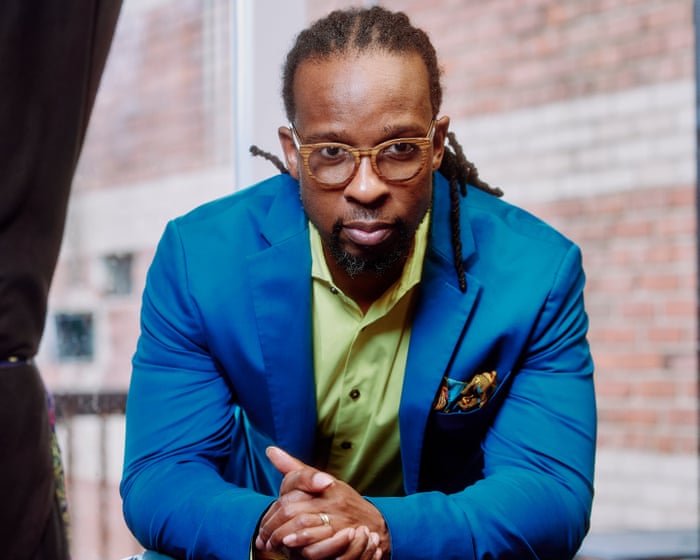
“I think I’ve had at least seven books banned in the United States,” says Ibram X. Kendi, his tone free of bitterness yet edged with something close to pride. To him, it’s evidence that his works on racism—ranging from dense scholarly histories to a children’s biography of Malcolm X—are reaching the right audiences and unsettling the right people. According to PEN America, his books have been banned at least 50 times across multiple U.S. school districts over the past five years, amid a turbulent “anti-woke” backlash. While not pleased by this, Kendi remains undeterred. “I understood that the main reason people singled me out and demonized me was because they didn’t want others reading my books,” he explains. “When character assassination didn’t work as well as they hoped, they started banning my books, along with many others.”
Kendi’s work is divisive almost by design, often framing ideas in stark, uncompromising terms. In his 2016 breakthrough, Stamped from the Beginning, he argued that racist policies give rise to racist ideas, not the reverse. His 2019 bestseller, How to Be an Antiracist, introduced another contentious view: there is no “not racist” middle ground—one is either racist or anti-racist. Inaction or neutrality, he contends, amounts to complicity. He further asserts that all racial disparities affecting Black people stem from racist policies—without exception.
Discussing his latest book, Chain of Ideas, the 43-year-old Kendi presents another binary choice. “We, as human beings, have two options in the 21st century: antiracist democracy or racist dictatorship,” he tells me via video call from his book-lined study at Howard University in Washington, D.C. In person, he is mild-mannered and softly spoken, but his rhetoric packs a punch.
“There is almost certainly a likelihood that in 20 years, much of Europe, and frankly the world, could be led by racist dictatorships,” he continues. “We’ve gone from monarchy to democracy to dictatorship. We’re literally moving backward. Why? Because we fear people we don’t know.”
Chain of Ideas centers on the “great replacement theory”—a once-fringe conspiracy theory, now mainstream, which claims that powerful elites are enabling people of color to “replace” white populations, primarily through immigration. Kendi argues that this theory’s real aim is to pave the way for authoritarian regimes worldwide, from Trump’s America (where far-right marchers chanted “You will not replace us!” in Charlottesville in 2017) to Orbán’s Hungary and Modi’s India. He also points to rising forces like Reform UK in Britain, the AfD in Germany, Marine Le Pen’s National Rally in France, and many others.
“As a scholar of racist ideas, I’m constantly trying to stay aware of what I call the progression of racism: how racism changes, evolves, and takes new forms,” he says.
Kendi didn’t initially connect racism with authoritarianism. He began by seeking answers to questions like, “Why, especially in the United States, were increasing numbers of people, particularly white Americans, empowering leaders whose policies clearly harmed them?”
As the title suggests, Chain of Ideas traces the ideological and historical links that have led many societies to their current state. And while many far-right figures would bristle at the association…To understand the great replacement theory, we can start with Nazi Germany. After World War II, Kendi notes, “the house of Hitler became uninhabitable for the rest of the 20th century. It became difficult for politicians to attract voters with Nazi ideas and win.” However, he argues that certain far-right elements did not abandon this ideological structure. “They gutted it. They renovated it. New walls and fixtures and furniture.”
For example, overt mentions of “race,” “genetics,” or “biology” are now too unpalatable. Instead, as Kendi explains, “They’ve essentially said that these people from Africa and the Middle East are changing the cultural makeup of Europe. They’re arguing that multiculturalism is destroying ‘indigenous’ white, European cultures. And then they’re arguing that those indigenous European cultures are ‘Christian,’ certainly not Muslim—even though, for about 44,000 years in Europe, people didn’t practise Christianity.”
In the U.S., the scapegoats are slightly different—migrants from Latin America and non-white immigrants from Africa and Asia—but the language is similar and continues to harden. During the 2024 presidential campaign, Trump claimed that immigrants were “poisoning the blood of our country,” echoing Hitler’s words about Jews and migrants “poisoning Aryan blood.” Discussing recent shooting attacks by immigrants in the U.S., Trump told Fox News, “Their genetics are not exactly your genetics.”
Kendi argues that the far right’s proposed solutions are not so distant from those of the Nazis either. Instead of concentration camps, we now have mega-prisons, such as those run by U.S. Immigration and Customs Enforcement (ICE)—crowded, unsanitary, inhumane, shielded from public scrutiny, and growing in scale. And in place of the Nazis’ genocidal Final Solution, we hear about “remigration.” Once an extreme idea, this concept is now openly discussed by far-right parties worldwide, including in the U.K., where Reform has suggested it could deport up to 600,000 people in its first term.
Kendi points out that great replacement theory often hinges on another racist binary: between “eternal natives” and “eternal immigrants.” Through this lens, white people are seen as inherently belonging wherever they are—the eternal natives. In contrast, people of color are viewed as not truly belonging or properly assimilating—the eternal immigrants. “Apparently, white immigrants do not signify that the country is changing,” Kendi writes, only Black and brown ones. Trump expressed this directly in 2019 when he told four congresswomen of color (all U.S. citizens) to go back to the “corrupt” and “crime-infested” countries they came from. Trump’s own family are immigrants from Germany and Scotland, but this is never seen as problematic. Nor is the fact that, for centuries, the most extreme “replacing” has been done by white people—across the Americas, Africa, and Australia.
A similar “eternal immigrants/eternal natives” mindset inspired French writer Renaud Camus to write his 2011 book The Great Replacement, which gave the conspiracy theory its name. Visiting the southern French region of Hérault in 1996, Camus believed that parts of it—and by extension, the entire country—had been overrun by African immigrants. “During our lifetime, and even less, France was in the process of changing its population,” he later wrote. Kendi notes that those Africans made up no more than 4% of Hérault’s population at the time, and that Hérault was also a popular destination for white immigrants from Spain, Portugal, the U.K., Italy, and other European countries.Many people have legitimate concerns about the scale of immigration, and Kendi acknowledges this. However, he points out that politicians who promote “great replacement” rhetoric typically do not support policies that would actually reduce immigration. People often migrate due to a lack of economic opportunity, war, political instability, poverty, violence, or climate breakdown. Kendi argues, “The very people who claim to be so firmly against immigrants of color coming to their nations are simultaneously launching wars and creating humanitarian crises in those regions, which only fuels more immigration… They need these immigrants to keep coming so their political agenda can thrive.”
Kendi notes that the “great replacement” theory relies on a zero-sum logic: it leads people to believe immigrants are taking their wealth, jobs, security, and public resources. Yet these beliefs are rarely supported by facts. For example, immigrants in the U.S. often pay more in taxes and use fewer benefits than the average citizen, and they are significantly less likely to commit crimes. But, Kendi explains, “once you can convince a population that they are under attack, that their lives and livelihoods are at risk, and you position yourself as their savior, you can present yourself as a strongman, an authoritarian, and dismantle democratic traditions.”
Those democratic traditions include mechanisms for dissent—such as a free media, academia, cultural expression, and protest. This context helps explain why Kendi found himself targeted in 2020. As Black Lives Matter protests surged following the murder of George Floyd, his book How to Be an Antiracist, published the previous year, became a key text. “It was a book in which I largely looked in the mirror,” he says. “Unlike other books that might talk down to people, I was talking down to myself, really thinking through how I could unlearn these internalized, anti-Black, racist ideas.” Much of the world was asking similar questions, and the book became a bestseller, turning Kendi into a minor celebrity who frequently appeared on television and in the media, including the Guardian.
However, Kendi’s analysis and his distinction between “racist” and “antiracist” rubbed many people the wrong way. He now realizes there was a coordinated attack plan. In early 2021, the far right focused on the term “critical race theory”—an academic field studying structural racism. Conservative activist Christopher Rufo openly outlined the strategy in a tweet: “We have successfully frozen their brand—’critical race theory’—into the public conversation and are steadily driving up negative perceptions. We will eventually turn it toxic, as we put all of the various cultural insanities under that brand category.” Rufo labeled Kendi “critical race theory’s chief marketing officer.”
Depressingly, the plan largely worked. The right-wing propaganda machine swung into action, and the genuine grievances highlighted by Black Lives Matter were overshadowed by a relentless narrative of white victimhood, ostensibly at the hands of critical race theory, “DEI,” “identity politics,” and “wokeness.”
The backlash went beyond book bans; it also affected Kendi’s work. In 2020, he had been invited to establish a new Center for Antiracist Research at Boston University, backed by $55 million in grants. But by 2023, personal attacks had led to a significant decline in funding, Kendi says. He was also accused of financial mismanagement and having an “imperious leadership style.” While journalists eagerly reported the allegations, Kendi recalls, far fewer covered the outcome of the investigation: “I was completely cleared.” The center ultimately closed in…Last year, as Kendi shared in How to Be an Antiracist, he was recovering from stage 4 colon cancer. Diagnosed in 2018, he underwent surgery and six months of chemotherapy. He says the treatment seems to have worked, though it’s still too early to say he’s completely in the clear. Ironically, the cancer helped take his mind off other troubles: “If that wasn’t the primary worry in my life, I feel like the attacks would have been much harder to endure. When you’re facing a major health crisis, it puts everything else in perspective.”
Kendi admits it’s been a traumatic few years, “which is why I’m so happy—happy isn’t the best word—fortunate to have been able to work on a book project while going through all of that. It’s therapeutic for me because when I’m researching and writing, I become completely laser-focused. It’s as if the whole world melts away.”
He attributes his career success to “a combination of luck and a willingness to be self-critical,” while also acknowledging a stubborn curiosity. “My parents would say that ever since they can remember, I’ve been able to point out contradictions.” Growing up immersed in African American politics and activism also helped. Born in Queens, New York, to deeply religious parents who both became Methodist ministers, he notes their religiosity wasn’t all-encompassing: “There was also a secular, scientific part of their ideological makeup.” He argued with them, but they remain close. When he married in 2013, he changed his name from Ibram Henry Rogers. The “X” stands for Xolani, meaning “peace” in Zulu. Kendi, a new family name he chose with his wife, Sadiqa, means “loved one” in Meru. They have two daughters, aged nine and two, so now he finds himself on the receiving end of arguments, with his own rules being questioned. “And when they do, there’s nothing I can say. They know how to get me,” he laughs.
As he prepares for a nationwide book tour in the U.S., Kendi says he’s excited but also apprehensive. “Apprehensive because this is a pretty fraught, polarized, and to some extent dangerous political time in the United States.” Going out and speaking on these issues as a prominent, often demonized Black intellectual comes with significant risk.
Then there’s the bigger problem: the world seems to be moving steadily toward the “racist dictatorship” end of Kendi’s binary. Outlining the process is one thing, but what can be done?
“I think it’s incredibly important for us to hold people accountable,” he says. “Germany decided to only incarcerate Hitler and ban his party for a few years after he led an insurrection. If the level of accountability had matched the harm, the face of European history might have been different.” He hardly needs to finish the thought. Just as Trump and his associates are likely to avoid accountability for the January 6th insurrection, so too did enslavers, Confederates, and architects of Jim Crow segregation never truly face justice. “That is, frankly, the American tradition: not holding racist power accountable. And generations of Americans have suffered as a result.”
But the main way to help antiracist democracy flourish, he says, is simply to improve people’s conditions. “Because it is those conditions, and people’s own struggles, that are being exploited to blame immigrants, Muslims, Black people for why those conditions exist. By giving people more, it becomes harder to say, ‘You don’t have because others are taking.’”Replacement theory is a distraction from the true causes of poverty and deprivation: neoliberal capitalism and the vast inequalities it has produced. “As a society, we must move beyond the notion that if other groups advance, my group loses, or that other groups are inherently our political enemies. That idea is being exploited by oligarchs worldwide to divide and conquer us… We are so easily led to believe that strangers are a threat. The real danger comes from those who tell us that strangers are dangerous.”
Chain of Ideas: Great Replacement Theory and the Origins of Our Authoritarian Age is published by Bodley Head (£25). To support the Guardian, you can buy a copy at guardianbookshop.com. Delivery charges may apply.
Frequently Asked Questions
FAQs Understanding Ibram X Kendis Warning About the Rise of Racist Dictatorships
BeginnerLevel Questions
Q1 What is Ibram X Kendis main warning
A1 He warns that if current trends like book bans and farright fearmongering continue unchecked much of the world could be governed by racist dictatorships within 20 years
Q2 What does racist dictatorship mean in this context
A2 It refers to an authoritarian government that uses state power to enforce racial hierarchy systematically discriminate against certain racial groups and suppress dissent through censorship and violence
Q3 What are book bans and why are they a warning sign
A3 Book bans involve removing booksoften about race LGBTQ issues or historyfrom schools and libraries Kendi sees this as a tool to control information erase marginalized voices and enforce a single often intolerant worldview which is a step toward authoritarianism
Q4 What is farright fearmongering
A4 Its a political strategy that spreads exaggerated or false fears about social changes to stoke anger gain power and justify discriminatory policies against minority groups
Q5 Is this warning just about the United States
A5 No While Kendi often uses US examples his warning is global He points to the rise of authoritarian nationalist movements in multiple countries that use similar tactics of racial division and censorship
Advanced Practical Questions
Q6 How do book bans and censorship connect to the rise of dictatorships
A6 Controlling information is a classic authoritarian tactic By deciding what history or ideas people can access a regime can shape public belief eliminate dissent and create a sanitized narrative that justifies its racist policies
Q7 Are there historical examples of this pattern
A7 Yes PreWorld War II fascist regimes in Germany and Italy systematically burned books controlled media and used propaganda to scapegoat racial and ethnic minorities which paved the way for genocide and totalitarian rule
Q8 What are the specific mechanisms that could lead from todays politics to a racist dictatorship
A8 Key mechanisms include 1